As announced by the government, neither land nor relief was given, those who used to live as farmers are now living on wages and salaries.
We use Google Cloud Translation Services. Google requires we provide the following disclaimer relating to use of this service:
This service may contain translations powered by Google. Google disclaims all warranties related to the translations, expressed or implied, including any warranties of accuracy, reliability, and any implied warranties of merchantability, fitness for a particular purpose, and noninfringement.
Seventeen years have passed since the flood caused by the bursting of the eastern embankment of the Saptakoshi river. On 2 August 2065, there was a huge loss of wealth in Sunsari and Saptari. But until all these years, the victims have neither received the land as stated by the government nor the announced support.
7,563 families from Sunsari's Sripur, Haripur and Paschim Kushaha were displaced by the flood. 6 thousand 800 bighas were covered with sand. There is still sand in 1300 bighas, where cultivation is not possible. Panchnarayan Mandal, Chairman of Koshi Flood Victims Struggle Committee, says that it is not yet certain that the flood victims will get relief. "There is a pile of sand in the paddy field. The flood victims are forced to make a living by cultivating vegetables and watermelons on that heap,' he says.
When he remembers the flood 17 years ago, Mohammad Noor of West Kushaha-4 in Sunsari still trembles. His 5 bigha land was swept away shortly after the Koshi dam broke and flooded the settlement. Even now the sand in the field is the same. Earlier, about 300 manas of paddy grew in his farm. Now there is no situation to plant rice. He is now cultivating watermelons and green vegetables in the farm. Due to lack of irrigation, vegetable cultivation has not been able to flourish. Noor says, "The government said it would remove the sand, but it has not removed it." The Jenten family has been living with the income from vegetable and watermelon farming.'
The local Naresh Mukhiya has not been able to return to his old life. The chiefs who used to make their living as farmers now work as wage earners. Koshi rural municipality-7 of Sunsari, the head of Harinagar once had his own house. Now a river flows through that land. 55 year old Naresh has 7 people in his family. He said that now it is very difficult to support the family. He said, "even after 17 years, my life has not been the same as before, rather it has become more and more difficult." The government had also promised to build a house, but nothing was given.'
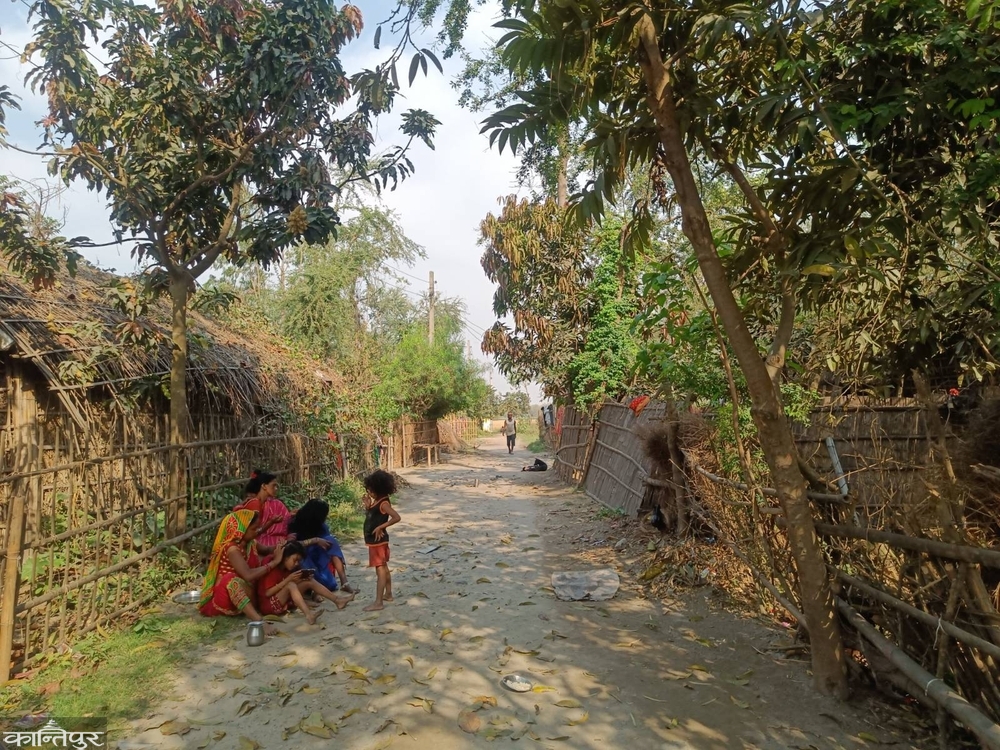 Local Suryanarayan Sada recalls the incident 17 years ago and says, 'At that time, it rained continuously for 20 days. We fled from there at night when we heard that the Koshi dam had suddenly burst. We saved lives, but we could not save property.' He says that those who have land in other places have migrated, but they have not been able to rise from the life of squatters. The government said that houses, schools, and health posts will be built in squatter areas, but nothing has been done yet. 17 years have changed, our lives have not changed,' he says.
Those who were displaced by the Koshi flood at that time are now going to the cities of Bihar, Punjab, Gujarat and other cities in India for employment. Sada said that he is also going to different places in India for employment because he can get work in India during farming.
Mohammad Uzir Mansoor used to cultivate wheat on 12 bighas after importing paddy in October. After deducting expenses from paddy and wheat, the annual income was 10 lakh rupees. "After spending three lakh rupees, I removed the sand from 6 bighas, but not even half of the grains grow in it compared to before," he said.
According to the chairman of the Koshi Flood Victim Struggle Committee, 3600 bighas in the most affected red area, 2200 bighas in the medium yellow area and 1000 bighas in the third green area were filled with sand due to the flood. At that time, the then government released 1.68 billion rupees to the account of Sunsari District Disaster Relief Committee. Of that, 1 billion 34 crore rupees were distributed and closed. More than half have not received relief after the government stopped distribution. The government had announced immediate relief of 20,000 rupees to all the families affected by
and provision of 30 cubic feet of wood to build houses and two plots of land. The victim got cash relief at the rate of Rs 20,000 at that time. The Sangharsh Samiti Chairman said that out of 3,770 families whose houses were completely damaged, only 1,970 families received wood. 1,433 families were squatters in the flood-affected areas. According to him, 950 people got two plots of land. The rest haven't got it yet. According to
chairman, at that time, the government paid compensation of 2 lakh rupees per bigha of red area, 1 lakh rupees per bigha of yellow area, and 50 thousand rupees per bigha of green area where crops were washed. In the original Bhangalo area, compensation was given at the rate of Rs 250,000 per bigha. At that time, they were told to give ration for nine months, but only six months were given, the Mandal also informed. The chairman said that the compensation of two crops to the landowners of the red area was 29,200 per bigha, but only 14,000 was given.
Koshi rural municipality chairman Ayub Ansari says that there is nothing the local government can do to provide relief to the flood victims. He says, "The local government does not have the budget to provide relief. The local government will only take things up.

