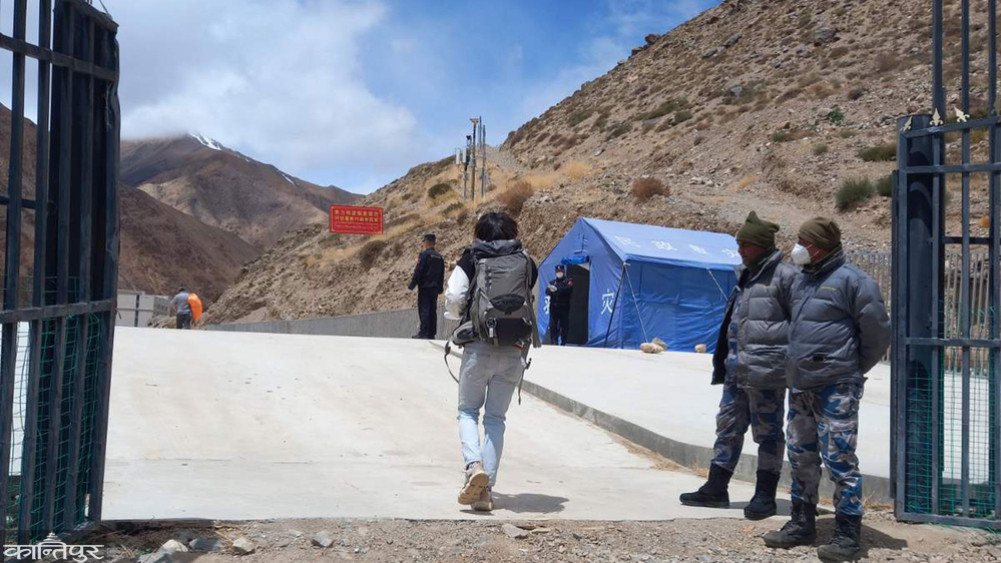
New job opportunities and monthly income of up to one and a half lakh rupees are pulling the residents of Humla towards Taklakot.
We use Google Cloud Translation Services. Google requires we provide the following disclaimer relating to use of this service:
This service may contain translations powered by Google. Google disclaims all warranties related to the translations, expressed or implied, including any warranties of accuracy, reliability, and any implied warranties of merchantability, fitness for a particular purpose, and noninfringement.
Pasang Chomten Lama of Namkha Rural Municipality-4 in Humla has been going to the Chinese trading center of Taklakot across the border for almost 11 years. Due to the Corona epidemic, the border was not opened for four years, and he had a problem with his family's livelihood.
"Heavy carrying, loading-unloading goods in vehicles, repairing roads etc. will be done by Nepalis there," he said.
Lokjung Budha of Simkot Rural Municipality-7, who has been a laborer of Taklakot for almost a decade, has bought a house in the headquarter. "There is no employment at the local level, even if you work for 6 months in Taklakot, you will have to pay for the whole year," he said.
The number of young people going to Taklakot is increasing after the opening of Hilsa Naka, 2081 Baisakh 18, which was closed by the Chinese government for almost four years due to the Corona epidemic. Chief District Officer of Humla Narayan Pandey said that 10,955 people have taken border passes for this year. Out of which 8 thousand 237 people have new and 2 thousand 718 people have renewed their border passes. He said that now 15 to 50 people take border passes daily.
The pass, which is distributed free of charge to the residents of Humla, is valid for one year and must be renewed every year in July. "The pass can go 30 kilometers towards China to Taklakot. Taklakot is a city that developed later, so new infrastructure construction work can be easily found there," Pandey said, "but there is no labor agreement between Nepal and China, due to which they are deprived of the wages set by the local government, and they do not get other facilities such as insurance."
Taklakot is the capital of Pulan County (District) under the Chinese Autonomous Region of Xizang (Tibet). Pemba Tamang of Namkha Rural Municipality-5 said that he earns up to one and a half lakh rupees per month by working here. Daily wage earners earn an average of 300 Chinese Yuan (pig) per day. The Nepali exchange rate of the said currency is 19 rupees 45 paise. "Ration and room rent are also cheap, food-stay costs 15 to 25 thousand rupees," he said, "so even if you work for 3/4 months a year, you can cover the expenses of the year."
Most of the people of Humla carry heavy loads, build houses, and work in hotels. Summer season is considered suitable for Taklakot employment as it is very cold in winter. "When we return from work, we bring home goods from China that will last us the whole year. When we return, we save 3/4 lakh," Tamang said, "Taklakot is the basis of livelihood for us because it is easy to go and earn well." According to the office, 312 people have obtained passes to do various businesses in Taklakot. Chief District Officer Pandey said, "We have given a border pass with a person's photo and other details for a period of one year, and on that basis they enter China."
Most people from Namkha and Simkot go to Taklakot. Namgyal Tamang, the former president of the Chamber of Commerce and Industry, said that about 70 percent of the youth of these two municipalities went to Taklakot. Some have even taken children with them. Trade in Nepali herbs is also good in Taklakot. Because of this, some traders from Humla go there every year to sell herbs such as Yarchagumba, Furu, Gucci mushroom, Thakna.
``When transporting herbs from here to Kathmandu, we have to face unnecessary hassles and heavy taxes,'' Tamang said, ``Not a single trader comes to Kathmandu, even if they come, they have to sell at whatever price they want.''
Karna Bahadur Rawal, a businessman from Simkot, said that it is rare for the residents of Humla to go to other countries for foreign employment. "For us, like the Gulf countries and European countries, China is the only destination for employment, and we can easily go to Taklakot for labor," he said. Locals who went to Taklakot return home around November before the heavy snowfall.
Rawal says that the roads are closed due to thick snow in Nyalu, Nara and other lakes of Humla in winter. February to November is considered the best time to visit Taklakot. "Even if a person works there for 3 months, a person earns at least 4 lakh rupees, so it is easy to manage household expenses," he said, "The youth here consider Taklakot to be a reliable destination because it is easy to find work and earn good money."
Namkha Rural Municipality President Prem Bahadur Lama said that Taklakot is the main destination for employment of the residents of Namkha, Simkot, Kharpunath and Sarkegad Rural Municipality due to lack of employment and production. In Namkha, due to extreme cold and lack of irrigation facilities, only one crop lice is produced in the village throughout the year. "Here, the families who can eat for 3 months are counted in the rich category, the main means of earning income of most of the locals is animal husbandry and herb collection," he said, "even because of the problems in earning a living, many have made the labor of Taklakot the basis of their livelihood."
Namkha-5 Hilsa Ward President Paljor Lama said that due to the people going to Taklakot, traffic is increasing daily at the Hilsa checkpoint on the border with China. Up to 50 local people are going to China daily through the border, and the hotel business has flourished as tourists have also started coming here. "Now, food and daily consumable goods have started coming to Humla through the Chinese route," he said, "Tourism business, which was stopped due to Corona, has also started to tighten."
There are about 35 tourist hotels in Hilsa. Lama said that after the increase in traffic, regular transport facilities are also being operated from the headquarters Simkot to the Chinese border Hilsa. He says that Indian pilgrims going to Kailash Mansarovar have also increased the traffic at the border. He said that 150 to 300 Indian tourists are going to Kailash Mansarovar a day.