Since 27th June, the constitutional bench has been blocked, around 400 cases are pending, in the full meeting held by the Chief Justice on Wednesday, the issue of constitutional bench formation process was not raised.
We use Google Cloud Translation Services. Google requires we provide the following disclaimer relating to use of this service:
This service may contain translations powered by Google. Google disclaims all warranties related to the translations, expressed or implied, including any warranties of accuracy, reliability, and any implied warranties of merchantability, fitness for a particular purpose, and noninfringement.
As differences between the Chief Justice and the judges continued, the Constitutional Bench could not be formed on Wednesday. The bench could not be formed because of the dispute over whether to select judges through the round robin process or to appoint them based on seniority. All the cases on the weekly payee list were published in the adjourned case list in the morning.
Chief Justice Prakashman Singh Raut called the full court (full meeting) on Wednesday. In the meeting, the judicial circle predicted that there would be an 'ice-break' in the dispute regarding the constitution of the constitutional bench. Soon after the
meeting started, he submitted the agenda of discussion on the Supreme Court Rules, advising on the bill to amend and unify the Revenue Tribunal Law, case management in Kathmandu District Court, work load and manpower management and amendment of the law on free legal aid.
A judge said that there was no discussion in the meeting about the constitutional bench formation process. "Only the four agendas presented by the Chief Justice were discussed," he said.
The constitutional bench is a special bench of the Supreme Court that hears matters that are in conflict with the constitution. The Constituent Assembly did not put a 'Constitutional Court' in the Constitution and arranged for a 'Constitutional Bench'. The Constitutional Bench consists of the Chief Justice and four senior judges appointed by the Chief Justice on the recommendation of the Judicial Council.
In Article 137 (3) of the Constitution, it is mentioned that a constitutional bench will be formed if a case under consideration in the Supreme Court involves a question of serious constitutional interpretation. Only special cases related to union, state and local levels, elections and fundamental rights that conflict with the constitution are registered in this bench.
The decision made by the constitutional bench is final i.e. not subject to review. Apart from the registration in the constitutional bench, the court orders and the Chief Justice see the matter of serious constitutional interpretation and go into it. Based on this provision of the constitution, the Supreme Court has made the Constitutional Bench Operation Rules - 2072.
The constitutional bench sits on Wednesdays and Fridays for judicial practice. On Wednesday, the cases that are under consideration and reached the stage (eligible for judgment) are heard. Friday is the first hearing practice. The bench has not been constituted since 27 June due to the dispute over the bench formation process. Wednesday is the twelfth time that the bench has not been constituted.
The Judicial Council has made a 'roster' of 14 judges for the constitutional bench. On the basis of seniority, there are Chief Justice Raut, the senior-most judge Sapna Pradhan Malla, Justice Kumar Regmi and Hariprasad Phuyal respectively. The roster includes Manoj Kumar Sharma, Kumar Chudal, Nahkul Subedi, Til Prasad Shrestha, Vinod Sharma, Saranga Subedi, Abdul Aziz Muslim, Mahesh Sharma Paudel, Tek Prasad Dhungana and Sunil Kumar Pokharel. From the names in this roster, the Chief Justice can form a constitutional bench based on seniority.
After the appointment of 52 officers in various constitutional commissions by amending the law through the ordinance, the constitutional bench on June 18 approved the controversy over the formation process. Chief Justice Raut was in the minority while deciding on the appointment of officers of constitutional bodies. Only Judge Nahkul Subedi had the same opinion with Raut, who headed the Constitutional Bench, while Malla, Chudal and Sharma had different opinions.
In the annual review meeting on the action plan of the Supreme Court held on July 12, Chief Justice Raut introduced the topic of 'applying the round process in the formation of the constitutional bench as in other cases'. Then polarization started within the Supreme Court. In the review meeting, the senior most judge Malla did not allow it to be discussed. Two days later on July 14, Chief Justice Raut called a full court and moved the proposal. While 9 judges stood in his favor, there were 10 judges against him. Even then it has not been finalized.
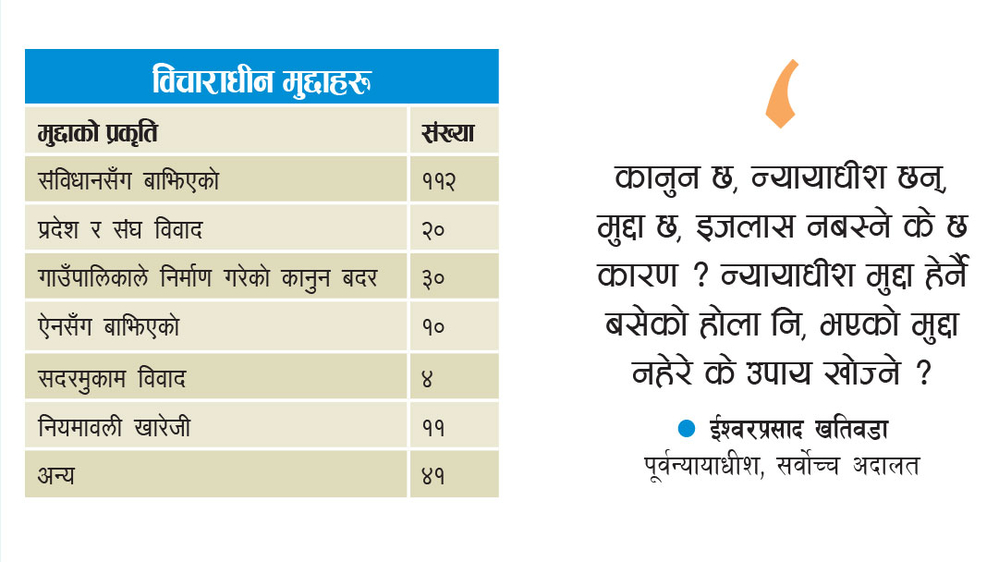
Former Supreme Court judge Ishwar Prasad Khatiwada says there is no reason why the constitutional bench should not sit. If you don't find a reason to work, no matter how much you try. There is a law, there is a judge, there is a case, what is the reason why the court is not sitting?'' He is of the opinion that the constitutional bench should be run based on the standards set by the constitution.
Former Chief Justice Harikrishna Karki says that the constitutional system should be followed. "There is no other way to do it except according to the constitutional provisions," he says. It is better to designate it from the roster made on the recommendation of the Judicial Council. Former Supreme Court judge Andanmohan Bhattarai opined that the bench should be formed by recalling the situation of unprecedented crisis in the past. He said that a solution can be found through mutual consultation in the current dispute of constitutional bench formation process.
Former Chief Justice, former judges and sitting judges of the Supreme Court have suggested three options to resolve the current dispute. According to them, in the first option, the bench can be constituted by the Chief Justice (pick and choose) system by keeping all the judges working in the Supreme Court on the roster. In the past, there was a controversy because the then Chief Justice Cholendra Shamsher Jabara constituted the bench in this style. The former judges say that the decision was made to appoint the bench based on seniority.
The second option is that the decision to implement the Gola procedure may be made by a meeting of the Judicial Council. They say that the third option is to appoint the bench in order of seniority as it is now.
Constitutional bench of the case Chang
There are 228 cases under consideration, including 198 regularly registered cases and 30 cases registered under the jurisdiction of the Constitutional Court. About 170 cases related to the elections of 2074 and 2079 are also in the constitutional bench. Some of them are serious constitutional disputes and disputes between states and unions.
The petition demanding the abolition of the Parliament Development Fund, which allocates budget according to constituencies, is also under consideration in the Constitutional Court. There are also cases filed by the Madhesh state government for interfering in the affairs of the police, forest and civil servants. The constitutional bench has yet to dispose of the cases filed demanding the annulment of the laws, regulations and guidelines created by the municipalities.

