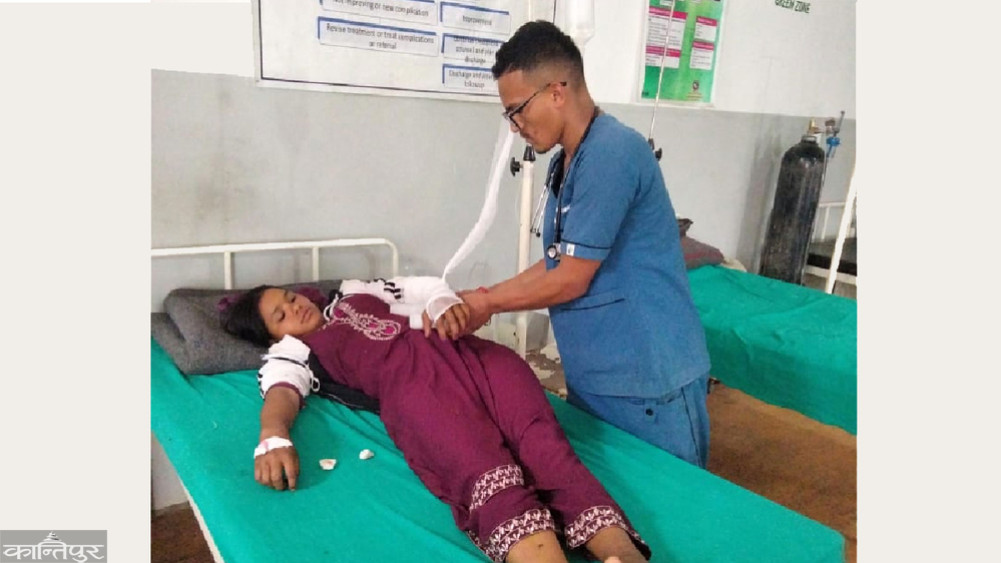
Among the 10 districts of Karnali, only Surkhet has a snakebite treatment facility. Since it takes at least 8 hours to 2 days to reach Surkhet by road from Kalikot, Jumla, Mugu, Humla and Dolpa, the risk of death of snakebite patients is high.
We use Google Cloud Translation Services. Google requires we provide the following disclaimer relating to use of this service:
This service may contain translations powered by Google. Google disclaims all warranties related to the translations, expressed or implied, including any warranties of accuracy, reliability, and any implied warranties of merchantability, fitness for a particular purpose, and noninfringement.
21-year-old Lokendra Karki of Khandachakra-5 Karkiwada was bitten by a snake at 5 am on July 28 last while he was sleeping at his house in Lasi. He screamed in panic. When the relatives found out, Lokendra was carried uphill for an hour and a half and after 3 hours he was taken to the district hospital in Manm through the Karnali highway. By then he was unconscious.
There were no snakebite treatment facilities in Manma. The doctor referred to Surkhet. While searching for an ambulance and taking him to Surkhet, Lokendra died on the way. "It was already too late to get to the hospital from home," said Dr. who referred from the district hospital. Shubnarayan Thakur said, "Due to the poor financial condition of the house, the relatives could not bear the cost of the helicopter, they were sent to the ambulance, and died on the way."
30-year-old Manichandra Chaulagai of Khandachakra-5 Dhadgaon was bitten by a snake last year in Lasi. Kalpana Choulagai's wife said that Chaulagai, who raised his family by cultivating vegetables, was bitten by a snake while working in the karesabari. Like Lokandra, Manichandra was taken to the district hospital. 5 hours after being referred to Surkhet State Hospital from Manm, Choulagai died while being taken to Surkhet via Karnali Highway.
Last year, 26-year-old Dhanprasad Acharya of Shubhakalika-6 Howdy was bitten by a snake while cutting grass. Acharya's life was saved when a helicopter was arranged and brought to Surkhet within an hour, as it was difficult to bring patients from Howdy, which takes a whole day on foot to reach Manm. The cost of the helicopter was only 5 lakhs. After being treated in ICU for 15 days in Surkhet, he recovered. At that time, Acharya complained that Shubhakalika Rural Municipality did not pay for the helicopter.
Similarly, local Lakshmi Bogti said that 35-year-old Kesari Khadka of Pachaljharna-1 Siku was bitten by a snake two years ago and died before she could reach her senses. He says that due to the lack of nearby snakebite treatment facilities, the death of the injured is increasing. Kali Bahadur Malla, a human rights activist, said that even in the district hospital, there is no treatment.
In recent years, snakebite incidents have started to occur in the Himalayan district as well. Thakur said. It is extremely hot in the riverside area of Kalikot. Snakebite is a problem in hot places. Incidents of snakebites, which used to be sporadic, are now becoming more frequent," he said. Among the 10 districts of Karnali, only Surkhet has a snakebite treatment facility. Due to geographical difficulty, it takes at least 8 hours to 2 days to reach Surkhet by land from Kalikot, Jumla, Mugu, Humla and Dolpa in Upper Karnali.
Even though it is a Himalayan district, poisonous snakes are found in hot areas of Khoch and Bensi districts of Karnali including Kalikot. Bhishamprasad Pokhrel said. "Nowadays, patients who have been bitten by poisonous snakes come every month in Barkha. A snake treatment center is necessary in the district hospital, he said. Antisnake Venom with ICU, ventilator facilities is required for snakebite treatment centers. He said that even though the district hospital has been demanding 'antisnake venom' since last year, there was no hearing.
According to Katak Bahadur Mahat, Information Officer of Health Service Office, Calikot, 3 out of 10 people who have been bitten by snakes have died in the last 5 years. However, he said, there is no data on snakebite patients who died after being referred by the hospital. According to standard 077 regarding the establishment of snakebite treatment center, it is mentioned that for the treatment of snakebite, physical structures including doctor's room, nursing station, patient bed, ventilator, oxygen cylinder, ICU, refrigerator, patient monitor and other equipment, 7 manpower including 1 medical officer.
Information Officer Mahat said that after the building was built last year, there was no space problem in Kalikot Hospital. He said that the government should provide free helicopter service for snakebite patients. "If there is an air rescue facility like the mother safety program, all snakebite patients can be saved," he said. Ravin Khadka said. He said that there is a demand for 'anti-snake venom' from some districts and they are ready to provide it after analysis.
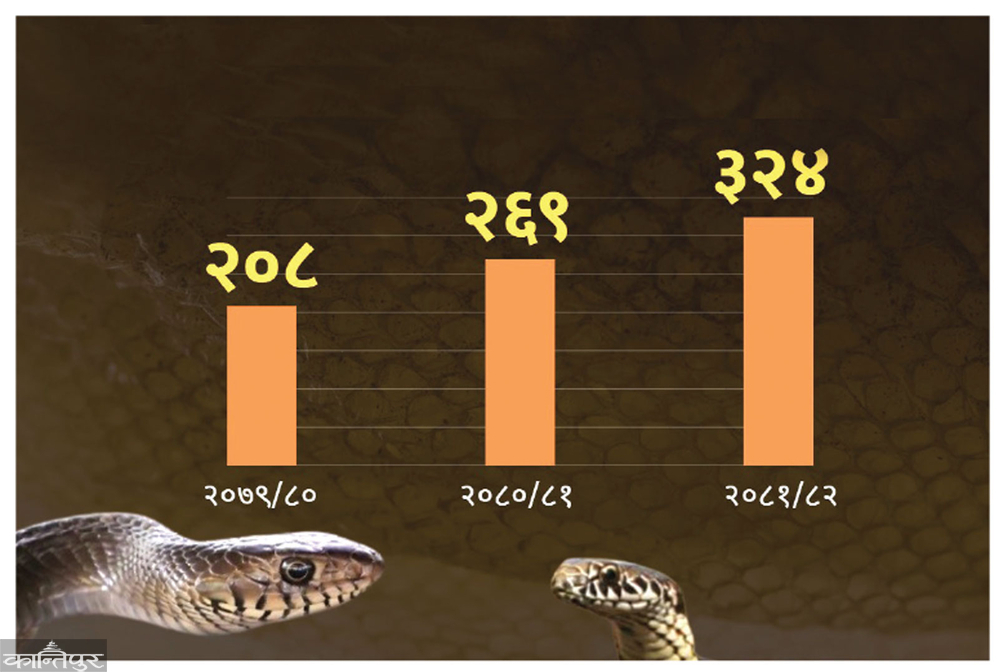
According to the provincial health directorate, 801 people have come to the hospital for snakebite treatment across Karnali in the last three financial years. In the financial year 2079/80, 208 people in all 10 districts of Karnali, 269 in 2080/81 and 324 in 2081/82 came to health institutions after being bitten by snakes.
During this period, 614 people were bitten by less venomous snakes and 187 were bitten by more venomous snakes and were admitted to the hospital, said Shyam Acharya, the vector control officer and focal person of the provincial health directorate.
He informed that even though he heard the news that a snakebite patient had died on the way to the hospital, it could not be included in the official statistics. In the last three financial years, among the 10 districts of Karnali, the highest number of snakebite incidents occurred in Rukum West and the lowest in Dolpa.
Snake and turtle expert Karan Bahadur Shah says that there are fewer poisonous snakes in the hills and mountains compared to the plains. According to him, although all the venomous species of snakes found in the Terai are not found in the hills and mountains, Rajgoman, Goman and two types of Karat snakes are found in Kalikot, Jajarkot, Dailekh and other districts. According to the 72-year-old Shah, who has lived in Kalikot, Mugu, Jajarkot, Dailekh and other districts for work. Shah claims that Goman and Karat snakes are found in areas around Lalighat, Serighat, Lali, Bhattadi, Rakam in Dailekh, Dhungeshwar Paltada, Bheri in Jajarkot.
After a snake bite, the risk of death is higher when the blood circulation is stopped, and the rope is tied and taken to the hospital late. Shah suggests that the risk of death can be reduced if awareness is spread at the community level about snake bites and prevention measures. "The chance of death from a snake bite found in the Himalayas is minimal," he said. Shah said that some people get heart attacks after being bitten by a snake.