The water level in the Kulekhani Reservoir has risen by only 9 meters since the onset of monsoon till Tuesday afternoon, indicating problems in power generation.
We use Google Cloud Translation Services. Google requires we provide the following disclaimer relating to use of this service:
This service may contain translations powered by Google. Google disclaims all warranties related to the translations, expressed or implied, including any warranties of accuracy, reliability, and any implied warranties of merchantability, fitness for a particular purpose, and noninfringement.
Even after the month of July, the water level in Kulekhani Reservoir has not increased due to lack of rain in the catchment area.
Since the onset of monsoon till Tuesday afternoon, the water level in Kulekhani Reservoir has increased by only 9 meters. During the dry season, the water level of the Kulekhani reservoir fell to 1485 meters. After the onset of the rainy season, only 1494.56 meters of water has been collected in the Kulekhani reservoir till Wednesday afternoon. On August 4 of last year, the level of Kulekhani reservoir reached 1516.47 meters.
"During the current rainy season, there is no water in the catchment area," said Taradatta Bhatt, the head of Kulekhani Hydropower Project I, "July has passed, looking at the weather, it is difficult to fill Kulekhani Reservoir this year." does not increase At present Kulekhani hydropower project has been operated only occasionally for voltage management.
Due to the lack of water level in Kulekhani Reservoir, there is not only a problem in electricity production during dry season, but domestic and foreign tourists who came to Markhu and Chitlang also return disappointed. Quadrupeds are currently grazing on the land of Markhu and Simlang areas, which are covered by the water of Kulekhani Reservoir. In the past years, tourists used to enjoy themselves at that place.
'From October 10th to 12th of last year, the Kulekhani reservoir was filled only by the rain that fell in the catchment area. If there is no such rain, the reservoir will not be filled with the current rain,' said a senior technician of the Kulekhani hydropower project. The water that fell on October 10-12 of last year caused damage to roads, bridges and settlements in the lower coastal area of Sisneri when the reservoir was suddenly filled and the gate of Kulekhani was opened.
If the Kulekhani Reservoir, which is the ``back-up'' of the Nepal Electricity Authority, is not filled, the Electricity Authority will face problems in the production and distribution of electricity during the dry season. Thaha Municipality, Daman, Palung, Bajravarahi, Chitlang and Indrasarovar Rural Municipality in the northern region of Makwanpur are the catchment area of Markhu and Fakhel Reservoir. There is not enough rain in that area now.
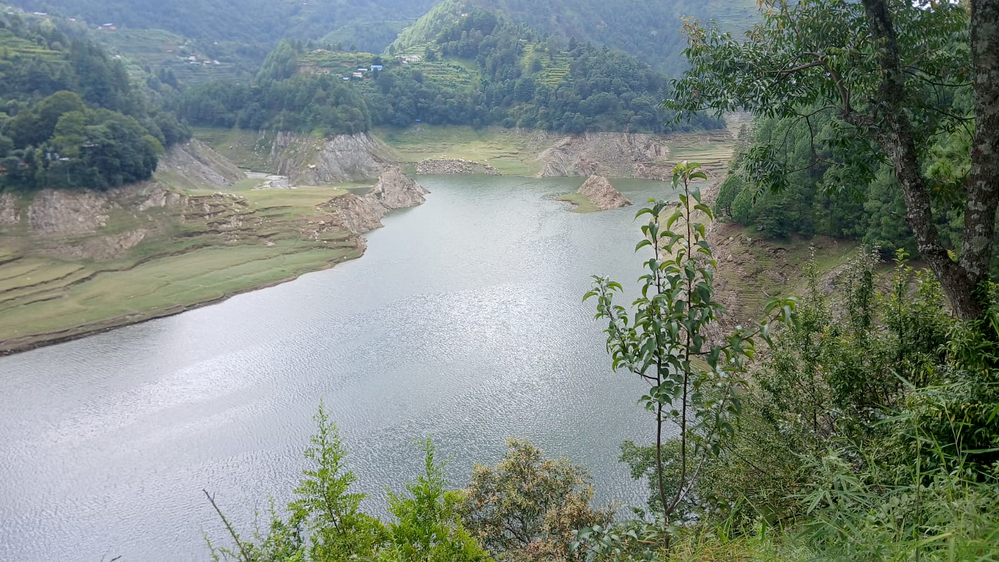
The water of Kulekhani Reservoir can be used until it falls down to 1484 meters. Of the water collected in the reservoir, only 46 meters can be used for power generation.
Kulekhani has the capacity to produce 60 megawatts of electricity from the first, 32 from the second and 14 from the third. All the three projects generate electricity from the water collected in the Kulekhani Reservoir. The width of the reservoir is 300 meters and the length is 7 kilometers. Kulekhani is one of the largest hydropower generation projects in Nepal.

