In the National Investigation Department Bill, which was introduced to control, monitor and tap citizens' phone calls, messages and other conversations, there is a provision to recruit employees on the basis of merit.
We use Google Cloud Translation Services. Google requires we provide the following disclaimer relating to use of this service:
This service may contain translations powered by Google. Google disclaims all warranties related to the translations, expressed or implied, including any warranties of accuracy, reliability, and any implied warranties of merchantability, fitness for a particular purpose, and noninfringement.
The government is about to enact a law to allow permanent staff to be appointed in the National Research Department without open competition. A draft of the National Investigation Department (Intelligence) Bill has been prepared to recruit 50 percent of the unranked and junior posts and 20 percent of the Assistant Inspectors (ASIs) without competition.
In the National Investigation Department Bill, which was introduced to control, monitor and tap citizens' phone calls, messages and other conversations, there is a provision to recruit employees on the basis of merit.
According to the draft law, the privacy rights of individuals will be violated against the spirit of the constitution, while employees will also be recruited against the standards/practices of the Public Service Commission and the orders of the Supreme Court. Security experts and administrators have objected that not only will political influence dominate the intelligence system, but the intelligence system itself will become a recruitment center for activists and security forces. In point 19 of the
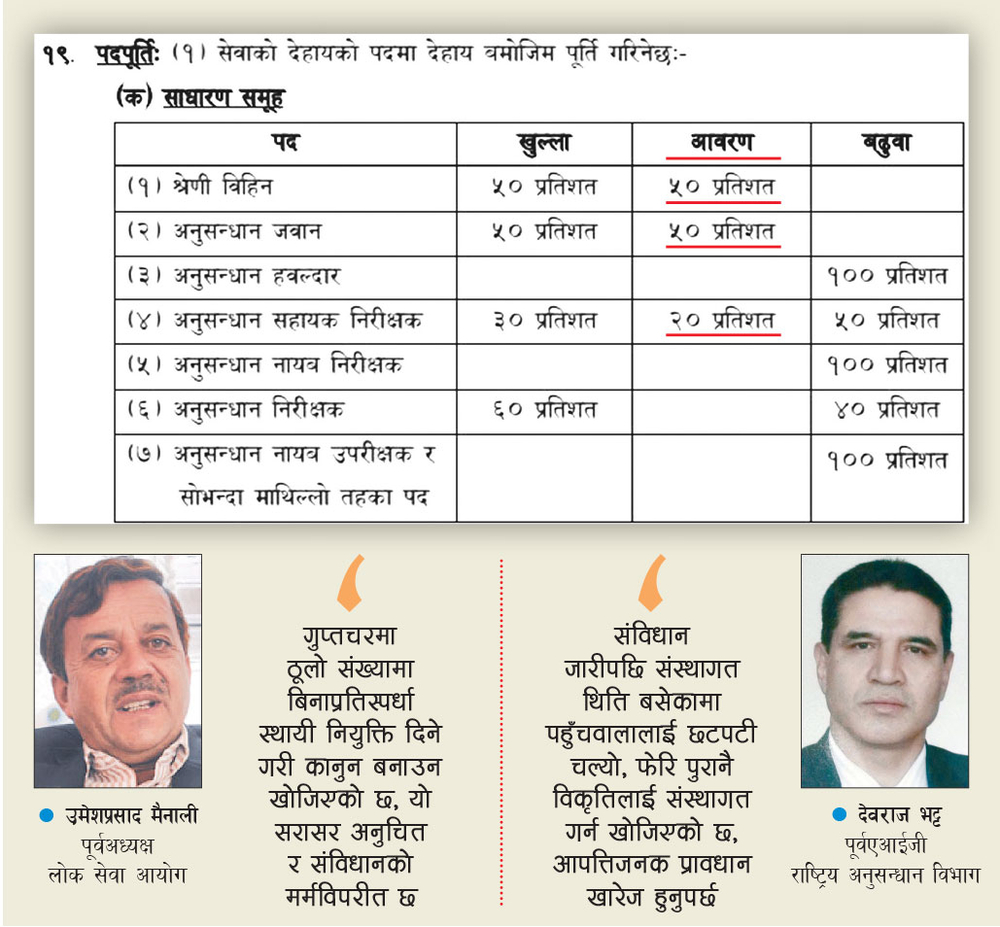
draft, it is mentioned that 50 per cent open competition and 50 per cent cover (non-competition) recruitment will be conducted for unranked employees and junior posts. It is mentioned that the posts will be filled through 100% internal promotion at the constable level, 30% open competition, 20% cover and 50% internal promotion at the sub-inspector level. It is proposed that 60 percent of the inspector level will be filled through open and 40 percent through internal promotion.
The constitution does not envisage such 'arbitrary' hiring of pensioners. Civil service, military, police, armed police force, investigation department and all the employees who get permanent appointment from the government of Nepal have been conducting the public service exam. Article 243 of the Constitution covers the work, duties and powers of the Commission. In the said article, it is said that the permanent appointment in the government service will be done through public service examination. Non-competitive recruitment has been proposed in the draft in order to interpret sub-section 5 of the said article.
In the constitution, it is mentioned that 'the posts receiving pension from the government will be appointed after an examination by the Public Service Commission'. In this, there is a provision to explain the government/public bodies that provide pensions including civil servants as organized organizations and even if they are given permanent appointment in those organizations, mandatory consultation of public service is required. However, it is the comment of the former administrators that the draft came from the game of appointing a large number of intelligence agencies by taking this "hole" that "needs consultation".
In a writ filed by Yagyamani Neupane of Taplejung against arbitrary recruitment and the intention to hide information in Ravi, the bench of then Chief Justice Kalyan Shrestha and Judge Vaidyanath Upadhyay of the Supreme Court ordered to recruit employees only from public services in Baisakh 2070. 2 years after that, the constitution was promulgated. After the provisions related to the work, duties and rights of the public service were further explained in the constitution, Umesh Prasad Mainali, the then chairman of the public service, issued the procedure itself and stopped the random recruitment.
The former chairman of the commission, Mainali, who is also the former home secretary, said that the proposal to recruit a large number of permanent employees in intelligence without competition is not only wrong but also unfair and objectionable and it is in conflict with the constitution. He also suggested that apart from internal promotion, appointment should be made only through open competition. According to Mainali, the order of the Supreme Court, the current practice of the Public Service Commission and the Constitution also do not envisage direct recruitment of permanent employees to the Asepase.
Mainali recalled that when he was the secretary of the Ministry of Home Affairs, he faced pressure/influence to recruit the civil servants in the department and also had to suffer a lot. Also, when he was the chairman of the public service, Mainali said that the then home ministers even pressured him with threatening language after he decided to stop the recruitment. "There is an attempt to make a law to give permanent appointments to a large number of unranked, young and unskilled intelligence personnel, this is completely unfair and against the essence of the constitution," Mainali told Kantipur, "The government should correct such a controversial and wrong draft and amend the bill. If it comes from the government, then the law-making body (Parliament) must be amended, if there is no amendment, the investigation department will be in power/power." There is a risk of becoming a recruitment center for those who are there, as a result of which the sensitive mechanism of the country will be destroyed.' -Umesh Prasad Mainali, former chairman of the Public Service Commission
'Until the constitution was issued by the Constituent Assembly, those in power recruited up to 30/40 percent of the intelligence personnel from the secret service. I was already aware of the level of injustice this was when I was the home secretary. Later, I became the chairman of the Public Service Commission. It is unfortunate,' said Mainali.
Former AIG of the National Investigation Department (RAI) Devraj Bhatt responded that after the promulgation of the Constitution 2072, the recruitment of permanent employees in 'covert' was stopped and now it is objectionable to try to repeat the same trend.
'Until 10 years ago, 40% of recruits at the level of jawans, trainees and inspectors were recruited through covert and 60% open competition. It has been talked about in public circles that those who had access to covert appointments worked even after receiving money. So, after the promulgation of the Constitution in 2072, the Public Service ensured open competition by reining in such appointments. After that, after a kind of institutional status was established in the organization, the people who had access ran away, now in collusion with the Prime Minister's Office and the Ministry of Home Affairs, they are trying to institutionalize the old distortions again, the objectionable provisions of the draft should be repealed.
He commented that agents and contracts can be appointed in the department and in that too, it is necessary to pay special attention to the measurement of utility and qualification.
'Those who get permanent appointment in the department must work according to the nature and characteristics of the organization, this is a specific responsibility set by the state,' Bhatt said, 'Furthermore, the employees needed by the department can be appointed on agents and contracts, that too based on utility only by considering the specific work.
Moreover, institutionalizing random recruitment under this or that pretext is a way of selling positions, the organization does not get anything from this, it is only a recruitment center for those in power and power. The draft law released by the government is against the existing practice of the Public Service Commission, the court order and the constitution, and the draft of the law is made to get a large part of the appointment from the power center. is. After the promulgation of the constitution, those who have been institutionalized have been slandered, again they are trying to institutionalize the old distortions, objectionable provisions should be repealed. - Devraj Bhatt, Former AIG, National Investigation Department
Similarly, in the draft of the bill, it has been proposed that the age of the Chief Inspector (Inspector General) will be 58 years and other ranks will be ranked accordingly. While preparations are being made to make a law to maintain the age of 60 years for the employees working in the civil service, police, armed police and other permanent institutions.
Currently, the Bill on Civilian, Police and Armed Police under consideration in the Parliament also has provisions for service and conditions such that the age limit of the head of the organization is 60 years and the others at the same rank level. However, in the draft, it is proposed that the age of Inspector General, Additional Inspector General and Deputy Inspector General will be 58 years, Senior Superintendent 57 years, Superintendent, Deputy Superintendent and Inspector 56 years, Sai and Asai 55 years, Jawan and Havaldar 52 and unranked level 55 years.
According to the draft, the tenure of the Inspector General is 3 years, Additional Inspector General 4, Deputy Inspector General 5, Senior Superintendent 6 and Superintendent 10 years. It is mentioned that the remaining posts will not have tenure.
Also read:


