The government is being criticized for neglecting multipurpose millet, which requires less fertilizer and does not require much irrigation.
We use Google Cloud Translation Services. Google requires we provide the following disclaimer relating to use of this service:
This service may contain translations powered by Google. Google disclaims all warranties related to the translations, expressed or implied, including any warranties of accuracy, reliability, and any implied warranties of merchantability, fitness for a particular purpose, and noninfringement.
The government formally celebrated National Millet Day for the first time on Friday. But it has been three years since Tripureshwar Agricultural Cooperative Society of Bharatpur Metropolitan City-9 started celebrating millet day like this. After the government decided to celebrate millet day on July 16, the cooperative, which had been organizing a program for the promotion of millet crop on July 15, organized a millet planting program on Friday morning.
In the previous years, we used to plant millet on July 15. This Raithane crop is nutritious as well as an easy crop for the farmers . This crop is farmer-friendly because it grows even without irrigation, does not require much fertilizer, and is not affected by diseases or insects," said Ved Prasad Sapkota, president of the cooperative. But recently, after the practice of planting millet has disappeared, he said that he is conducting a program for the promotion of this cultivation.
Durga Sapkota's family migrated from Baglung in the year 2023 and came to Gaurigunj near Chitwan headquarters Bharatpur. Out of the 2 bighas and 13 kattas of land bought there, Durga's family has always planted millet on four or five kattas during the dry season. It was customary to plant millet at the end of July and August. Bikase fertilizer, no need to keep any other medicine, grew very well . One and a half to two muri grew in Kattham,' said Durga.
The only harvest was to harvest the seeds after ripening . He said that it takes some time to enter the millet when it is milled and threshed. Later, the tradition of eating millet bread also disappeared. It's hard to find working people. Durga says that since 2040 millet has become less and less planted and now it has almost disappeared. Ward president of Bharatpur-9 Yamlal Kandel says that millet cultivation is good in Gauriganj Sharadpur area.
'Now that the practice of planting millet is becoming popular, we have taken a policy to encourage rice crops including millet . We have said that if someone rents land and plants millet, the rent will be paid by the ward. Mother groups are involved in this . In this way, millet has been cultivated in two to three bighas," said Kandel, the ward president. By doing this, Raithane crops will be promoted and the land will not remain barren, he said.
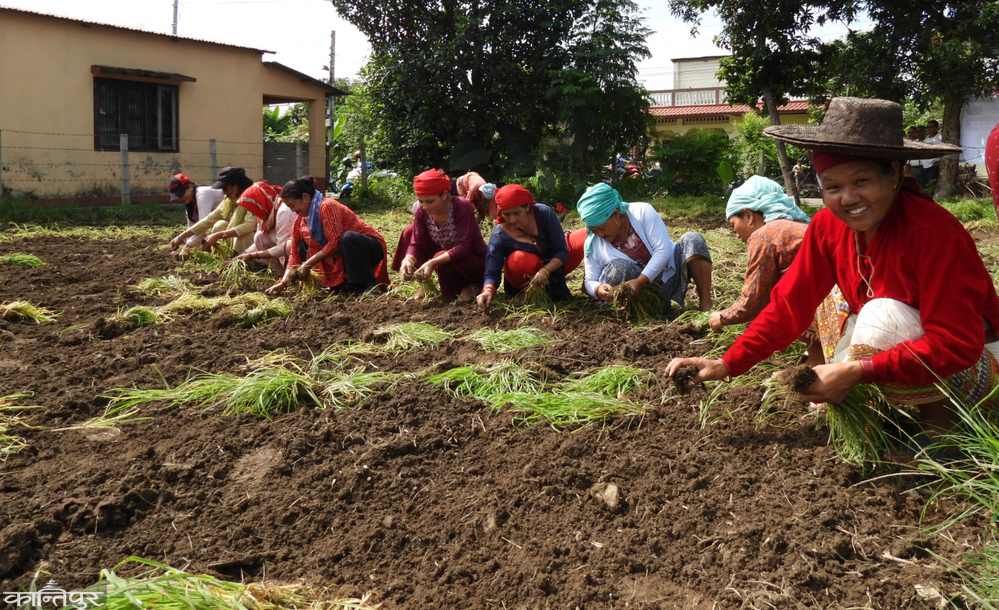 This time, Bharatpur Metropolitan Municipality's Agriculture and Livestock Business Promotion Branch and Tripureshwar Agricultural Cooperative have jointly celebrated the first National Millet Day. President Sapkota said that Tripureshwar Agricultural Cooperative has been planting millet since four years ago on July 15. He said that for the first time millet was planted in two fields for seeds. After that, the co-operative has been planting millet by renting seven acres of land.
``We brought in two crops of millet from that seven kattha land . For the first time, five quintals were grown in seven plants . We have rented a barren and old playground . Last year, seven quintals grew on the same land. It is hoped that this time it will increase even more," said Sapkota, the president of the cooperative. Jhalaknath Kandel, head of Chitwan's Agricultural Development Office, said that millet will be cultivated on 1,500 hectares in the district.
According to the statistics of the office, 1200 metric tons of millet is produced in Chitwan annually. This area and productivity can be increased. It should also be increased . Because millet is a dry grain. After eating this, workers can work with pleasure . Nutrients are also found in millet, which is rich in nutrients. Eating millet helps to increase the amount of hemoglobin in the blood,'' said Kandel, the head of the Agricultural Development Office.
Similarly, Kandel said that this crop, which does not require much irrigation or fertilizer, was remembered by many during the drought this year. He said that millet is a useful crop for Nepali farmers as millet grows well even in weather and soil that is unfavorable for other crops. He said that it is necessary to increase the cultivation of different varieties of Chino, Kaguno and millet crops along with millet.
Deputy Mayor of Bharatpur Metropolitan City, Chitrasen Adhikari, who came to Gourigunj to plant millet as the chief guest of the National Millet Day program, spoke about the taste and benefits of millet. ``In other areas where nothing else grows, after planting millet with a spade, the spring came. Masyang and soybeans were also planted together, he said.
Gundruk was prepared in winter. ``After preparing the millet dumpling, it would have been delicious to make jhol or masyang dal mixed with soybeans in gundruk and eat the dumpling with it. Moreover, the taste of mixing cow's milk, buffalo's milk, curd, and ghee gives the present imported khanki,' said Deputy Mayor Chitrasen Adhikari . He said that there is a belief in the past that one muri of millet works for 10 muri of rice.
He said that the metropolis has taken a policy to discourage the trend of leaving land barren. According to the Deputy Mayor's officer, encouraging the planting of rice crops such as paddy and millet on such lands. Sapkota, the president of the cooperative, says that the cooperative has started planting millet from a small area and is gradually increasing the area. He said that he is planning to collect and cut the millet produced by others and sell it.
The government has decided to celebrate the National Day in July when millet cultivation, which is a versatile grain, is decreasing. The government has declared rice, maize and wheat as national crops. Billions of chemical fertilizers are imported every year to increase the production of these crops.
However, the government is being criticized for neglecting multipurpose millet, which requires less fertilizer and does not require much irrigation. According to the Ministry of Agriculture, millet can be grown in 77 districts at an altitude of 60 meters to 3650 meters. According to the National Agricultural Genetic Resource Center (Gene Bank), Karnali has the most potential in terms of production.
Although the demand for millet and millet products has increased, the government has not been able to increase production. Looking at the past data, millet production is decreasing. According to the Ministry of Agriculture, in 2078/79, 267 thousand 71 hectares were cultivated and 339 thousand 462 tons were produced.
In 2079/80, the area decreased to 227 thousand 934 hectares. According to the data of the ministry, the production also decreased to 3 lakh 10 thousand 847 tons. Millions of millets are imported into the country every year.

