Although the government has stopped it, it seems that organized human traffickers continue to send Nepali women to the Gulf. However, since no government agency has the data and records of illegal domestic workers, it is becoming difficult to provide legal assistance.
We use Google Cloud Translation Services. Google requires we provide the following disclaimer relating to use of this service:
This service may contain translations powered by Google. Google disclaims all warranties related to the translations, expressed or implied, including any warranties of accuracy, reliability, and any implied warranties of merchantability, fitness for a particular purpose, and noninfringement.
It has been nine years since the government banned Nepali women from doing domestic work. However, Nepali women continue to be illegally employed as domestic workers and subjected to labor exploitation in countries including the Gulf.
To understand the details of this matter, the government formed a high-level committee on March 28 under the coordination of the head of the Central Asia, West Asia and Africa Division of the Ministry of Foreign Affairs and former ambassador Ramkaji Khadka . What is in the report prepared by the high level committee? Ikantipur read the entire report and prepared a five-point briefing.
• On 20 March 2073, the International Relations and Labor Committee of the Parliament decided to instruct the Council of Ministers to completely stop the sending of Nepali workers to the Gulf countries until the respective countries enact concrete laws on domestic workers and sign a bilateral labor agreement with Nepal. And based on this decision, the government stopped sending domestic workers institutionally. Although the government has stopped it, it seems that organized human traffickers are continuing to send Nepali women to the Gulf. Just last Friday, 47 Nepali women who were going to Kuwait via India were returned from the international airport in New Delhi, India. All these women were going to do domestic labor . The high-level committee has written based on similar backgrounds, since the data and records of illegal domestic workers are not with any state agency, it is becoming difficult to provide legal assistance.
• Neither the government agencies in Nepal nor the Nepalese embassy or consulate in the respective countries are aware of the Nepalese women who have illegally reached the Gulf countries and are doing domestic work. Even though the cases of domestic workers being subjected to violence and labor exploitation are coming out from time to time, the government has not been able to work for their rescue and establishment of rights . In this background, it is said in the report, "Workers who have reached their destination through illegal routes are increasingly choosing to commit suicide due to physical, mental stress and psychological problems."
• The government has only estimated data on how many women have reached domestic labor in which country. This committee has informed the government about which countries Nepalese women have reached illegally. The report states that most of the domestic workers are extremely poor, destitute and single women. The report has also brought out the fact that the maximum number of female domestic workers went from Jhapa, Sindhupalchok, Makwanpur, Morang, Kathmandu, Kavre, Ilam, Nuwakot, Sunsari and Chitwan. According to the report, the number of women who used visit visas in UAE, Bahrain, Kuwait, Oman, Qatar and Saudi Arabia alone within the last four years is 1778. But it is not possible to estimate how many of these stayed there or how many returned. The report has given some factual basis about how many Nepali women there may be. For example, 48,000 domestic workers are employed in Kuwait alone. Among them, only 8,000 arrived with a work permit before the ban. The number of jobseekers with visit visa in UAE alone is 437 thousand 44 . The number of women has not been disclosed. Although this report gives factual bases, it is not able to say exactly how many Nepali women have gone abroad for domestic work.
• The government of Nepal does not have policy clarity regarding sending domestic workers . Therefore, the report has suggested to the government for policy clarity. The government has not received such a suggestion before. On October 13, 2077, the team of the parliamentary committee reached Oman and the UAE and conducted an on-site study, followed by security measures, and suggested to open up sending domestic workers as a model (pilot) and to study the results and remove the restriction imposed on sending domestic workers to more countries. Based on that, the Ministry of Labor signed a labor agreement with the UAE and a protocol to recruit domestic workers and made a proposed model project. But the file of this project has been sent to the Ministry of Law for further suggestions, but it has not gone ahead.
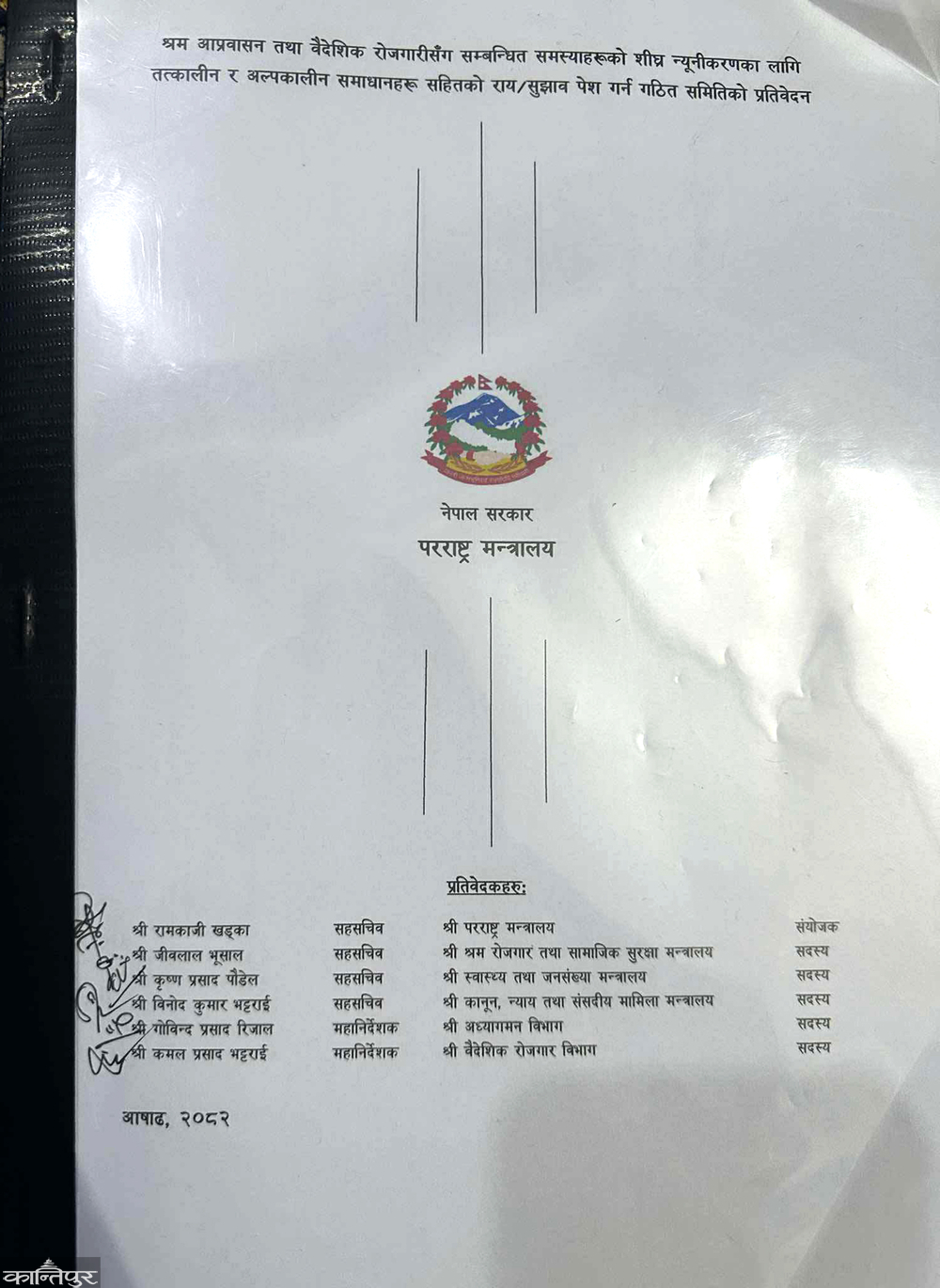
• This report does not only talk about women domestic workers . Some opinions have also been given regarding the disputes regarding the existing visit visas. The report not only suggested that Nepali workers who are working illegally in the destination country on visit visas should be given a labor permit or renewal by the mission, but also asked the government to arrange for skilled and professional workers to go on visit visas for employment. .


