Although Nepal has increased the number of tigers, there are still challenges in conservation and management
We use Google Cloud Translation Services. Google requires we provide the following disclaimer relating to use of this service:
This service may contain translations powered by Google. Google disclaims all warranties related to the translations, expressed or implied, including any warranties of accuracy, reliability, and any implied warranties of merchantability, fitness for a particular purpose, and noninfringement.
World Tiger Day is celebrated on July 29 every year to spread awareness about the importance of tiger conservation. In 2010, the International Tiger Forum held in St.Petersburg, Russia, started celebrating 'World Tiger Day'.
The first World Tiger Conference was held on that platform. In Nepal, the Ministry of Forest and Environment has been conducting various programs on the occasion of the day. According to the latest national tiger census conducted in 2022, the number of tigers in Nepal has reached 355.
With the number of tigers in Nepal increasing more than the target, various challenges including their management, human-tiger conflict, and habitat have also been seen. Locals in the central region have been attacked by tigers while going to pick grass, firewood, and graze cattle. Similarly, in some cases, tigers are being poached, they are the target of local people's anger and tiger deaths have also increased due to attacks on large and long infrastructures.
capacity four hundred !
A debate has begun about the need for tiger numbers in Nepal. Some have argued that the number of tigers in Nepal is more in terms of environmental capacity, while others have said that the 'carrying capacity' of the number of tigers is around 400.
The 'carrying capacity' of tiger numbers in Nepal is currently being studied by the National Parks and Wildlife Conservation Department, National Nature Conservation Fund (NTNC), World Wildlife Fund (WWF) Nepal and Geological Society of London (ZSL) in coordination with the Ministry.
Dr. Bhagwanraj Dahal, the national representative of ZSL, informed that the preliminary report of the study shows that the carrying capacity of tigers in Nepal is around 400. He said, 'Therefore, it cannot be said that the number of tigers has increased now, but we should move towards increasing water sources and grasslands to increase the quality of food for tigers to stay in their habitat.' He argued that the protection area is not low in proportion to the number of tigers and emphasized that the quality of the habitat should be increased.
The spotted tiger is found in 13 countries of the world. The conference of the governments and heads of state of those countries in 2010 in St. Petersburg expressed the commitment to double the number of tigers by the year 2022.
In that conference, Nepal made a commitment to double the number of tigers in Nepal from 121 as per the 2009 count. At present, the number of tigers in Nepal has increased and has almost tripled.
Dr. Chirinjeevi Prasad Pokharel, director of National Nature Conservation Fund (NTNC) and a scholar on tigers, mentioned that tigers are the most important in the country's tourism. He said that the tiger lives in a certain area and fights with other males, searching for food, searching for drinking water when the rivers and ponds inside the forest dry up, and so on.
human-tiger coexistence program required The director Dr Pokhrel who has to change human habits, including the
tiger, will be converted to the protected area, including the Mantra Party and program, "he said, Redemption of human-difficult facilities programs for promoting the parliamentor and prevent human governments with humans should .'
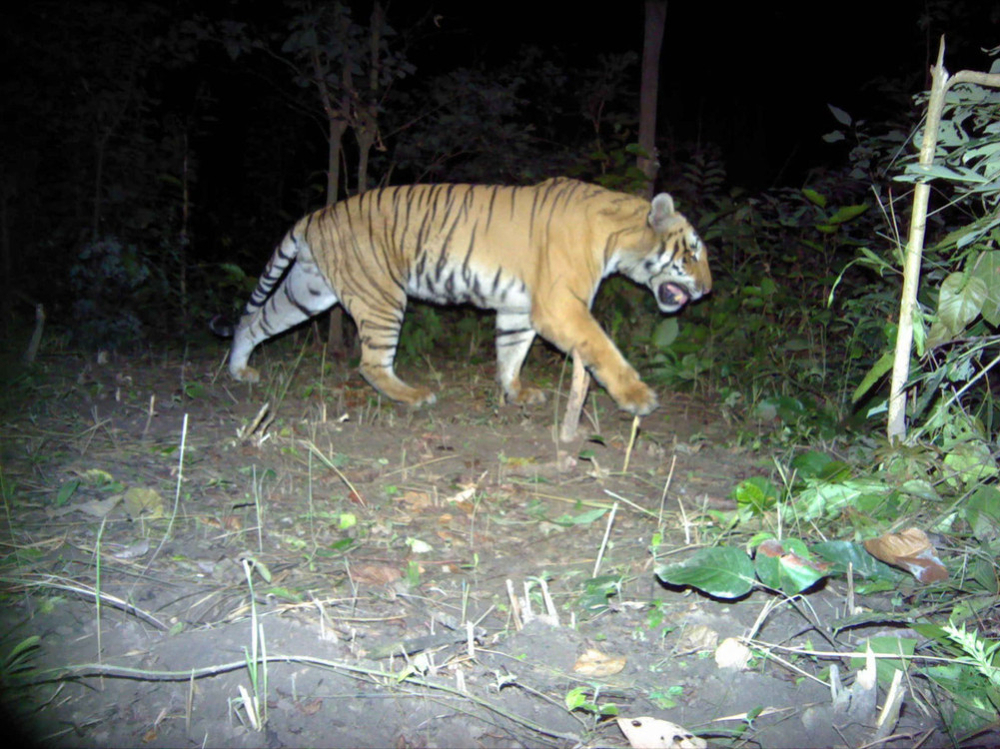
According to the last count of 2022, there are 128 tigers in Chitwan National Park and 125 tigers in Bardia National Park. Similarly, there are 25 tigers in Banke, 41 tigers in Parsa and 36 tigers in Shuklaphanta.
Nepal has been celebrating Tiger Day since 2067 and counting tigers at the national level every four years. The number of tigers in Nepal was 98 in 1995, 109 in 2000, 126 in 2005, 121 in 2009, 198 in 2013 and 235 in 2018.
Dr. Ghanshyam Gurung, national representative of World Wildlife Fund Nepal, said that the tiger is a great heritage of tourism and said that everyone should work together to protect it . In order to reduce the human-tiger conflict, he suggested that the locals around the forest should be given an alternative to earn a living so that they do not enter the forest, and the behavior of the locals towards wild animals should be changed.
'If the habitat of wild animals can be managed well, the wild animals will not go out and if the local people can also be provided with alternative income, a situation can be made that they are not forced to go to the forest for livelihood . All stakeholders should be involved in this,' he said. He argues that tigers are not a problem and should be managed.
5 thousand 357 tigers in the world
Apart from Nepal, tigers are found in India, China, Bhutan, Russia, Bangladesh, Vietnam, Myanmar, Malaysia, Indonesia, Thailand and Laos. It was estimated that the number of tigers around the world was around 100,000 by 1900. That number was reduced to 3,200 in 2010.
According to the statistics of the World Wildlife Fund, the number of tigers increased to 3 thousand 900 in 2016 and 4 thousand 500 in 2022. According to the latest statistics of 2025, the number of tigers in the world has increased to five thousand 357. Most of them are 3 thousand 167 in India, 750 in Russia, 400 in Indonesia, 355 in Nepal, 189 in Thailand, 151 in Bhutan, 150 in Malaysia, 146 in Bangladesh, 22 in Myanmar, 20 in China, five in Vietnam and two in Laos.
Haribhadra Acharya, senior ecologist of the park department, said that looking at the density of tigers in the national parks of neighboring India, it cannot be said that the number of tigers in Nepal has increased. He argues that there is a great possibility that the number of tigers can be increased in the current area by increasing quality grassland, water sources and food.
Mentioning that they are making various efforts to reduce human-tiger conflict, he said, 'The department is doing various programs for tiger and human coexistence in collaboration with various agencies. In order for the tiger to remain in the interior of the forest, we are trying to increase the quality of food and to ensure that the locals are not forced to go to the interior of the forest to earn a living.'
18 problem tigers
With the significant increase in the number of tigers, the problem of problem tigers in national parks, conservation areas and surrounding areas is also increasing . Especially tigers that have entered human settlements, attacked humans and domestic animals and were found injured have been rescued and kept in cages.
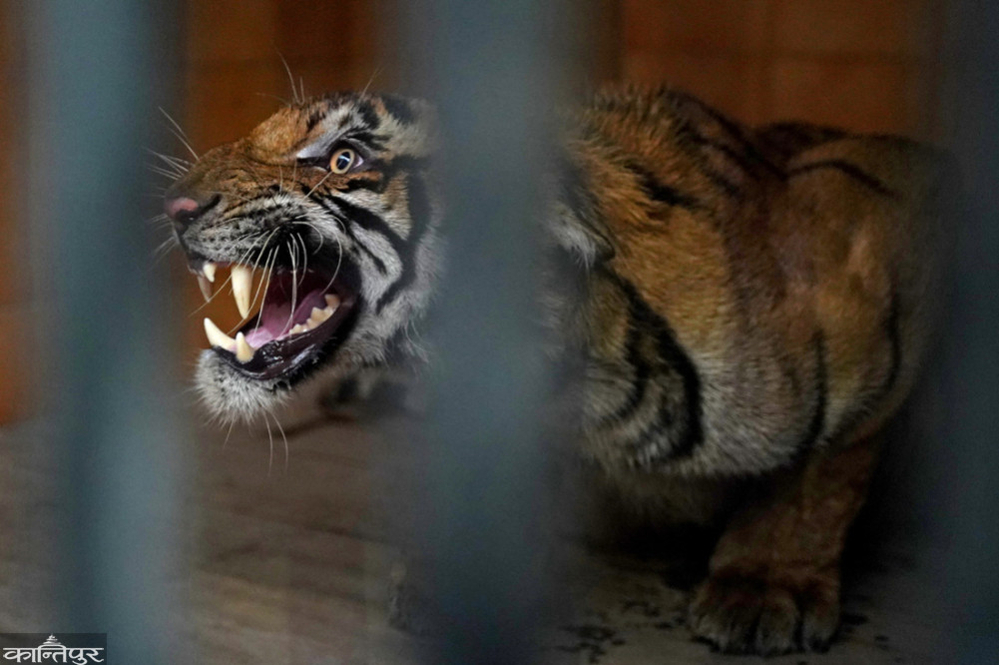
Currently, the number of such problematic tigers in the country is 18. Among them, five tigers have been caged in Sadar Zoo at Jawalakhel in Lalitpur, seven tigers in Chitwan National Park, four tigers in Bardia National Park, and one tiger each in Banke and Parsa National Parks. A large amount of money has been spent by the Barseni government on the daily feeding, care, treatment and other management of these tigers.
There is a legal provision that tigers cannot be killed and sold. Therefore, for the management of such problematic tigers, a debate has started on the options such as establishing a 'Tiger Zoo', providing it as a gift to the allies through wildlife diplomacy, managing the zoos in the province and earning income, and killing them without resorting to some measures .

