Maoist's amendment proposal to keep 'cooling off period' for 3 years, Congress's proposal to correct the rigging of the House of Representatives and maintain it for 2 years
We use Google Cloud Translation Services. Google requires we provide the following disclaimer relating to use of this service:
This service may contain translations powered by Google. Google disclaims all warranties related to the translations, expressed or implied, including any warranties of accuracy, reliability, and any implied warranties of merchantability, fitness for a particular purpose, and noninfringement.
The UML, which is leading the government, has supported the 'cheat' to neutralize the 'cooling off period' in the federal civil service bill. On Sunday, UML MPs proposed a collective amendment in the National Assembly to remove the provision of two-year 'cooling off period', which was unanimously put in the bill by the State Order Committee of the House of Representatives.
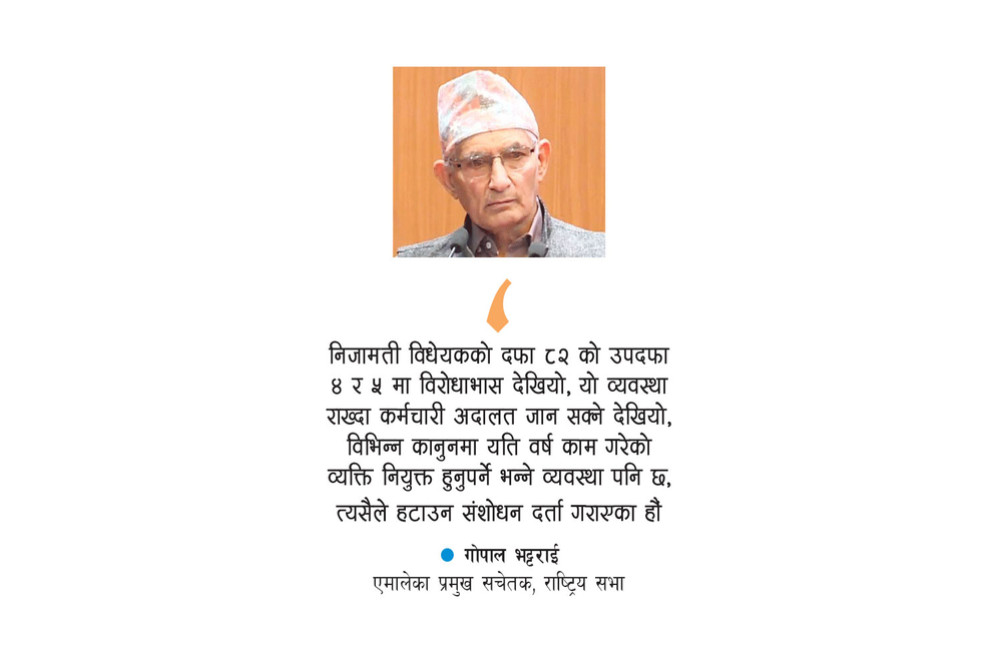
In the National Assembly, under the leadership of UML's Chief Whip Gopal Bhattarai, MPs Sonam Gelzen Sherpa (Chairman of Federalism Empowerment and National Concerns Committee), Sumitra BC, Indira Devi Gautam, Rukmani Koirala have filed a proposal to remove the provision of 'cooling off period' of Section 82 (4) of the Bill.
UML parliamentarians have put an amendment in section 82 to 'remove point number 4 of the report of the House of Representatives State System and Good Governance Committee'. This proposal of UML has supported the interests of the Constitutional Commission, the ambassador as well as the chief secretary and secretary of the government who are waiting for various government appointments after their retirement.
The main opposition Maoist has filed an amendment proposal to amend the two-year period made by the House of Representatives in the 'cooling off period' and keep it for three years. Maoist whip Gangakumar Belbase, MPs Krishna Prasad Adhikari, Renu Chand and Manrupa Sharma have registered a collective amendment proposal to keep the 'cooling off period' for three years and to remove sub-section 5 of section 82, which has been kept as ineffective.
The chief whip of the ruling Congress, Krishna Bahadur Rokaya and MP Anand Prasad Dhungana have filed an amendment proposal to keep the 'cooling off period' for two years.
They have put an amendment in the House of Representatives to remove the cheating arrangement. JSP Nepal's Mrigendra Kumar Singh, Mohammad Khalid and Pooja Choudhary have also filed an amendment proposal that the cooling off period should be two years.
The State Law Committee, by unanimous consent, in section 82 (4) of the bill, provided that 'an employee who has resigned or retired from civil service or other government service shall not be appointed to any constitutional or government position before the completion of a period of two years from the date of retirement.' After making this arrangement, section 82 (4A) of the original bill should be amended and the report should be submitted to the House of Representatives.
But through the amendment, section 82 (5A) was kept to make the provision of 'cooling off period' made in the previous sub-section ineffective. In section 82 (5A) it was said that no appointment can be taken in any position other than constitutional or diplomatic appointment and any other appointment made by the Government of Nepal. Whereas Section 82 (5A) had to be removed to implement the new provision.
Controversy arose after it was discovered that the system to neutralize the 'cooling off period' was maintained in the House of Representatives. The State Administration Committee unanimously passed a decision to request the National Assembly to correct the fraud on the 'cooling off period'. On the other hand, the high-ranking staff were still scrambling to reverse the 'cooling off period' regime. Congress and Maoist MPs have said that this is reflected in the UML amendment in the National Assembly.
Congress leader Shekhar Koirala has objected after UML proposed to remove the 'cooling off period'. The amendment proposal of UML is objectionable. The consensus of the coalition and the unanimity of the committee are contrary. UML has shown a dual character. This is a betrayal to the country, the people and the alliance,' Koirala wrote, 'Congress should demand the official opinion of UML in this regard.' Contradictions were seen in sub-sections 4 and 5 of section 82 of the Civil Bill. It was seen that employees can go to court when this arrangement is in place," he added, "There is also a provision in various laws that a person who has worked for so many years should be appointed, so we have registered an amendment to remove the cooling off period."
UML chief whip Bhattarai also said that there was no cheating on the arrangement of 'cooling off period' in the House of Representatives. He said that since 'cooling off period' is against the law, another system may be put in place. Bhattarai also said that the views of the Constitutional Commission, the aspirants of ambassadors and government appointments, the opposition of the 'cooling period' system and their opinions may have coincided.
'We have five MPs of UML sit and discuss from various angles and register the amendment. We are not influenced by anything. The chief secretary and secretaries of the government and the general secretary of the parliament can agree with us,' he said, 'We have put this amendment after looking at many laws.' UML MP Padam Giri was of the opinion that if there is a 'cooling off period' for public service commission and other government appointments, it should be kept for a maximum of 1 year.
Current Education Minister Raghuji Pant was also against the 'cooling off period'. Before becoming a minister, he was a member of the State Arrangements Committee. Where he repeatedly maintained that there should be a 'cooling off period' of at most 6 months. Even after he was appointed as the Minister of Education, he brought a letter from the Prime Minister's Office and participated in the discussion on the bill. Even at that time, he was repeating the stance that 'cooling off period' should not be kept.
Rajkumar Gupta, the then federal affairs and general administration minister on behalf of UML, used to remain silent. Between Minister Pant's opposition and Minister Gupta's silence on the 'cooling off period', Home Minister Ramesh Ukhtar on behalf of the government informed that there is an agreement to keep it for 2 years. However, when the report of the committee was made, another provision was kept to make the provision ineffective.
Chief Secretary Ek Narayan Aryal, General Secretary of Parliament Padma Prasad Pandey and Government Secretaries came against the bill after the bill was passed by the parliamentary committee with the provision of 'cooling off period' and the writing of the report started. They met Prime Minister KP Sharma Oli, Congress President Sher Bahadur Deuba, Speaker Devraj Ghimire, National Assembly Speaker Narayan Prasad Dahal and pressured them not to keep the 'cooling off period'.
They threatened to resign collectively if that arrangement was kept. General Secretary of Parliament Pandey made a public statement that the provision in the bill was unconstitutional. After meeting the Speaker and the Speaker of the National Assembly under the leadership of the Chief Secretary, General Secretary Pandey said, "The cooling off period was not according to the constitution, keeping the cooling period is not a constitutional matter."
A special investigation committee has been formed by the House of Representatives after the cheating regarding the cooling off period in the report writing of the Civil Bill. A seven-member committee has been formed under the leadership of Congress Co-General Minister Jeevan Pariyar to investigate the disturbance over 'cooling off period'.
The said committee is working. Along with Pariyar from Congress, whip Sushila Thing, Narayan Prasad Acharya and Ishwari Gharti from UML, Madhav Sapkota from main opposition Maoist, Ganesh Parajuli from RSVP and Roshan Karki from RPP are in the committee.
This committee was also cheated during its formation. The chairman of the committee was made to be announced by the speaker as the coordinator. After the members of the committee objected, Pariyar was made the chairman according to the rules of the House of Representatives.
This committee has been asked to investigate and find out who is responsible for the "cheating" as there is a section that violates the "cooling off period" provisions. The committee has been asked to submit its report to the House of Representatives by July 12.