Prime Minister Oli did not visit India, the BRI project with China did not proceed
We use Google Cloud Translation Services. Google requires we provide the following disclaimer relating to use of this service:
This service may contain translations powered by Google. Google disclaims all warranties related to the translations, expressed or implied, including any warranties of accuracy, reliability, and any implied warranties of merchantability, fitness for a particular purpose, and noninfringement.
The two largest parties in Parliament, the Congress and the UML, had an average year in foreign affairs. During this period, the relationship with the two neighbors has not been productive. Prime Minister KP Sharma Oli's failure to visit India for a year has been considered as 'coolness in relations between neighbours'.
In the past, the Prime Minister used to visit India within a few months. But despite repeated attempts, Prime Minister Oli has not been able to visit India this year. The government, which has signed the BRI Framework Agreement with another neighbor China, has not been able to take it forward. The project under BRI has not been selected yet.
Foreign Minister Arju Rana Deuba's secretariat has claimed that diplomatic relations have been increased in one year and that it has done important work to strengthen Nepal's foreign relations. However, experts in international affairs have commented that the government, which is said to be strong, has not been able to show the corresponding results. In the meantime, despite the government organizing an international program like 'Sagarmatha Samvad', they said that there is a lack of diplomatic initiatives due to the inability to bring high political leaders from different countries to Nepal.
Nepal's former ambassador to India Nilambar Acharya said that the two-party alliance does not seem to have made a leap in international relations. A government consisting of two major parties in the parliament is naturally strong. However, it was not seen that the so-called strong government could have made a strong way in international relations,'' he said, 'it is going on as usual. As it was yesterday, there is no fundamental difference now. There was hope to make some leaps, but it was not seen.'
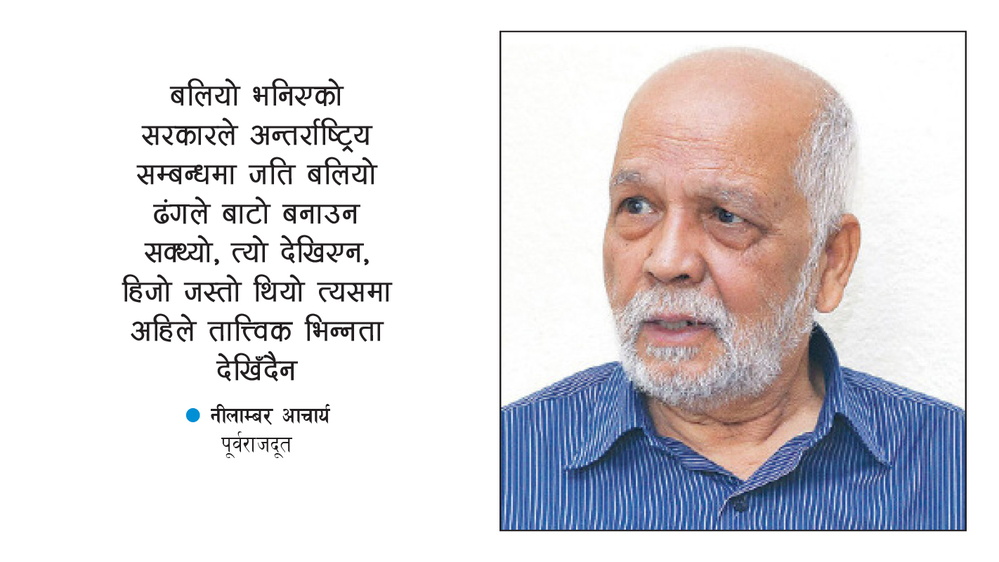 Even though various level meetings and 'engagements' are being held with India, due to lack of exchange of high-level political visits, the traditional 'special' relationship between the two countries has started to be questioned. The relationship with India is friendly and cooperative. However, this alone is not enough to satisfy,' said Acharya, 'there should be further development and improvement in the relationship. More warmth should come. A special kind of relationship is expected between the two countries, but it was not seen.' He commented that the Indian side is equally responsible for the failure to happen.
Foreign Minister Rana has been ahead of previous ministers in terms of foreign visits and presence at international forums. She visited India within a month of being appointed as Foreign Minister. After he had to go to Delhi for treatment, India formalized his visit at the request of Nepal. On August 3 last year, she met Indian Prime Minister Narendra Modi. She had a bilateral conversation with her counterpart S Jaishankar. The importance given to him by Delhi was discussed.
Excited from the first visit, Rana reached Delhi again in the first week of December. She came down to New Delhi from Germany. Having made Delhi a 'transit' with the belief that Prime Minister Oli's visit to India can be created, she did not get to meet the Indian high officials until she stayed for four days. After Prime Minister Oli visited China from 17-20 November and signed the BRI framework agreement, it was commented that the Indian establishment was dissatisfied and ignored Rana. After returning from China, Prime Minister Oli claimed that he would visit India soon, but he did not say so.
Chandradev Bhatt, an expert in international affairs, comments that there is a decrease in the proximity with India. Even though the foreign minister tried to improve the relationship, it did not seem to be successful. Trust was not created between the two countries. Only regular activities are being done," he said, "Prior to that, high level political engagement is less." He said that the "BRI Framework Work" agreement with China cannot be considered as an achievement. The BRI framework is not new. It is a subject that has already been agreed upon," he said. "What is the new progress on that? Which project should we work on, keeping our national interests at the forefront? Nothing has been done in that direction.'
Despite its presence in multilateral forums such as the United Nations and BIMSTEC, it has not been able to take diplomatic initiatives as the president to activate the South Asian Regional Cooperation Organization (SAARC). Professor and former ambassador Vijayakant Karna says that Nepal's presence in international forums in recent times can be considered good. "Foreign Minister Rana's command of the English language and his personal and collective engagement is good," he said. She has been successful in engaging various countries in Australia, Japan, Canada and Europe.'
Karna says that such a relationship can be expected to give positive results in the future. He commented that relations with India and China are normal. He mentioned that the BRI project with China could not make further progress, the pending projects including Pancheswar with India, and the Prime Minister's visit to India did not show the expected results. He said that the government has not been very successful in attracting foreign investment.
Foreign Minister Deuba has visited India three times in a year. She has met her Indian counterpart twice in New Delhi and once in Muscat, Oman. She also had two bilateral meetings with Chinese Foreign Minister Wang Yi in Beijing last November and May. In the last one year, she has met with counterparts and ministers from Japan, Germany, New Zealand, Switzerland, Norway, Canada, Indonesia, Oman, Qatar, Israel, Philippines, Iran, Mexico.
Apart from that, she addressed the platform of the 79th UN General Assembly, G77, G20, LDC and Non-Aligned Summit. The Sixth Summit of BIMSTEC in Bangkok, Canada has participated in the Conference of World Women Foreign Ministers. Rana addressed the 59th high-level session of the UN Commission on Human Rights in Geneva and the Raisina Dialogue in New Delhi. Minister Rana, who has traveled abroad 10 times during her one-year tenure, has spent 3 months outside Nepal. Regarding his frequent foreign visits, MPs have also raised questions about the achievements of the visit in the International Relations and Tourism Committee of the House of Representatives.
Former ambassador Acharya says that since the main responsibility of the foreign minister is to improve international relations, his foreign visits should not be taken otherwise. The more the foreign minister's engagement, the better. However, such a visit should be justified. Even if there is no immediate result in diplomacy, there is hope that it can have a good effect in the future," he said.
Foreign Minister Rana is also the wife of the chairman of the ruling Congress, Sher Bahadur Deuba. According to experts, there is more opportunity to demonstrate diplomatic skills and achieve success. Now there is a favorable situation. There are two major parties in government. The foreign minister should be able to use this opportunity," says former ambassador Acharya. "It would be better if the two parties brainstormed and found a common path in foreign affairs in a new way. It also reduced the chances of foreigners to play.' Bhatt, an expert in international affairs, also suggests that the two parties should be able to have a long-term vision of presenting Nepal to the international world.

