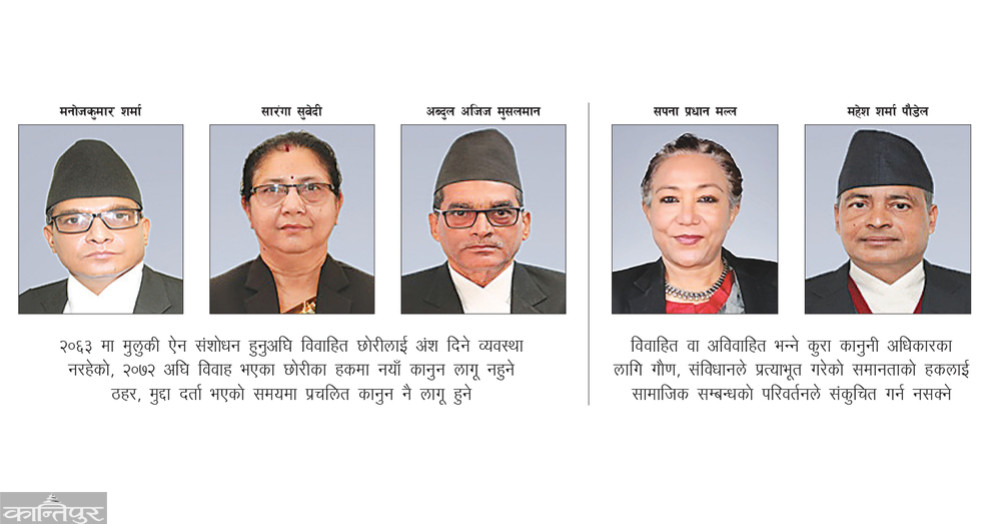
After the amendment of the Civil Code in 2072, the Supreme Court's decision was based on the majority opinion of Judges Manoj Kumar Sharma, Saranga Subedi and Abdul Aziz Muslim, that equal rights to property will apply only to married daughters.
We use Google Cloud Translation Services. Google requires we provide the following disclaimer relating to use of this service:
This service may contain translations powered by Google. Google disclaims all warranties related to the translations, expressed or implied, including any warranties of accuracy, reliability, and any implied warranties of merchantability, fitness for a particular purpose, and noninfringement.
The Supreme Court has decided that only women married after 14 October 2072 will have full rights to their ancestral property. The Constitution of Nepal 2072 provides that both the children will have an equal share in the ancestral property. However, the five-member full bench of the Supreme Court resolved the long dispute on the date on which this provision is considered to have come into force.
The Supreme Court has decided that only women married after 14 October 2072 will have full rights to their ancestral property in accordance with the Constitution.
The opinion of the larger full bench is divided on which law will be applied in the case of marriages before this date but there is a case in the court. Judges Manoj Kumar Sharma, Sharanga Subedi and Abdul Aziz Muslim have decided that the law will apply as the case arose. Similarly, Justices Sapna Pradhan Malla and Mahesh Sharma Paudel have given the opinion that the decision should be made according to the revised law in force at the time of hearing the case. The opinion of Justices Sharma, Subedi and Muslim was upheld by the majority.
The Supreme Court judgment is related to a case related to the division of a family's property. Rammani Mudbhari of Lalitpur had three daughters from his first wife. After the death of his first wife in 2049, he married a second time, with whom a son and a daughter were born. Poonam Mudbhari, the eldest son of the first wife living in the US, filed a case in the district court claiming that her father and younger mother had taken care of her in food and care. She insisted that she should get one part out of six.
The 11th Amendment to the Mooloki Act of 2059 gave the daughter a legal right to share for the first time. By amending the civil law in 2063, the right was expanded and provision was made to give a share to married daughters as well. The district court of Kathmandu ruled in his favor on the basis of the amended provisions of the Civil Code and gave a partial decision. The then Appellate Court of Patan upheld the decision of the district in 2070. However, father and younger mother rejected this decision and appealed to the Supreme Court.
In 2076, the Supreme Court sent this case to the full bench considering it involved a complex legal question. While the case was going on, a new constitution was issued on 3 October 2072. In which it has been arranged that sons and daughters will have equal rights in the case of property. On the basis of the new constitution, the civil law was amended once again on October 14, 2072, which gave equal rights to sons and daughters. This amendment was based on the principle of gender equality according to the new constitution. The full bench decided to refer the case to a larger full bench to remove confusion as to which law would apply as the law was amended during the trial.
Judges Sharma, Subedi and Muslim have decided that the new law will not apply to daughters married before 2072. They mentioned the judgment that 'the prevailing law at the time of registration of the case is applicable'. They argue that the eldest daughter got married in 2051 Chait and before the revision of the Civil Code in 2063, there was no provision to give a share to married daughters. The court's ruling reversed the district and appellate courts, and the eldest daughter lost her right to a share.
Judges Malla and Paudel mentioned in their opinion that the 11th amendment of the Civil Act of 2059 gave the right to share to the daughter and the amendment of 2072 ensured equal rights to both sons and daughters in the property. They are of the opinion that as the law was amended while the case was pending in the court, the daughter should get a share according to the new provision. "Married or unmarried is secondary to legal rights, because the right to equality guaranteed by the constitution cannot be narrowed by changes in social relations," they believe. In the discussion of the
case, some lawyers on behalf of the father and the younger mother even claimed that it would be unequal if the married daughter gets a double share in the property of her father and her husband. However, judges Malla and Paudel rejected this argument and mentioned that this case is not a matter of examining the constitutionality of the legal system and is unrelated to the main question of the dispute.