This year alone, 5 people who went to Patan in Karnali to pick yarcha lost their lives, 26 deaths in 3 years
We use Google Cloud Translation Services. Google requires we provide the following disclaimer relating to use of this service:
This service may contain translations powered by Google. Google disclaims all warranties related to the translations, expressed or implied, including any warranties of accuracy, reliability, and any implied warranties of merchantability, fitness for a particular purpose, and noninfringement.
19-year-old Dhanlal Vick of Nalgad-8, Jajarkot, who had gone to collect yarchagumbu in the second week of May at Nawarpani Patan in Kaike Rural Municipality of Dolpa, died after falling into the lake. He walked for 4 days and reached Patan with Babu Hari Bahadur.
"From the day he went to Patan, he fell ill, he could not pick the yarcha," said Hari Bahadur.
Before the Jajarkot earthquake of 17 October 2080, he went to India for employment with his son. "After the earthquake, everything went wrong, he lost his job and his son was gone," he said. Bohra died on the way while he was being brought home after being hit by a lake. He was a farmer in the village and had been going to Patan to pick yarcha for almost a decade.
``The money brought from Patan used to cover the household expenses,'' said wife Kamala Bohra, ``After the death of the householder, there has been a problem of earning a living.
On June 8, 27-year-old Kalpana Shahi of Toplagaon, Tatopani Rural Municipality-8, Jumla, was struck by lightning while he was going to Subbakuna Patan to collect yatra. He was struck by lightning while he was searching for Yarcha in Patan.
According to the Karnali Province Police Office, 5 people have died this year alone. Similarly, 3 people died in Dolpa, 1 in Mugu and 1 in Jumla. This year, 29 people including 10 women and 19 men have been injured. Police rescued 13 sick people.
In the last 3 years, 26 people have died in different Patans for collecting the documents, according to the office. Similarly, 82 people were rescued according to the office data. Provincial police chief DIG Madhav Shrestha said that due to difficult terrain, heavy snowfall, inattention, unfavorable weather etc.
This year, Yarcha was opened for picking in Dolpa from 5 June and in Mugu from 13 June. But Vasanthi Budha, Forest Officer, Forest Division Office, Mugu, said that the collectors returned from Patan within two to three weeks after finding less Yarcha. "Yarcha was also less produced, the collector did not get much price," she said, "so the collector, who stayed in Patan for at least one and a half months till noon, returned home within 3 weeks this year."
According to the Ministry of Industry, Tourism, Forest and Environment of Karnali Province, 309 kg of yarcha was produced in the financial year 2079/80. Last year 204 kg of yarcha was produced, this year only about 110 kg of yarcha was collected, said Surya Sharma, information officer of the state forest directorate.
Minister of Industry, Tourism, Forests and Environment Suresh Adhikari said that since the production of yarcha is decreasing, the master plan for yarcha conservation is being prepared.
"In order to strengthen the regional economy and also for the prosperity of Karnali, the protection and marketing of the herbs here is necessary," he said, "Through herbs and tourism, necessary initiatives are being taken for job creation, economic growth and overall regional economic development and improvement."
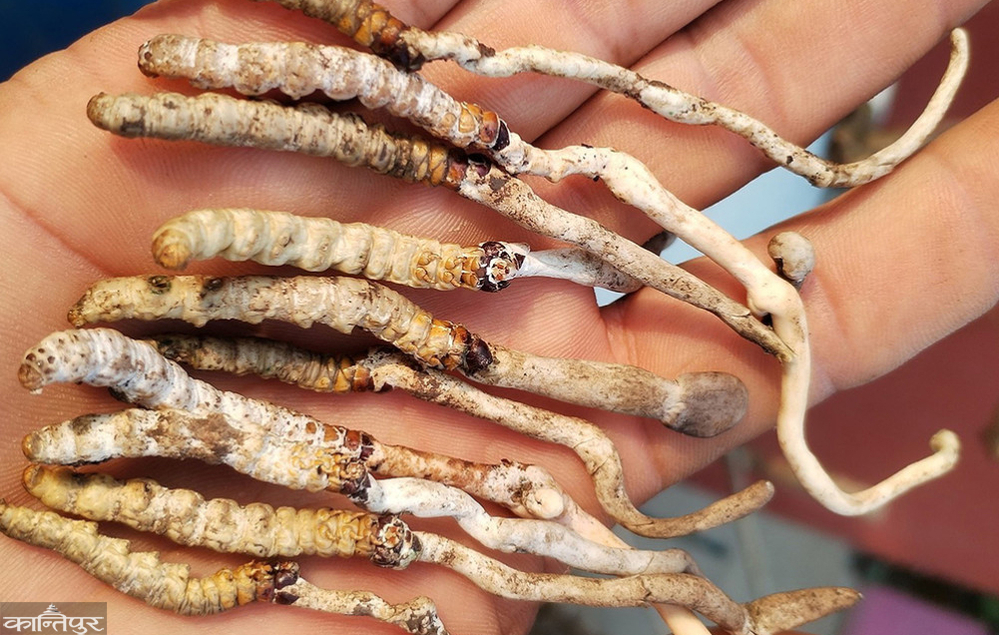
Purna Bahadur Devkota of Aathbiskot Municipality-1 in Rukum West said that as the yarcha production is decreasing every year, it is becoming difficult to meet household expenses. He has been taking care of family expenses for the whole year by picking yarcha for almost 15 years and this year he reached Patan with his wife Janaki after investing around 50,000. But he said that he was barely able to earn 120,000 rupees.
"Even after staying for 23 days, we could not make more than 150 yarchas, the price of yarchas sold for 1,000 per 1000 till noon this year did not exceed 800," he said. If there is no business, there is no option to go to Patan.
Om Bahadur Budha of Tripurasundari-4 in Dolpa, who has been going to harvest yarcha every year since 2052, said that the decline in yarcha production has made it difficult for him to earn a living. "Let's not talk about the sorrows of going there. When we reach Patan, we have to risk our lives and walk in Bhirpahara all night, risking our lives, risking getting a lake, falling from the river and getting sick," he said. Jagdulla rural municipality chairman Narsingh Rokay said. "Yarcha collection is the main means of livelihood of the local people who depend on traditional farming and animal husbandry," he said, "but the local people are disappointed because of the problem of not going to Patan."
This year, nearly 10,000 people picked Yarcha in Patans under Chefoxundo National Park. According to Nurendra Aryal, senior conservation officer of the park, 19.3 million revenue has been collected from the collectors.
The park charged Rs 500 from the residents of the central area, Rs 2,000 from the residents of Dolpa and Rs 3,000 from the collectors outside the district. Admission was given through 9 posts for compilers. In Dolpa, Yarcha is found in Ruppatan, Chinarangsi, Majhdanda, Turi, Bagar, Majhdhari, Batulile, Kanda, Furke, Gyane, Jairi, Saikumari and other Patans.
Mugumkarmarong Rural Municipality of Mugu has collected 3.6 million revenue this year. Sovendra Malla, information officer of the rural municipality, said that 1,500 per person entry fee was collected from inside the district and 2,000 per person from outside collectors. According to him, Yarcha is found in small Koiki, Big Koiki, Rimar, Tanke and other areas of the municipality. About 26 kg of Yarchagumbu has been released this year from Division Forest Office Mugu. A revenue of Rs 31,000 per kg has been set for
. According to Forest Officer Vasanti Budha, so far only 10 traders have taken leave. She said that most of the collectors did not sell Yarcha because they did not get the price.
'Until last year, yarcha was bought and sold in Patan for up to 1,000 rupees per head, but this year the production has also decreased. The collector complains that traders are not willing to pay more than 800 rupees per head because of low quality yarcha.' Yarcha was sold at Rs. 19 lakh per kg. Every year, China holds a market in Hajiamar, which is located on the Mugu-China border. In the same hot bazaar, local traders have been selling yarcha to Chinese traders.
Yagya Bahadur Budthapa, a herbalist, said that they are buying yarcha for 500 to 800 rupees this year in Patan. This year, since low quality yatra was found and the Chinese traders did not give much price, the yatra was bought and sold at a low price. "90% of the yarcha market here is China, the yarcha we bought should be stored in the warehouse until the Chinese traders come," he said.
Parbal Lama, a businessman from Charkatangsong in Dolpa, said that there is a problem because the Chinese businessmen are reducing the prices as much as possible. According to him, yarcha, which was sold up to 32 lakhs per kg before Corona, barely sold up to 22 lakhs last year. He said that 3,000 to 3,500 gota of yarcha are planted in one kilo of yarcha.
Botanist Kamal Sharma said that even though Yarcha was not harvested for 3 consecutive years due to the corona epidemic, it affected the reproductive process. "Production is decreasing every year, collectors and traders are also forced to face the problem of the market," he said. He says that Moler used to go to Patan to search for Yarcha.

