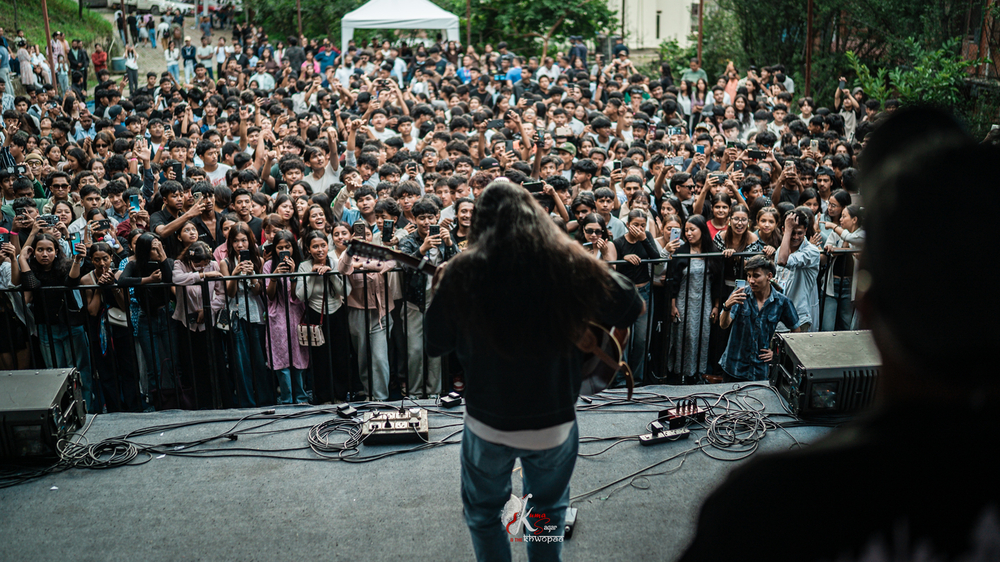
Kumsagar, who has no formal education in music, is actually a singer who does 'music design'. When listening to his songs, it sounds like Western, even folk. And, while listening to rock, pop and hymns. He does not care about the 'genre' of his song.
We use Google Cloud Translation Services. Google requires we provide the following disclaimer relating to use of this service:
This service may contain translations powered by Google. Google disclaims all warranties related to the translations, expressed or implied, including any warranties of accuracy, reliability, and any implied warranties of merchantability, fitness for a particular purpose, and noninfringement.
In Bhaktapur's Osila and Andhyara-Ujyala street, Kumsa Sagar meets the 'fusion' of dreams, sorrow and happiness. He feels that the bells ringing in the streets and temples he used to walk are the 'material' of his songs. "That's why Bhaktapur is a city that is always buzzing with music," says Kumah, "it seems like you come here to listen to the tabla-harmonium and bhajans playing in the evenings in the temples."
In the city 'visited by deities', he also keeps engrossed in music. I only meet music in Bhaktapur. So don't rush out of the city,' he says, 'My song is a song of the street, it is called devotional music.' He says, 'That story-folk made him a singer. The stories of the streets of Bhaktapur are also the stories of my songs. My songs have this tone. Therefore, it can be called the tune of Bhaktapur.'
Calling his songs 'the story of the city', he wanders back to the old days of Bhaktapur, when he used to go to dafa khalas to listen to bhajans while holding the hand of a bazaar. Being born in Bhaktapur has given Kum a sense of 'luck'. "I must have done meritorious deeds in my previous birth," he sounded confident, "my friends and relatives are here." I like to live in my own house, I like to sit in Kausi and see the city.'
What level of love is there for Bhaktapur and its streets, Kum feels that Kathmandu, which is connected to this city, is like 'another country'. I have walked in Kathmandu only when I was studying in college. "I only remember going to the zoo, Mahabuddha and Ratnapark," Kum says, "Our Bhaktapur buddies have not yet gone to Kathmandu. There are many people here who only know Pashupati, Gokarna of Kathmandu.'
Kumari Janani Ah, Kumari Janani Devi, intangible Bhairav, O Janani!
Kum in a world living in sorrows: Life, earth and wind wave in the rhythm of music -
You came to life and became cool again, I wanted to stay as your shadow
Brightened with the rays of the morning, you came to earth again like God
I wanted to fly with the waves of the wind, your desire moved in my heart
I was engrossed in your words, even the flowers danced in front of you sparkling!
remembers Baje, who was a tobacconist, in his first song. The song was 'Bajeko Bajan'. In the memory and infatuation of the tobacco 'smoke' flying towards the sky, Kumh fused the tobacco i.e. the smoke with the smoke -
I felt like flying in the sky, I felt like I was flowing in the river,
I felt like I was dancing with the music, with your look, the smoke became ashes, I felt like I was flying in the ashes!

is a widely preferred Kumha song –
Let's go, my love, don't stay too long
Today, seeing your move, I felt a little bit of excitement, didn't you?
'This song is our Shiva's song,' Kum says, 'It takes years to make a single song. It also happened like that.'' Tamang Selo Vaka, he gave a fusion of Newa: Lokbaja, Folkdhun, which the audience listened to very attentively.
Kuma knows that life is full of sorrow, but life is also like a rainbow. That's why he sang -
When I heard that speech of yours from the other side, my heart felt happy. When the sun shines, I feel a little more song," he says. "If the sun had not come to the earth, it would have been dark. That's why, in this song, saying 'Par patat ayo' means trying to become ``Ayo from the east.''
There is a line in the song, 'Tuki Balesari zindagi utarat pari, Aayau tu Bhagwansari', which was written by Kum after realizing something while switching off the lamp at night. After turning on the flashlight of the mobile phone, a small flicker of light came in the dark room. Then I thought - life itself became bright. And wrote this line in the dark," he remembered. As said in the song, he feels 'life is like a rainbow'.
Kumah, who started singing after being influenced by the band's song 'Mukti and Revival', doesn't care about his song 'Janara'. "Well, I haven't searched for my own song, please tell me what kind of song I'm singing," he says, "I'm confused." Shall we call my song God's song? Be it a bhajan or a pop-bhajan.' During the conversation, Kum repeated many times - 'I make songs for God, I sing for God.'
...
Kumasagar, who has no formal training in music, is actually a 'music designing' singer who is known as the favorite singer-avatar of the youth. When listening to his songs, it sounds like Western, even folk. And, while listening to rock, pop and hymns. A fusion of all these can be found in his songs.
'The Khwapa Band' of Kumh has become the name of not only Bhaktapur, but the entire country. Whether in the country or abroad, Kum and his band are in demand everywhere. Song-music connoisseurs claim that Kumha's songs have brought newness to Nepali music after a long gap. That's why they believe that Kumha's creation has been welcomed wholeheartedly by music lovers and they are cheering with their hands. After listening to the
song, you will know that he is not only a singer, but also a skilled wordsmith. In the song, the deity of the Kathmandu valley, Kumari, Bhairava is associated with faith and culture by Kum. The blend of original instruments is unmatched. For the new generation, Kum is 'our singer', who has held the ropes of culture and sung stories of pain, sorrow, love and separation, just as Bob Dylan used to tell his stories in song.
Lyricist Biplav Prateek sings Kumh Sagar from the heart, thus connecting with the listener's heart. "Success is more lasting than fleeting in the interest of both the artist and the audience. Therefore, Kum has now got the responsibility to make his creations even better, which responsibility he must have realized,' says Biplav.

has become the identity of Kum through different and specific singing. There is a music-match with his voice and 'melody'. Sudeep Shrestha, editor of the online magazine "Setopati.com" is a "die-hard" fan of Kumh Sagar, who has written a long article on Kumh Sagar after diving deep into it - now there is a wave of Kumh Sagar in the air. Sudeep continued to listen to Kum as a fan. As for his listening routine, even today, Sudeep listens to Kumah's playlist at least once – every morning after waking up and before going to bed. Just like a child falls asleep after listening to his mother's 'lullaby' or 'parikatha', Sudeep falls asleep listening to Kum, the daily Kum playlist plays in his house. There is a saying about Sudeep in the office - he starts a job, after leaving that job he goes to Kumha Sagar.
After listening to the songs of Kumah continuously for 7 months, Sudeep meets the singer, gossips Desire awakened. For the first time any music rocked 'Sudeep-Sol'. He wished to meet, but could not save his life. The desire remained in the soul. And to get rid of that hang, he wrote a long article, without meeting Kum. "I used to listen to his songs even while walking on the road, I was like a psycho," says Sudeep, "Kumah's songs have the atmosphere of Kathmandu. His songs have caught the music of the temple, street and filled it with modernity.'
Why does Kum's music touch the soul? Because when listening to his songs, one gets the feeling of wandering around Kathmandu and its ancient heritage. In them, the music found in the streets is found, where the modernity and antiquity of Kathmandu travel together. The listener is not listening to the song, it makes the core areas of Kathmandu feel like walking towards Asan, Indrachok,' says Sudeep.
The songs of Kumah lead to the memory-struck memories of the old people of the city singing bhajans with flowers sewn into their ears, playing the harmonium with a clapper on the falcha, or make them wander towards the 'memory' of their childhood - as if the dark days of the past are standing still and people are remembering the footprints of the people who have walked.
'Kumah's music is enough to bring back the memory of his childhood,' Sudeep says, 'His voice-words bring tears, where there is no abstract literature, there is colloquial language. And every playlist of Kum has variety, which is unique.'
...
Now there is a great wave in singing, words and combinations in world music. Some 'new and Original content' is being searched for. Before, it was said - the voice of the singer/singer should be good.
Yogeshwar Amatya, Savin Rai have a unique identity in Nepali music field. They followed different styles than music-standards and trends. Standing on the same wave is Kum. Composer and music analyst Raju Singh says, 'Kumah has composed songs consciously.' His analysis is – The tone quality of Kumh's voice is in bass clap.
'Kumah' has taken Nepali music to the heights by representing the Kathmandu Valley by making music a medium. He also gave innovation in arranging, presentation,” says Singh, “He composes songs based on harmonic melodies, who have made songs consciously. He understood how closely music is related to literature, culture, language and thought. His song can be called a country song.'
Kumh's Neva Loves have - 'T' and 'Ta'. He had to leave the competition of 'Voice of Nepal' because of the pronunciation of the word. He says, 'That phase is also in my life. At that time, my only weakness was not singing well, going on that stage was a big thing for me. In the end, everyone liked my same tone.' Some still see 'problems' in Kumh's Loves, but he has made those Loves his 'signature'. "That tone suits him, in which he finds his own," says Singh.
...
Chamhasinka Siddhisagar Prajapati is Kumhasagara, who is now a 'brand' for the youth. His childhood was spent watching the dances of Bhaktapur and going to Bhajan-Khalahas. Kum: Used to play taekwondo, played well for 14 years. He had a special interest in swimming.
Kumh's mother Krishnalakshmi Prajapati was a farmer who spent most of her time in farming. She used to make clay pots at home and sell them. After Baje passed away, pottery making stopped. Krishnalakshmi still goes to the farm, brings home fresh vegetables.
'It's like mother gets sick when she doesn't go to the farm, we get sick when we go to the farm,' he says. Mother loves her very much, sometimes her father beats her and saves her. "Who else in this world can love as much as a mother?," he says. His father Buddhiram Prajapati used to work in agriculture, now he works as an accountant in Malpot. "During our childhood, we suffered financial deprivation," says Kum.
His son-in-law Siddhikumar was very fond of Prajapati Kumha, who used to take his grandson to bhajans. I used to listen to that bhajan very attentively - sometimes I used to sing, God has given me a gift to sing bhajan? "I learned to sing songs by going to bhajans," he says, "I learned bhajans from bajes." After learning to play khin baja, he became more interested in bhajan. He became addicted to hymns. Who would sing hymns if we didn't go? That's why we used to go. Bhaktapur has underground music along with bhajan, I was attracted by both," he said.

Going back to his childhood days, Kum remembers – singing songs playing on radio-TV, playing the guitar. He used to listen to the songs of Nepali bands, he liked special rock bands.
Kum's life-graph and path is rough. On the menu of childhood 'flashbacks' are stress, anxiety, anger, and a host of sorrows. "I didn't even like to read", Kum says, "what mistakes were made when I was young!" There are some things that cannot be said. Mother scolded a lot. I used to bunk school so much that I used to enter through this gate and run away from that gate. We will never go home! First, we learned to go to the bath after bunking the school, then we learned to play tas, pool-snooker. And how to pass?'
When I was in 9th grade, I got into many fights with the 'boys'. Eventually Kum had to drop out of school. Then he joined 'Open School' in Sallaghari. There was a bigger 'gang-fight'. "There, we got worse, we got stuck in Kulat," Kum: turns to memory lane. After that, his father kept him at home for 2 years - within four walls. However, the confinement of that domestic 'wall' also became creative for him. He listened to many songs, played the guitar and wrote meditatively within the 'prohibition' of not being allowed to go out.
After being freed from 'Parkhal', he went to open school again and Ikhai studied, topped the school in SLC. Came to Kathmandu to study college, did not stay here. Bageshwari College, the same school which had restricted him, did plus-two, leaving the bachelor in half.
No one liked the songs sung by Kum at first. People used to say to him - Is this a lake? What do you sing?
What do you do? There were many people who made fun of me. There was no way to get money, they used to call to sing songs somewhere, they didn't give money. But, I continued to compose songs," he says. "I didn't take any formal music classes, I learned from my friends. I am a musician who does not study music.'
Kum's confession is - 'I am not a singer who knows that. Even singing does not come well. I learned slowly. When singing, when composing, sometimes what does not match / sometimes what! I learned most of the art of singing by guesswork. I never feel like my songs are complete. Always want to make. Friends remind me that it's done, but I like to work on it. The drums are too loud. That's why we gave priority to Madal.'
Kum thinks - a song is successful when it touches the ears and heart of the audience, but have I created such a masterpiece? Singing is 'God's grace' for him. They say, 'Everything seems like God's grace. And, everything is for God.' "But, I am a person who looks at the present, I don't look at the past and forget, then life becomes easier." Kumha is a fan of the song - a great line. But, Kum remembers - the song of Narayangopal that he heard a long time ago, which is still heard from time to time, 'I remember it, I forget it!' He has sung this song of Narayangopal many times in the restaurant.
Mother's wish was different - Kum: to become a businessman. "Mom is happy even now that she is a singer," Kum says, "Mom found out - recently we did concerts in Australia, Japan and the UK. People everywhere in the country/abroad loved us very much.'
Kumh's 'tonal quality' is melodious and his music reflects his simplicity. Standing 'different' in the long line of songs and singers, Kumha's songs are soft, reminiscent of Bhaktapur's Osila Galli, Malla-Kalein Neva: bhajans and the tink-ting of bells ringing in temples. So his listeners are dazzled, with unique and different singing.