We use Google Cloud Translation Services. Google requires we provide the following disclaimer relating to use of this service:
This service may contain translations powered by Google. Google disclaims all warranties related to the translations, expressed or implied, including any warranties of accuracy, reliability, and any implied warranties of merchantability, fitness for a particular purpose, and noninfringement.
Dilsara Budha of Urthuk in Chandannath Municipality of Jumla sells vegetables worth around two lakhs worth of greens, potatoes, cauliflower, bananas, tomatoes and green chillies during the rainy season. He has 7 plantations, no other vegetables grow except potatoes due to lack of irrigation facilities in winter. In winter, there is plenty of vegetables from India.
Pampha Budha of Saniveri Municipality-3 in Rukum West also grows vegetables on about 3 plants of land during the rainy season, but in winter vegetables such as onions, garlic, capsicum, and chillies from India are cooked in her kitchen. Not being self-sufficient in vegetables, kitchens in all districts of Karnali are dependent on Indian vegetables.
According to the Ministry of Land Management, Agriculture and Cooperatives of Karnali Province, from July to March of the current financial year, about Rs.
According to the Plant Quarantine and Pesticide Management Center in Nepalgunj, 26 thousand metric tons of onions worth about 20 million rupees have been imported from India in the 9 months of the current financial year, and 80 metric tons of fresh vegetables. "Fresh vegetables come from big markets in Nanpara, Bahraich, Lucknow," says Bal Ranamar, the information officer of the center. The train service is currently closed due to the expansion of the line towards Nepal. From potatoes in Maharashtra to greens in Kanpur, they are cooked in Karnali's kitchen, he says.
During the nine months of the current year, 3 thousand 100 metric tons (about 27 million) of chickpeas, 811 metric tons (about 12 million) of plantain and 76 metric tons (about 17 million) of chillies have entered Nepal. Similarly, 353 metric tons (about 26 million) of apples, 560 metric tons (about 15 million) of mangoes, 56 metric tons (about 2 million) of dried grapes, 1,899 metric tons (about 8 million) of fresh grapes and 2,000 metric tons (about 12 million) of bananas have arrived in Nepal.
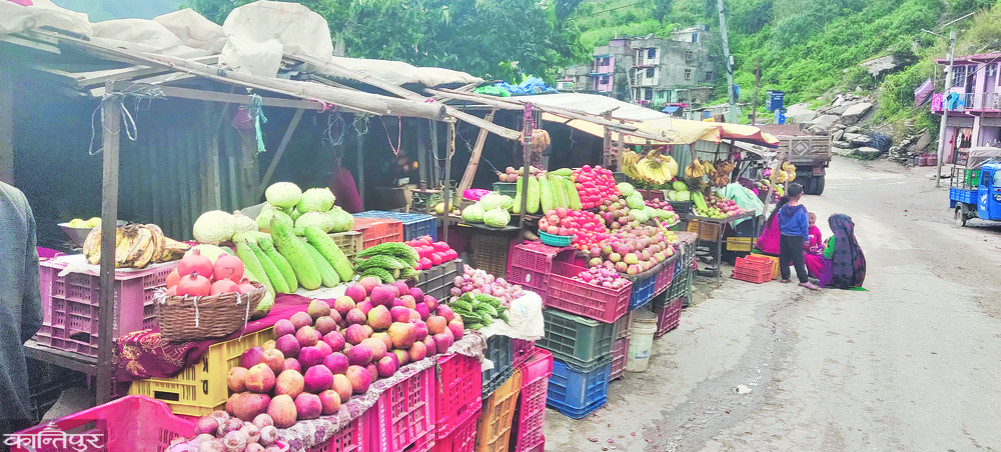
About 40 percent of that goes to Karnali, says Senior Crop Protection Officer of the Quarantine Office, Kafil Ahmed. "The surrounding Terai districts are 80 percent self-sufficient in fresh vegetables, so most Indian vegetables go to the Himalayan and hilly districts of Karnali," he says. Bhawani Gupta, a vegetable wholesaler in Nepalgunj, says that he delivers Indian vegetables to all district headquarters in Karnali.
In Gamgarhi, the headquarters of Mugu, local leader Ransingh Shahi says that Indian vegetables are everywhere. According to him, because local vegetables are expensive, foreign vegetables have taken over the market. "During the rainy season, vegetables, tomatoes, cabbage, and cauliflower are produced, even that does not last more than 3/4 months," he says. tells
Indian vegetables, which used to arrive in Humla by ship, are now reaching Simkot by car. "After the road facility, vegetables have been coming by wagons for a year, but we still have to rely on ships for fruits," says Hemant Puri, coordinator of agriculture branch of Simkot rural municipality, "Vegetables do not grow in winter because it is too cold, local produce has met the demand for only four months, everything else is supplied by vegetables from Nepalgunj and Surkhet." He informed that earlier, vegetables reached the headquarter by paying 110 rupees per kg air fare, but now vegetables reach the capital by paying 30 to 40 rupees per kg fare. Vegetables are produced in Humla only from June to October.
Namgyal Tamang, the former president of the Humla Industry and Commerce Association, says that 3 to 4 quintals of vegetables are coming to Humla from Nepalgunj and Surkhet every day. "During the season of Mansarovar-Kailash pilgrimage, Indian vegetables reach as far as Hilsa on the Tibetan border, but now the border is closed," he says, "locals who have come to Sadarmuka carry 30-40 kilometers of vegetables to Sarkegaard, Chankheli, Adanchuli." Local vegetables such as cabbage, cabbage, tomatoes are available for 150 to 200 rupees per kg, but imported vegetables are available for 100 to 150 rupees per kg. "Since it is a cold place, the production is low, Indian vegetables are also available cheaply," he says, "that's why most of the farmers have stopped growing vegetables." When Indian vegetables reach Jumla, the cargo vehicles cover a distance of 232 km on the Karnali highway. Rajkanya Neupane, the owner of Radha Vegetables and Fruits, said that although potatoes from Jumla go outside the district for sale during the season, they reach Jumla from Rupaidia in India during the off-season. According to him, in winter, daily consumption vegetables such as green vegetables, cauliflower, cabbage, banta, onion, mula, etc. reach villages 50 km away from the headquarters, Khalanga.
District Agricultural Development Office Chief Balakram Devkota says that 525 hectares of various vegetables are produced annually in Jumla. According to him, 2,500 metric tons of green vegetables are produced in the district. But he said that there is no definite data about how many vegetables come from outside.