The House of Representatives did not implement the amendments made by the State Arrangements Committee to the Shakti Center to remove the constitutional or government appointment provision for two years after resignation or retirement.
We use Google Cloud Translation Services. Google requires we provide the following disclaimer relating to use of this service:
This service may contain translations powered by Google. Google disclaims all warranties related to the translations, expressed or implied, including any warranties of accuracy, reliability, and any implied warranties of merchantability, fitness for a particular purpose, and noninfringement.
The Civil Service Bill, which has been a long time thorny issue for both the political leadership and the staff, has finally been passed by the House of Representatives. The bill was passed by the House of Representatives on Sunday while retaining the provision regarding 'cooling off period' which has become a topic of interest recently. The Bill will now be sent to the National Assembly.
After the bill is passed by the National Assembly and certified by the President, the way to implement administrative federalism will be opened. Even though political federalism was implemented after the constitution, the administrative federalism could not be implemented. Due to the lack of strong will in the political leadership and bargaining and pressure from the political leadership of the top staff, it was difficult to finalize the bill.
During the previous House of Representatives (2074-2079), when the bill was passed by the State Order and Good Governance Committee, it was withdrawn by the Council of Ministers due to pressure from the staff leadership.
The government again took the bill to parliament on 21 February 2080. This time too, even though the bill remained in the state system committee and after it was passed by the committee, it was taken to the assembly, but the staff leadership went door-to-door in the power centers to put in their own provisions. But according to the report prepared by the committee, the bill has been passed by the House of Representatives. In the
bill, employees cannot take constitutional, political, diplomatic and administrative appointments for two years after resignation or retirement (cooling-off period). Section 82 (4) of the bill states, "Civil servants or employees who have resigned or retired from other government services will not be appointed to any constitutional or government position until the completion of two years from the date of retirement." But after the leadership of the employees increased the rush to remove the provision of 'cooling off period', the committee arranged that even those who resign will not be appointed.
Chief Secretary Ek Narayan Aryal, General Secretary of the Federal Parliament Padma Prasad Pandey and the secretaries of the Government of Nepal, who play a major role in helping the law-making process, and the secretaries of the Government of Nepal lobbied until the end to remove the provision related to the 'cooling-off period'. For this, they met with Prime Minister KP Sharma Oli, Ruling Congress President Sher Bahadur Deuba, Speaker Devraj Ghimire, National Assembly Speaker Narayan Prasad Dahal, Home Minister Ramesh Ulak, Foreign Minister Arju Rana Deuba.
Prime Minister Oli had a discussion with the top leaders of the ruling political party in an effort to remove the provision of 'cooling-off period' after the pressure of the employees increased. The Chairman of the State Arrangements Committee, Ramhari Khatiwada, called Baluwatar and held the opinion that some provisions should be amended in the bill.
Federal Affairs and General Administration Minister Rajkumar Gupta, who was in charge of proposing the proposal on the day the bill was placed on the agenda of the Parliament, was absent from the House of Representatives meeting due to pressure. It was not kept in the agenda of the House of Representatives for a few days.
Leaders of the main opposition Maoists and United Socialists along with the ruling Congress criticized the government for stalling the Civil Bill in Parliament, Parliamentary Committees and public events. After increasing public criticism, the government was ready to submit the bill to the House for decision.
The ruling political parties were also ready to pass the arrangement made by the state arrangement committee. Speaker Ghimire announced that the bill was passed by a majority on Sunday. He said that this bill is of far-reaching importance for the successful implementation of federalism.
United Samajwadi MP Prakash Jwala responded that it was a victory for Parliament to pass the Civil Bill with the provision of 'cooling-off period'. In the fight between the government and the parliament, there was a lot of tussle over whether to keep a cooling-off period or not. We won in this, Parliament won," he said in the House of Representatives meeting on Sunday, "The way for civil servants to go to constitutional, state, and administrative appointments was open as soon as their term ends or not, it is commendable that that way be closed for at least two years." This bill has controlled the wrong practice of appointing leaders and ministers on the basis of attendance after retirement. This arrangement is important to prevent political interference in the civil service and re-appointment based on access," he said. The
bill provides for bringing civil servants into a hierarchical system along with ranks. The bill has made provision for 15 levels in civil servants. There are three specific categories. Under that, 13th level additional secretary, 14th level secretary and 15th level chief secretary have been arranged. After the implementation of this bill, the tenure of the chief secretary will be 2 years and the tenure of the secretary will be 4 years. Currently, the service period of the Chief Secretary is 3 years and that of the Secretary is 5 years.
Although the bill provides for an additional secretary, there is no provision as to how long his tenure will be, how many posts and where he will be. There was no provision for an additional secretary in the bill that the government took to the parliament. The State Administration Committee has arranged for an additional secretary between the joint secretary and the secretary. Parliamentarians have pointed out that when there are two secretaries in the ministry, there may be a problem when additional secretaries are kept. The
bill also seeks to regulate the facility of reservation in civil services. Provision has been made in the Bill to get reservation facility only once in gazetted and non-gazetted. The retirement age of employees has been increased to 60 years. Currently, employees retire at 58 years. Section 58 of the bill states, "The compulsory retirement age of civil servants will be 58 years in the fiscal year in which this Act is initiated, 59 years in the next fiscal year, and 60 years from the third fiscal year."
The secretaries of the government insisted that the retirement age of 60 years should be implemented all at once. The Public Service Commission had given a written suggestion to the State Arrangements Committee saying that once the retirement age is raised to 60 years, new employees cannot be recruited for three years.
The bill has stopped the provision of open competition for the post of Joint Secretary and Naib Subba. Under Secretary, Branch Officer and Assistant (Purchaser) will be admitted through open competition only. Section 10 of the bill provides that branch officers will be reduced from 70 to 60 percent through open examination. Similarly, it has been arranged that 10 percent of the posts of Deputy Secretary will be filled through open advertisement. The maximum age for entry into civil service for women has been reduced. The maximum age of men has been kept at 35 years and the age of women has been reduced from 40 to 39 years.
With the passage of this bill, the way for interprovincial transfer of state and local level employees will be opened. "During the formulation of laws related to state civil service or local service, provision may be made for inter-provincial transfer of employees of state civil service or local service to compatible positions and positions with the mutual consent of the respective state governments," the bill states.
The bill provides for interprovincial transfer only after 10 years of service in the state or local level where the service is entered. According to UML MP Ghimire, this arrangement will increase the enthusiasm of the local and provincial service employees. "The matter of inter-province transfer was raised, this has been addressed," he said. This has created an environment that encourages employees at the local level.'
Provision has been made in the bill to send secretaries (joint secretaries) and chief administrative officers of the local level to the ministries of the state government from the center for 10 years. After that, the posts will be filled from the state public service.
The bill tries to address the complaint that the employees who have good access to the political and employee leadership do not have to go out of easy and wealthy bases, but the employees who do not have access tend to be assigned to remote areas. Section 26 of the Bill provides for the transfer of employees on a cyclical basis. By dividing the geography of Nepal into categories A, B, C and D, there is a provision that the employees who worked in category A should be transferred to category D, the employees who worked in category D to category C, employees of category C and employees of category B should be transferred to category A for a specified period.
Although there is a demand to remove the trade union system among civil servants, the House of Representatives has maintained the current system in this regard. During the discussion in the Parliament and the Parliamentary Committee, the demand to remove the trade union was repeatedly raised. The bill will also stop the provision of double facilities. There is a provision in the bill to end the situation where employees who are receiving pension after retirement are appointed to a benefit position and receive monthly salary as well.
'Efforts of high-ranking employees to remove cooling off period continue'
Umesh Mainali, former chairman, Public Service Commission
The federal civil service bill was passed with the provision of cooling off period, how do you see it?
 requires a cooling off period. Because if appointed immediately, there will be a conflict of interest. For example, if a secretary is appointed as auditor general while still holding the post, he has to look after his own account. There is an audit only next year. If a secretary becomes the head of an authority, he may need to see his own file immediately. A cooling-off period of two years may have brought them out. Then it's okay to appoint. Other countries also have a cooling off period. There is a ban on working in the private sector, while here it is prohibited in the constitutional body.
Cooling off period is more necessary for chief secretary, secretary and joint secretary?
may be due to the influence of higher-ups. It is not necessary to apply it to all posts.
What do you see to be corrected in the National Assembly?
This bill had to be corrected from the draft stage. How to make the civil service accountable to citizens through this act? The focus should have been on how to improve the relationship between the politicians and the bureaucracy, but it did not seem to pay attention to these things that should ensure the accountability of the employees. There are topics like promotion, moral development, security of old employees. There was no question of correcting these issues by the National Assembly. It seems that the correction situation may not come. If the
is to be corrected, is there a place for the National Assembly?
High-ranking employees are trying to remove the cooling-off period, they will do it there too. All of them have to take another appointment after passing the post, so they are opposed to the cooling off period. Still, this arrangement can be a tug of war.
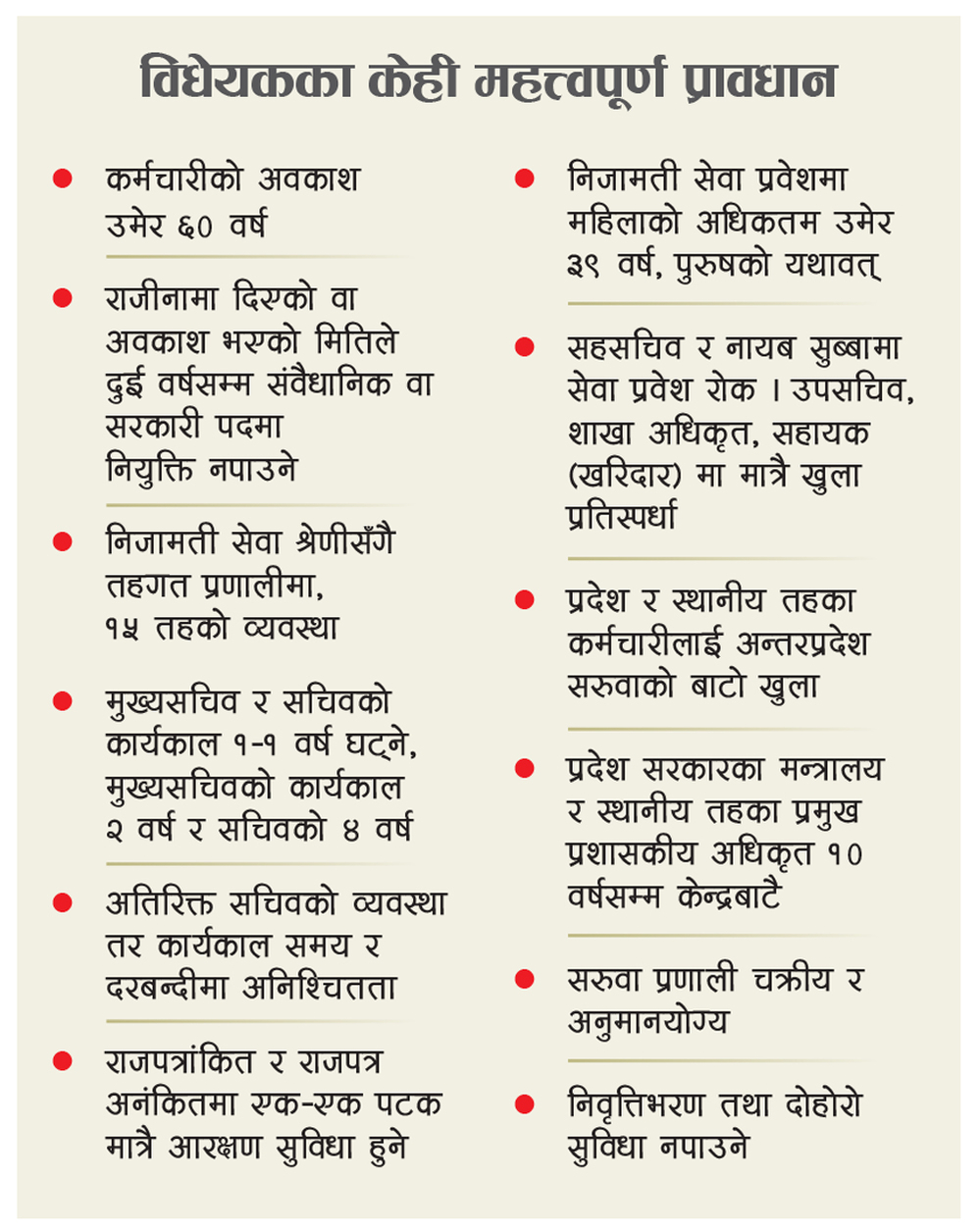
Some important provisions of the bill
- Retirement age of employees is 60 years
- Not being appointed to a constitutional or government position for two years from the date of resignation or retirement
- In a hierarchical system with civil service ranks, 15 levels
- The tenure of the chief secretary and secretary will be reduced by 1 year each, the tenure of the chief secretary
2 years and secretary's 4 years
- Provision of additional secretary but uncertainty in terms of tenure and rank
- One-time reservation facility for gazetted and non-gazetted posts
- Maximum age for civil service entry is 39 years for women, same as for men
- Stop entry to joint secretary and deputy sub-secretaries. Open competition only in deputy secretary, branch officer, assistant (purchaser)
- State and local level employees are open to inter-provincial transfer
- Provincial government ministries and local level chief administrative officers from the center for 10 years
- Transfer system is cyclical and predictable
- Not getting pension and double benefits

