Planted in 217 thousand 289 hectares out of 13 lakh 91 thousand 321 hectares, details are yet to come from Saptari, Rautahat and Mahottari in Madhesh.
We use Google Cloud Translation Services. Google requires we provide the following disclaimer relating to use of this service:
This service may contain translations powered by Google. Google disclaims all warranties related to the translations, expressed or implied, including any warranties of accuracy, reliability, and any implied warranties of merchantability, fitness for a particular purpose, and noninfringement.
Halfway through June, only about 16 percent planting has been done. As Paddy Day is being celebrated across the country on Sunday, the government has announced that 15.6 percent of planting has been completed by June 13. This is slightly less than last year. Last year till June 14, 2081, 17.2 percent of the area was planted.
The Crop Development and Agricultural Biodiversity Conservation Center has said that 217 thousand 289 hectares of Barkhe paddy have been planted in 13 lakh 91 thousand 321 hectares so far this year. "Monsoon is still active, planting in areas other than Madhesh is good," says Keshav Devkota, head of the center.
Devkota says that there has been some delay in planting because there are chaite rice and corn farms in Madhesh. He says that the process of introducing Chaite rice and maize cultivation in Banke, Bardia and other areas has not been completed. "The land has yet to be cleared for dry paddy," says Devkota, "that's why there is less planting in Madhesh, planting will increase after the third week of June." 380 thousand 283 hectares are planted in Madhesh. Of this, 14 thousand 785 hectares have been planted. Balram Rizal, a senior soil scientist at the
center, says that there is little planting in Madhesh because it is customary to keep bads only after Asar. He says that in the case of hills, planting will start from the end of May. "In Madhesh, planting has only been done sporadically, water has been withheld, now the planting will accelerate," he says.
Most of the plantations are in the central hills. More plantings have been done in riverbeds and adjacent fields. 45.5 percent planting has been done in the Far West. 176 thousand 151 hectares are planted in this province. Of this, 80 thousand 128 hectares have been planted. 39.1 percent planting has been done in Karnali. 40 thousand 884 hectares are planted in this province. Of this, 16,200 hectares have been planted.
In Bagmati, 20.5 percent planting has been done. 120 thousand 283 hectares are planted here. Of this, 24 thousand 743 hectares have been planted.
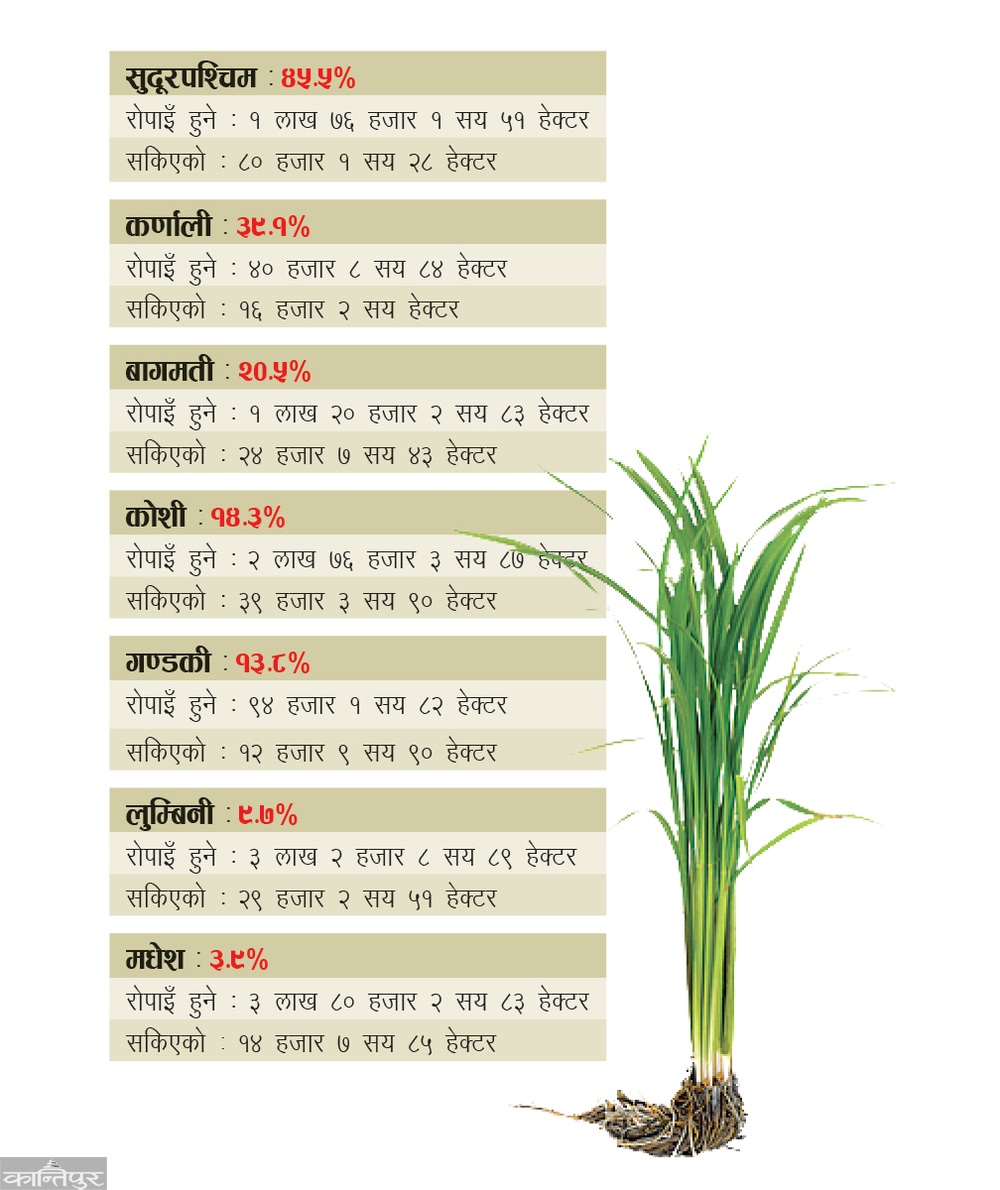
Koshi has 14.3 percent planting. 276 thousand 387 hectares are planted here. Of this, 39 thousand 390 hectares have been planted. In Gandaki, 13.8 percent planting has been completed. 12,990 hectares have been planted here. 94 thousand 182 hectares are planted in Gandaki. In Lumbini too, 9.7 percent planting has been done. 3 lakh 2 thousand 889 hectares were planted in this province, but 29 thousand 251 hectares have been planted.
Uddhav Adhikari, founding president of Farmers Group Federation, says that although planting has been done since the end of May, the expected planting has not been done due to lack of irrigation. Although it is called an agricultural country, the farmers are out of reach of irrigation, they have to wait for water from the sky for planting. That's why till the second week of June, only 16 percent was planted," says the official, "although it is claimed that the irrigation facility has increased in the government data, the farmers have not realized it." According to the survey, the irrigated arable land has increased by 1.5 percent on average. Under the irrigation system construction and maintenance program, 316 small irrigation projects have been constructed till February of the current financial year and additional irrigation facilities have been expanded in an area of 612 hectares. According to the survey, irrigation facilities have been expanded in the area of 31 thousand 306 hectares till February 2081.
Till February of the current financial year, irrigation has reached 1 thousand 55 hectares on the surface, 276 hectares on the elevator side and 3 thousand 136 hectares on the underground side, and an additional 4 thousand 467 hectares of land has been irrigated. "Only after some rain, the water There are canals where
s come. If there is no rain, the canal dries up, it is also called an irrigation facility,” says the official.
According to government data, the contribution of the agricultural sector to the gross domestic product is 24 percent. About 62 percent of the families' main occupation is agriculture. The contribution of rice to the gross domestic product is about 5 percent. But there is shortage of fertilizer and water during planting. As a result, the production has not been able to meet the demand.
Paddy-rice worth billions of rupees is being imported every year. In the financial year 2081/82, both Barkhe and Chaite were planted in an area of 14 lakh 20 thousand 636 hectares. From this, 59 lakh 55 thousand 476 tons of rice was grown. But still 1 million tons of rice is insufficient. Out of the 7 million tons of rice required for the country, 1 million tons are insufficient. Until the end of May, 753,000 tons of rice products including paddy, its seeds, rice and grains have been imported. 38.94 billion rupees have been repatriated from this," says Prakash Kumar Sanjel, Director General of Agriculture Department, "Especially there is more dependence on rice. Consumers prefer Masina and Basnadar rice, which are less produced in Nepal.'
He says that despite the increase in production, the import of paddy-rice has not been reduced relatively due to the policy measures adopted by the neighboring countries for rice export. He said that the program is focused on delivering fertilizers, quality seeds and the latest technology obtained from research to farmers to increase rice production.
Far West: 45.55
Will be planted: 1 lakh 76 thousand 151 hectares
completed: 80 thousand 128 hectares
Karnali: 39.15
to be planted: 40 thousand 884 hectares
completed: 16 thousand 200 hectares
Bagmati: 20.55
to be planted: 120 thousand 283 hectares
completed: 24 thousand 743 hectares
Koshi: 14.35
to be planted: 2 lakh 76 One thousand 387 hectares
completed: 39 thousand 390 hectares
Gandaki: 13.85
To be planted: 94 thousand 182 hectares
completed: 12 thousand 990 hectares
Lumbini: 9.75
To be planted: 3 lakh 2 thousand 889 hectares
Completed: 29 thousand 251 hectares
Madhesh: 3.95
To be planted: 380 thousand 283 hectares
Finished: 14 thousand 785 hectares

