We use Google Cloud Translation Services. Google requires we provide the following disclaimer relating to use of this service:
This service may contain translations powered by Google. Google disclaims all warranties related to the translations, expressed or implied, including any warranties of accuracy, reliability, and any implied warranties of merchantability, fitness for a particular purpose, and noninfringement.
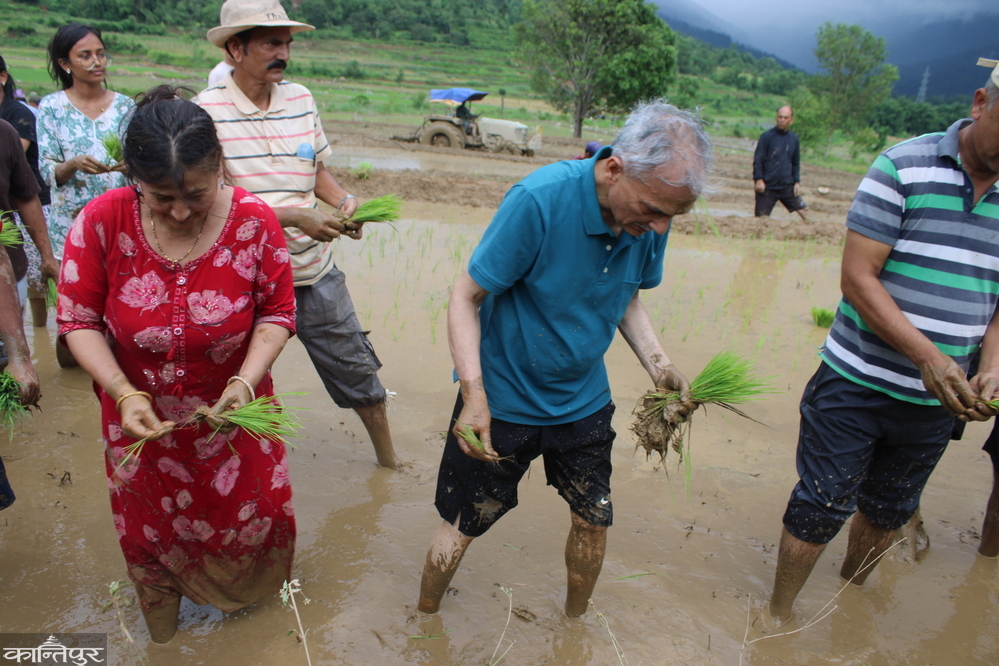
Former Prime Minister and Chairman of Nepal Samajwadi Party (Nyan Shakti) Baburam Bhattarai has planted paddy in Belwastar field in Palungtar Municipality-1 Khoplang. On the occasion of the National Paddy Day and Planting Festival, Bhattarai participated in paddy planting in his own farm at Purkhyuli Thalo Belwastar on Sunday.
Bhattarai, who went to the field with a spade in his hand, made a bow. Drove the tractor by hand, planted paddy. Bhattarai's wife and former minister Hisila Yami also participated in the planting.
Bhattarai has planted 'Sukkha 2' paddy of advanced variety in the field located in the ancestral land of Belwastar. The farm of 8 ropani area is in the name of Bhattarai's daughter Manusi Yami Bhattarai. Under the coordination and management of the local Mandali Mahila Kisan Club, 10 farmers were also employed to plant a field of 10 acres.
 Bhattarai said that Nepal's land and climate are areas of comparative advantage. The majority — 60 percent — of the people depend on agriculture. "Unfortunately, due to the inability to modernize agriculture, it has not been possible to provide enough production and employment, the youth have been forced to go abroad," he said, "to reverse this, traditional farming cannot be done. Let's cultivate in a modern way - planting using machines, let's cultivate with modern technology.
If adequate irrigation can be arranged, two-rowed rice and cash crops can be planted, he said. If that is done, production and employment will be created in Nepal," he said. "For this, the state should guarantee the market. Foreign imports should be taxed. He said that if at least 20 percent of the youth can be taught to farm in a modern way, they can transform into agriculture and become the basis of the country's economy.

