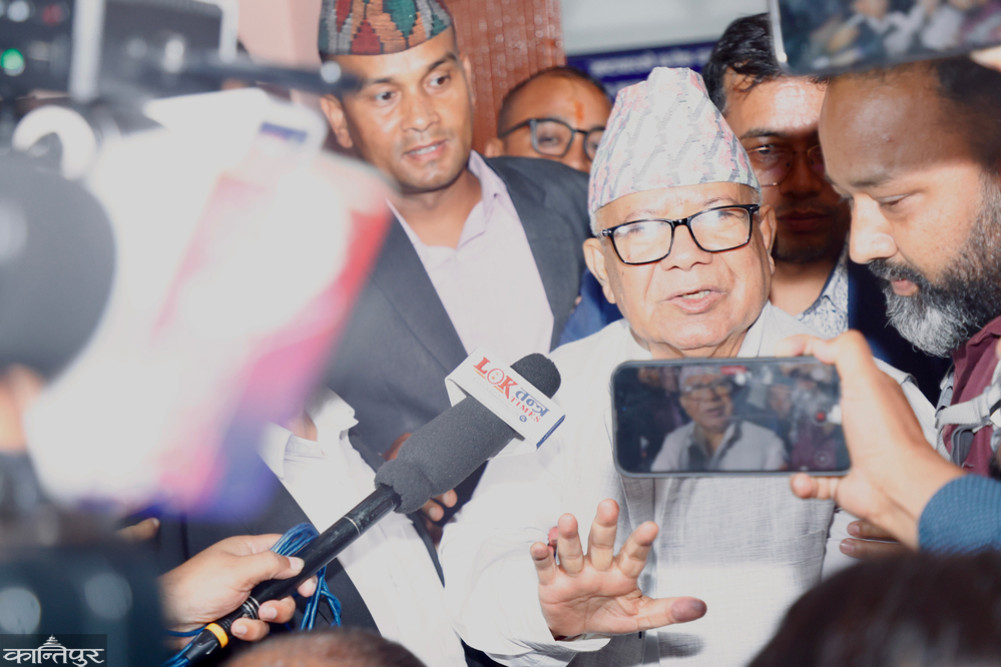
After posting the bank bail, he left the court at midnight
We use Google Cloud Translation Services. Google requires we provide the following disclaimer relating to use of this service:
This service may contain translations powered by Google. Google disclaims all warranties related to the translations, expressed or implied, including any warranties of accuracy, reliability, and any implied warranties of merchantability, fitness for a particular purpose, and noninfringement.
Former Prime Minister Madhav Kumar Nepal looked very tired as he sat quietly listening to the statements of the whole day, the arguments of the opposition lawyers against him and the arguments of his legal professionals in response to them.
After the debate ended at 6 pm, he had to wait for another three and a half hours for the order to send him to the pretrial detention or to release him.
Finally, at 9:30, the spokesperson of the special court, Yagyaraj Regmi, read out the four-page long detention order issued by the bench of judges Tejnarayan Singh, Ram Bahadur Thapa and Vidur Koirala, the gist of which was - based on the evidence obtained immediately, as determined later, he will be released on a bond of 35 lakhs, if the bond cannot be paid, he will be kept in prison.
Even though his lawyers argued in the courtroom that he should be released on a normal date, the former Prime Minister of Nepal's posture was further aggravated when the order came that he should be sent to prison without paying 3.5 million bail. His lawyers, Senior Advocate Shambhu Thapa and Govind Bandi were active in the process of taking Nepal out of the court immediately after paying the bail according to the order. Nepal, on the other hand, sat in a room of the court waiting for the process to proceed.
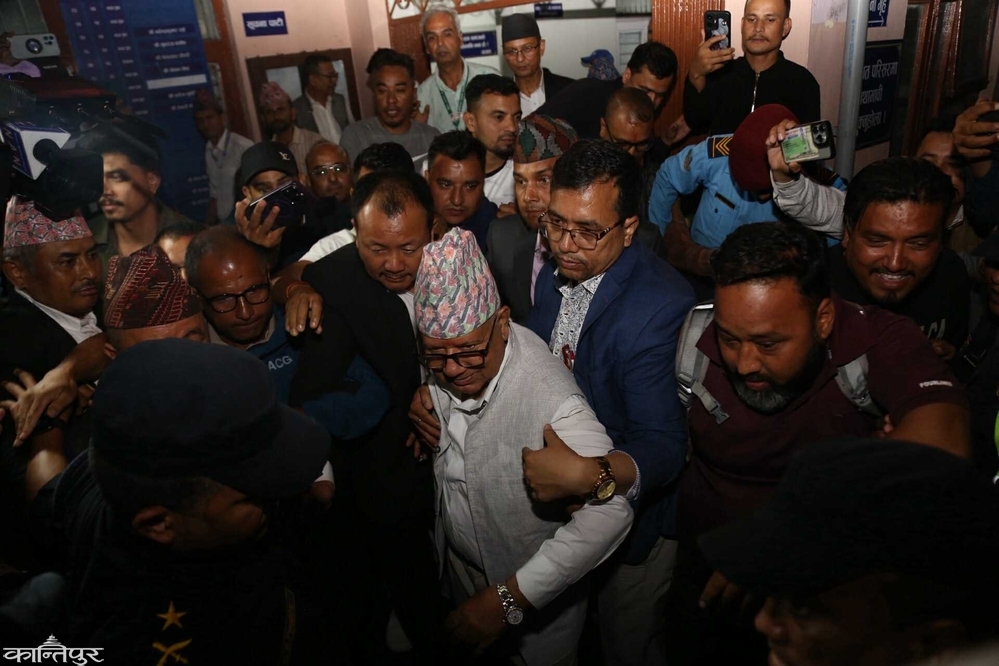
An hour after the order was issued, the bail was not deposited. After saying that the Global Bank would provide the bail of an amount equal to the bail, the court administration staff kept the special court open until 10:30 pm to facilitate the rest of the process. "Representatives of the bank are coming to the road, we are waiting," Regmi, the spokesman of the special court, was saying as midnight approached, "We will wait in the court until they hand over the bail."
When he was the Prime Minister of Nepal, the Commission on Abuse of Authority filed a case against him on 22nd of June against 93 people including him for embezzlement by allowing Patanjali Yogpeeth and Ayurveda Company to buy land at a limited discount through the Cabinet decision and later allowing the same land to be sold against the law. The former Prime Minister of Nepal was demanded to pay 18 million 58 million 50 thousand rupees, the same fine and imprisonment for 10 to 14 years.
The former Prime Minister of Nepal reached the special court at 11:30 on Wednesday morning to give a statement before the preliminary hearing of the case. The court staff asked him two dozen questions. After the statement ended at 2:30 pm, Senior Advocate and former Attorney General Sushil Pant argued against Nepal. Pant debated for an hour and a half saying that corruption was done to harm the country under the guise of a policy decision. He insisted that he should be kept in prison, arguing that Nepal has done illegal work with corruption.
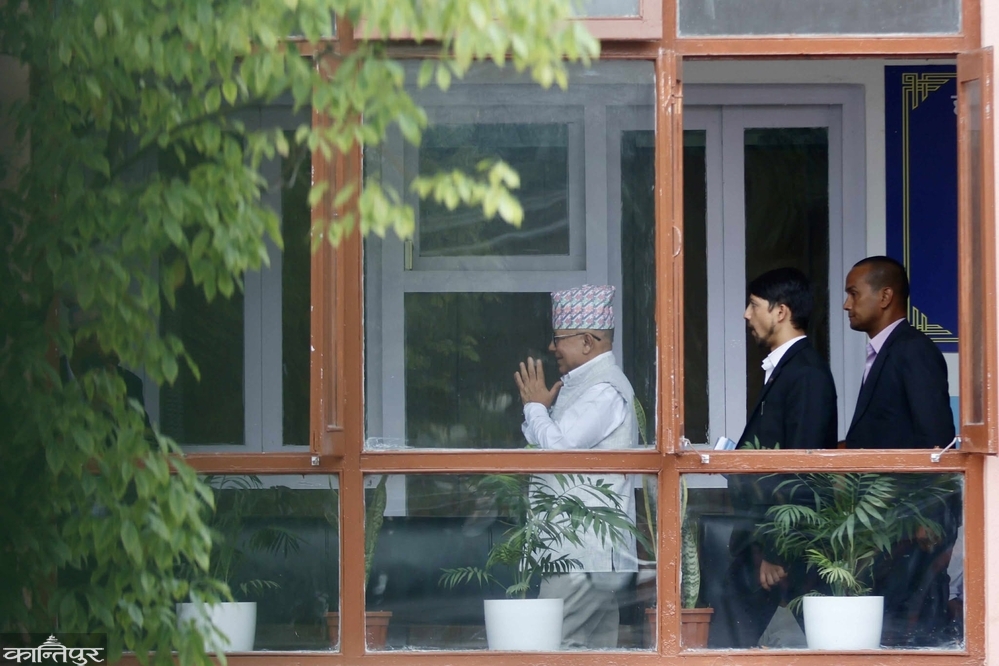
After Pant, four other government lawyers argued that Nepal should be detained anyway. According to the Land Act, 2021, Patanjali Yogpeeth is not an industry eligible for delimitation exemption, there is no legal basis for such an exemption, and the fact that it does not fall under the industry delimitation exemption facility from the memorandum submitted to the company registrar's office, they argued that the Nepal-led Cabinet knowingly made an illegal decision.
In the indictment, it is alleged that when he was the Prime Minister of Nepal on 6 March 2066, he gave permission to Patanjali Yoga and Ayurveda Company to sell 314 ropani 15 annas 2 paisa land of Daki Kavre's former cabinet meeting in the name of different people. According to the authority, the company got illegal benefits due to this action and the government and public property suffered a loss of 185.8 million rupees.
Nepal was listening to the debate against him sitting in the courtroom with a silent and serious posture. After the public prosecutor did not finish the argument until the end of the office hours, Chief Justice of the bench Tejnarayan Singh gave time for defense to Nepal by concluding it briefly. Senior advocate Shambhu Thapa first argued from the side of Nepal. After Thapa started speaking, there was a sudden change in Nepal's face and he started listening to the debate with interest. At the beginning of the
debate, Thapa claimed that it was a gross violation of the procedure to have 'lead opening' by a private legal practitioner, even though there were government lawyers and when it was written that the prosecution of the case would proceed from the government lawyer in the prosecution of the authority. "Should this case be initiated by a private lawyer?" he said in the courtroom, "This is a complete violation of Nepal's criminal legal system." Thapa claimed that a case was filed against the former Prime Minister of Nepal as a revenge case, saying that it is not corruption to let a company come to buy land and later agree to sell it when it is necessary for the cabinet to establish an industry. And, he argued that the court should order him to be released without bail. After Thapa, senior advocates Harihar Dahal, Gobind Bandi, Krishna Prasad Bhandari and others argued and insisted that Nepal should be left unconditionally.
By the time they ended the debate in brief, it was 6 pm. After the sitting, the former prime minister entered the Chamena House of the Nepal Special Court, where a bag of corn was served on his table. Nepal gave half of the corn to its lawyer Gobind Bandi and ate half of it himself.
After having a cup of tea with milk and some biscuits, he returned to the chair. When reaching the court, Nepal's post saying 'Despite scamming 18 crores, even shared a single corn with the lawyer', the post was going viral on social media. The news with the picture of the lunch he had at Chamena home had also come online.
After seeing those posts and news, the former Prime Minister of Nepal got serious and laughed. "I have become accustomed to this, no matter what I do, people will scold me," he gave a brief response.
After waiting for one, two, three hours after watching the many news about him as the first prime minister to go to court in the case of corruption and the rude comments on social media, the order did not come from the bench. Sitting in the courtroom from morning to night, not only him, but also his lawyers and well-wishers were suffering.
Kantipur questioned him about how close the argument against him was to the truth. "It was quite a breeze," he said with a light laugh, "quite a breeze."
Would he not get angry when he was excitedly told something that was not like this for three-three hours? And he said, 'You should not get angry, you should be restrained.'
131 senior and junior lawyers, from Shambhu Thapa to Chandrakant Gyawali, volunteered to argue in favor of Nepal, free of charge. At 9:30 pm, after a long time of Kuri sitting on the bench, gossiping with those well-wishers during a long period of silence, an order was issued to release him on bail. In the large hall of the special court, the spokesperson of the special court read out the order in the midst of packed lawyers, media persons and his well-wishers.
Patanjali Yogpeeth bought more land than the limit and it is mentioned in the court order that when he was the Prime Minister of Nepal, he decided to 'use the land only for the purpose for which it was purchased and to approve the purchase so that the purchased land cannot be sold'. After buying the land, the Yogpeeth plotted and sold the land and Nepal has given approval to sell it. The special court said in the order - "
" after examining the evidence, taking into account the position and role of the defendant Madhav Kumar Nepal at the time, to give a bank guarantee of 35 lakh rupees or its equivalent in cash for the preliminary hearing of the case. According to sub-rule (2) of rule 30 of 2080, the defendant will be sent to the relevant prison office for detention. Finally, at 11:30 pm, he left the special court after paying the bail to the bank and headed home.