The businessmen who started the protest with 7 point demands have warned that they will demonstrate tomorrow at Maitighar and if their demands are not met, they will stop their vehicles from the 19th.
We use Google Cloud Translation Services. Google requires we provide the following disclaimer relating to use of this service:
This service may contain translations powered by Google. Google disclaims all warranties related to the translations, expressed or implied, including any warranties of accuracy, reliability, and any implied warranties of merchantability, fitness for a particular purpose, and noninfringement.
After the Gandaki state government introduced ride sharing rules against the constitution, the transport businessmen are protesting with 7 points of demand. According to the program of the movement, on Saturday in Kathmandu, businessmen put black flags on their vehicles and jammed the wheels on the ring road from 11:30 am to 12:30 pm.
In order to fulfill the demand, transport businessmen had earlier submitted memorandums to all concerned ministries, held press conferences, submitted demand letters to the chief ministers of the provinces, etc.
'After our demand was not met, we protested by placing a car with a black flag on the circular path as part of the announced program,' said Bhim Jwala Rai, president of Nepal Travel Independent Workers' Organization.
The president of the National Federation of Nepal Transport Professionals, Vijay Bahadur Swar, says that he was forced to announce the program of the protest after the public transport sector was displaced due to the laws and regulations made by the provincial governments. According to him, the seven state governments are bringing regulations that are in conflict with the federal law, contrary to Section 8 of Section 2 and Section 12 of the Vehicle Act 2049. Businessmen are demanding that the provincial government should not bring a separate regulation in this way.
Gandaki provincial government has published in the gazette on 1st of June and they have demanded that the regulation 2082 section 2 (h) of regulation 2082 for the operation of private vehicles (red plate) should be canceled immediately. "Our protest is more malicious than those who use ride-sharing technology," Swar said. The state government is being used to increase its sales. According to Swar, there should be a difference between doing business and buying for private use. "The state should also give us red plates, otherwise we will not be able to operate public transport on red plates," Swar said.
But Kamal Kumar Adhikari, Secretary of the Ministry of Physical Infrastructure Development and Transport Management of the Gandaki State Government, says that the suggestions of the businessmen were also taken while making the rules. "Ride-sharing service was in practice, but it was not in the law," he said, "we have organized it based on the law received by the province." We have made this decision according to the law.
Director General of Transport Management Department Rajeev Pokharel also says that the provincial government has the right to make rules and regulations. "Ride-sharing, license etc. are all under the jurisdiction of the province," said Pokhrel, "Our job is only to make standards." The provincial government has done its work according to the constitution.'
The transport businessmen have also demanded from the Supreme Court that the mandate of the Sangh Samiti Renewal Assets Released in the Association Registration Act 2034 should be implemented immediately. While the Vehicle Act 2049 is in the process of being amended, they also demand that the Nepal government should implement the agreements reached with the Federation of Transport Professionals and Labor Unions on various dates and the recommendation reports of the various working groups formed by the government as soon as possible.
Similarly, according to section 13 of the directive on load regulation of freight vehicles 2074, the load capacity of domestic and foreign vehicles should be strictly enforced, the contribution-based social security fund must be enforced in the public transport sector, the insurance rate directive 2073 should be amended in time, and the demand for accident compensation and rescue, and the establishment of an accident relief fund for relief. are Businessmen have also put forward a demand to make a policy of compulsory insurance for goods by implementing the Shipping Act. Chairman Swar said that the demand for the establishment of a competent transport authority and the immediate amendment of the unequal policy of 72-hour facility for cargo and passenger vehicles at the Nepalese border when entering Nepal from neighboring countries has been moved.
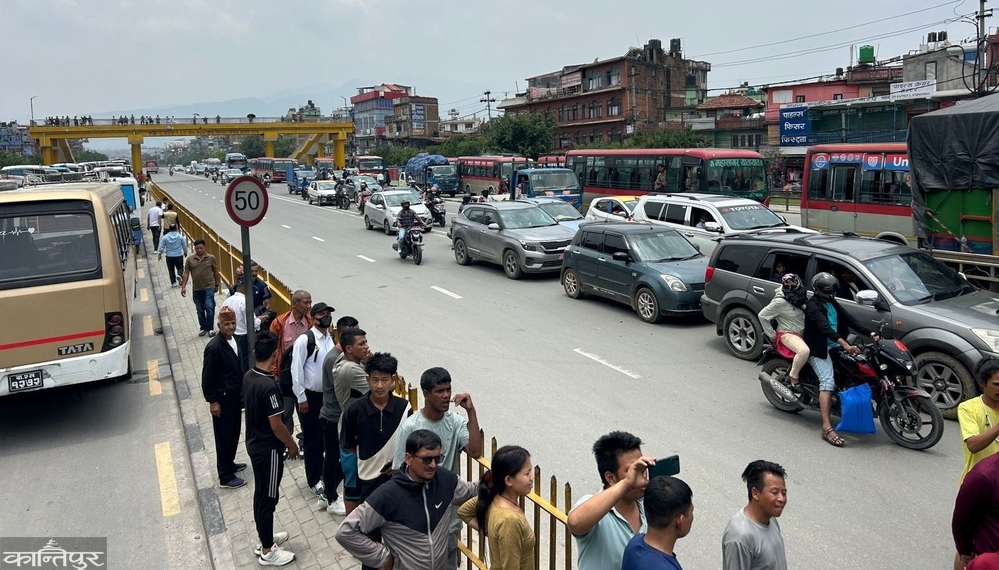
The businessmen have said that despite many discussions and dialogues with the government, there was no solution to the problem, so they had to form a Public Transport Save Sangharsh Committee and embark on a protest. The movement is led by the National Federation of Nepal Transport Professionals, Central Public Transport Federation, Federation of Nepal Truck Transport Professionals, Federation of Transport Professionals, Nepal Transport Independent Workers' Organization, Nepal Transport Workers' Association and All Nepal Transport Workers' Association.
Businessmen are holding a protest program at Maitighar on Sunday. Even after that, if the demand is not met, they have warned that they will protest indefinitely nationwide from the 19th by keeping their vehicles in their homes and garages.
In the year 2074, the government suspended the union committee, froze the property and transformed it into a company, saying that the government would organize the transport sector. They say that if their demands are not met, the investment of 13 billion in the public transport sector will be at risk. Businessmen claim that 1.5 million people are directly employed in this sector and 4 million families are dependent on the public transport sector.

