It is estimated that 36,000 women of reproductive age, 48,000 with disabilities, 1,64,000 children and 4,15,000 senior citizens will be affected.
We use Google Cloud Translation Services. Google requires we provide the following disclaimer relating to use of this service:
This service may contain translations powered by Google. Google disclaims all warranties related to the translations, expressed or implied, including any warranties of accuracy, reliability, and any implied warranties of merchantability, fitness for a particular purpose, and noninfringement.
According to the 'Monsoon Preparedness and Response National Action Plan, 082' announced by the National Disaster Risk Reduction and Management Authority on Wednesday, it is seen that the residents of Lumbini province will be affected the most by this year's monsoon. This year, 523 thousand 656 population of 119 thousand 830 households in Lumbini and least 127 thousand 308 population of 29 thousand 132 households of Karnali province will be affected, according to the authority.
Similarly, 3 lakh 27 thousand 376 population of 74 thousand 914 households of Bagmati province, 2 lakh 87 thousand 107 population of 65 thousand 699 households of Gandaki province, 2 lakh 75 thousand 867 population of 63 thousand 127 households of Koshi, 2 lakh 28 thousand 687 population of 52 thousand 331 households of Madhesh province, 2 lakh 27 thousand 730 population of 52 thousand 112 households of Sudurpaschim province will be affected. It is predicted.
It is estimated that 19 lakh 97 thousand 731 population of about 4 lakh 57 thousand 145 households will be affected by Mansunjanya disaster in a period of about four months.
Similarly, it is estimated that more than half of the total population i.e. 1 million 29 thousand women (52 percent) will be affected by the monsoon disaster. The affected male population is 969,000. Likewise, 36,000 women of reproductive age group, 48,000 people with disabilities, 164,000 children and 415,000 senior citizens will be affected.
In general: 80 percent of the total rain that occurs annually across the country occurs during the four months of monsoon from June 18 to October 14 and 20 percent of the rain occurs in the remaining eight months. As it is predicted that there will be more rain than Sardar in this year's monsoon and there will be damage, the action plan for the preparation has been passed by the executive head of the authority and member secretary of the executive committee Dinesh Prasad Bhatt said.
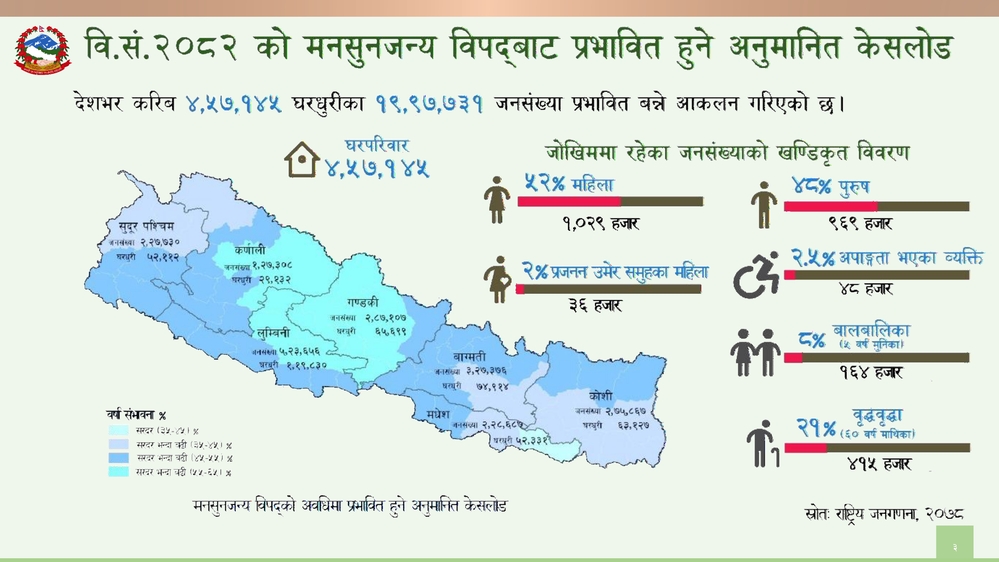
In this year's monsoon, there is a 55 to 65 percent chance of more rain than Sardar in the eastern part of Karnali province, the northern part of Lumbini and most of the parts of Gandaki province. There is a 45 to 55 percent chance of more rain than Sardar in the southern part of Sudurpaschim, the western part of Lumbini, the northeastern part of Gandaki, the northern part of Bagmati and Koshi. In the rest of the country, there is a 35 to 45 percent chance of more rain than Sardar.
There are 500 specialized disaster risk reduction units for preparedness and response. 10 thousand 85 police personnel will be on standby for search and rescue. 277 heavy equipments and 12 belay bridges have been prepared.
There is a balance of 4 billion 65 crore 24 lakh 18 thousand 286 rupees in the disaster management fund across the country. 1 billion 89 million 29 million 72 thousand in the Prime Minister's Divine Disaster Fund, 1 billion 27 million 47 million 73 thousand in the Central Disaster Management Fund, 79 million 41 million 29 thousand in the Provincial Disaster Management Fund, 695 million 43 thousand rupees in the District Disaster Management Fund.
Dissemination of monsoon disaster awareness materials including floods, landslides, pre-warning of possible infectious diseases, provision of mobile towers in case of damage to telephone towers due to floods and landslides has been prepared.
The Department of Water and Meteorology will operate a 24-hour weather station. Emergency weather bulletins in special weather conditions, issuing three-day and five-day weather forecast bulletins in special situations of heavy, very heavy and very heavy rains, sending early warning messages to the public in the main river watersheds for flood alert, and providing flood warnings, will operate a toll-free number 1155 service for the public throughout the monsoon.
One West Air Base helicopter of the Nepal Army will be on standby in Surkhet for Karnali, Lumbini and Sudurpaschim Provinces, and another Central Air Base helicopter will be on standby in Kathmandu for Bagmati, Gandaki, Madhesh and Koshi Provinces to conduct immediate rescue and relief operations during the monsoon. Air vehicles have been kept in readiness at Gauchar Barracks in Kathmandu so that they can be mobilized within 15 minutes of receiving the news for immediate rescue. There are 276 police personnel who are trained in water rescue and 2 thousand 823 who know how to swim.
With the aim of receiving disaster information at the community level, 168 thousand 575 people from all over the country will prepare disaster indicators at the rate of 25 people from each ward by the end of June. There is a plan to prepare 3,675 volunteers for disaster response at the community level.

