For years, the collectors who bet their lives on Bhirpakha, which is prone to leaks and monkeys, have not been able to get more than 1000 rupees per head, but in the Chinese market, they are being bought and sold for up to 80 lakh rupees per kilogram (about 2500 heads).
We use Google Cloud Translation Services. Google requires we provide the following disclaimer relating to use of this service:
This service may contain translations powered by Google. Google disclaims all warranties related to the translations, expressed or implied, including any warranties of accuracy, reliability, and any implied warranties of merchantability, fitness for a particular purpose, and noninfringement.
54-year-old Bhiudal Budha of Khatyad rural municipality-4 of Mugu has been picking yarcha every year for 15 years. He is preparing to go to Patan with his wife Durga and two sons this week, and he is saddened by the fact that for the last few years, the yarcha is less and has to be sold at the same price.
The old man's family, who reached Patan last year after investing about 50,000, could not earn more than 120,000. "If you don't go, you have to do the work you've been doing for years, if you go, you have to go to unconquered places with large crowds," he said.
59-year-old Prem Bahadur Pun of Aathbiskot Municipality-1 Syalakhdi in Rukum West has also been going to Patan to pick yarcha for two decades. The education expenses of his 3 children along with household expenses for the year are running from the proceeds from the sale of Yarcha. He has also built a mud house in Musikot, the headquarters, from the proceeds of selling yarcha. Last year, the Pun couple, who reached Kagmara and Nowre Patan in Dolpa, earned one and a half lakh rupees by spending about 70,000 rupees along with endowment goods. "We collected 170 yarchas together with the elders last year, we sold 150 yarchas at the rate of 1000 rupees in Patan, and the rest of the yarchas were brought home to send to relatives," he said.
Although the price and demand of yarcha in the international market is increasing, the collector complains that the price is never more than 1000 rupees. "Even when it was 22 lakh kilos, it was the same rate, even when it reached 32 lakhs, it is the same thousand, we never got more money," Pun said, "The prices of food, clothing and other basic goods have increased a lot, but we have been selling them at the same price for 7/8 years."
Yarcha is found in various Patans of Mugu and Dolpa of Karnali. Traders reach Patan to collect Yarchagumba. Yagya Bahadur Budthapa, a herbalist, said that they used to buy yarcha in Patan for 700 to 1000 rupees every year. According to him, two types of yarcha are being produced in Karnali based on quality. "Ninety percent of the yarcha market here is China, the yarcha we bought should be stored in the warehouse until the Chinese traders come," he said, "After they come, our yarcha will be sold only by determining the price, we also buy at a risk, so we could not give a price of more than 1,000."
In India and China, Yarcha is currently being traded at 50 to 80 lakh rupees per kg, he says. Some traders claim that the price of yarcha is continuously decreasing. Parbal Lama, a businessman of Charkatangsong in Dolpa, said that last year he sold yarcha for Rs. 27 lakhs per kg, but last year it was barely sold for Rs. 22 lakhs.
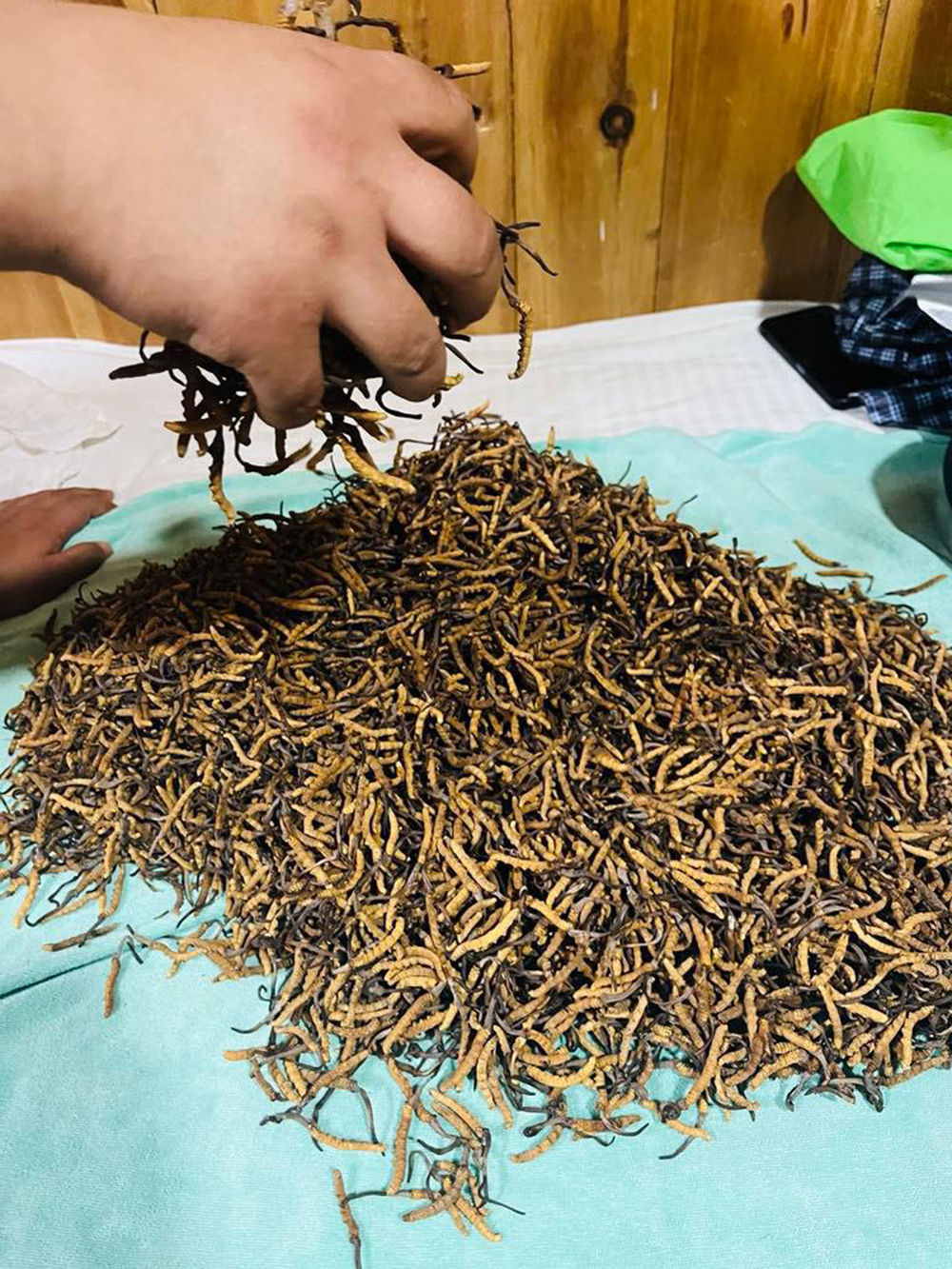
Before Corona, he told that he had sold yarcha for 32 lakh rupees. "If you could take it directly to China and sell it, you would get a higher price, as the traders who came to Kathmandu say, you have to pay that much," he added. He says that yarcha is bought and sold in China for about 6 million per kg. Narsingh Rokay, Chairman of Jagdulla Rural Municipality of Dolpa, said that as the production of Yarcha is decreasing every year, the locals are not able to earn as much as expected. "Yarcha collection is the main means of livelihood of the local people who depend on traditional farming and animal husbandry," he said, "but the local people are disappointed because of the problem of not going to Patan."
According to Surya Bahadur Budha of Tripurasundari Municipality-4 in Dolpa, who started going to Patan since 2052 to harvest yarcha, yarcha was sold at 60,000 rupees per kg at that time. He says that yarcha, which was sold in the same vicinity until 2058, then increased rapidly to Rs 1.5 lakh per kg. He says that although the price of yarcha is increasing every year, the production is decreasing, so most of the collectors are suffering and investment is not rising.
"Let's not talk about the sorrows of going there, coming to Patan, we have to walk overnight in Bhirpahara risking our lives because we will get sick when we reach Patan," Surya Bahadur said. Mun Bahadur Rawat, head of Division Forest Office, said that Yarchagumbu is being collected in 41 community forests and 21 Patans of She-Foksundo National Park area through the Division Forest Office. According to him, so far, about 4,000 local people have reached various places to collect Yarcha.
Last year, 4 kg of Yarchagumbu was released through Division One and 64 kg through Park. In Dolpa, Ruppatan, Chinarangsi, Majhdanda, Turi, Bagar, Majhdhari, Batulile, Kanda, Furke, Gyane, Jairi, Saikumari and other Patans, there is a rush of locals to pick Yarcha. The Mugumkarmarong Rural Municipality of Mugu is going to open Patan from May 13. The municipality has set an entry fee of Rs 2,000 for locals and Rs 2,500 for collectors from outside districts.
Village Chairman Chhiringkapne Lama said that the price of the Yarcha in Karnali is determined by Chinese traders. According to him, some collectors have not been able to sell even the manuscripts collected last year due to lack of price. He said that about 7,000 people collected yarcha in Mugamkarmarong last year. Last year, 69 lakh 52 thousand rupees were collected from the collector.
The Provincial Police Office has informed that two collectors who went to pick up paper in Dolpa have died in the last one week. According to the office, Bhim Bahadur Bohra of Guthichour Rural Municipality-1 of Jumla, who had reached the intermediate Patan located in Jagdulla Rural Municipality-1 of Dolpa, died after falling into a lake on Wednesday. Likewise, 27-year-old Kalpana Shahi of Toplagaon, Tatopani Rural Municipality-8, Jumla, died due to lightning on Thursday. She went to Subbakuna Patan located in Tatopani Rural Municipality-8 to pick yarcha. The state police office said that he was struck by lightning while searching for Yarcha in Patan. According to the office, last year 8 collectors died in Dolpa and 6 in Mugu due to the lake, while 43 people who went to different Patan were rescued. According to the data of the office, 39 people lost their lives for the collection of yarcha during the period of 3 years.
Last year, about 214 kilos of yarcha were exported from Karnali, according to the data of the state forest directorate. While last year 305 and 401 kilos of yarcha were produced in the previous financial year. Similarly, before the corona epidemic, there is a data of the directorate that 1 thousand 214 kg of yarcha was released in 2075/76. Botanist Kamal Sharma said that even though there was no harvest for 3 consecutive years due to the corona epidemic, it had an impact on the reproductive process. "Production is decreasing every year, collectors and traders are also forced to face the problem of the market," he said. He says that he goes to Patan to look for Yarcha.
Minister of Industries, Tourism, Forests and Environment of Karnali Province Suresh Adhikari said that work is being done to make the collection of yarcha systematic, low-risk and with appropriate marketing. "In order to strengthen the regional economy and also for the prosperity of Karnali, the protection and marketing of the herbs here is necessary," he said, "through herbs and tourism, initiatives are being taken to create jobs, increase economic activity and overall regional economic development."

