Illegal poaching of wildlife and birds also continues to pose a challenge to biodiversity
We use Google Cloud Translation Services. Google requires we provide the following disclaimer relating to use of this service:
This service may contain translations powered by Google. Google disclaims all warranties related to the translations, expressed or implied, including any warranties of accuracy, reliability, and any implied warranties of merchantability, fitness for a particular purpose, and noninfringement.
Stakeholders have said that the biological diversity is being reduced when building roads and parks randomly and building physical structures by clearing forests where they are not needed.
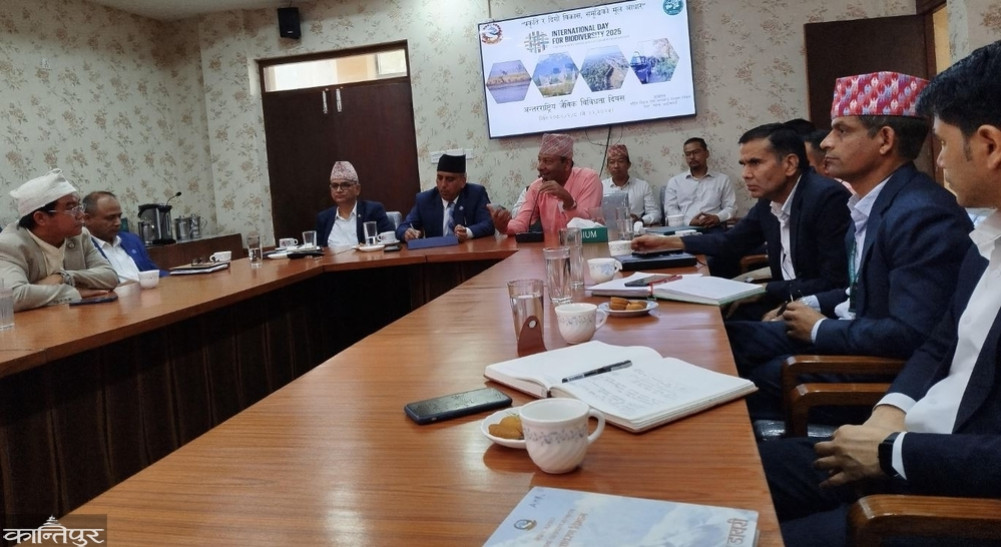
Buddhisagar Paudel, joint secretary of the Ministry of Forests and Environment, said in a program held in Kathmandu on the occasion of the International Biodiversity Day, which was celebrated with the main slogan of 'Nature and sustainable development, the foundation of prosperity' on Thursday, that there is no place where humans have not destroyed, human activities have greatly affected biodiversity, habitat fragmentation and degradation.
Poudel said. "We are saying that the protected area in Nepal is 23 percent (including intermediate ones), but the investment in biological diversity conservation is low," he said, "how much is the lack of study, it is not possible to classify the habitats of 38 species in Nepal."
He says that 25 percent of the species in Nepal are under threat and this rate is increasing. In Nepal, 172 species of birds have reached the status of extinction. Director General of Parks Department Ramchandra Kandel said that the illegal poaching of wild animals and birds also poses a challenge to biological diversity.
Relating to the recently attempted theft of a red panda from the Sadar Zoo in Jawalakhel, he said, 'Illegal poaching is terrible, its impact is also on biological diversity.'
According to the 2009 census, the number of tigers in Nepal was 121. In 2022, this rate increased to 355 cases. With the increase in the number of tigers in Nepal, habitat and food problems have also increased, resulting in human-wildlife conflict. Kandel, director general of the park department, said, "The tigers have increased, they have become problematic, 15 tigers are kept in cages". An employee of the Ministry of Forests said, "The situation has come to a point where the locals want to take your tiger with you, if you don't associate it with income and prosperity." Climate change and the spread of invasive species have also added challenges to biodiversity. The participants said that research should also be done on increasing air pollution and biodiversity loss in cities including Kathmandu.
Secretary of the Ministry of Forests, Rajendra Prasad Mishra proposed that the local level should be made a 'signature party' (party level) saying that without coordination with the local government, which is directly connected to the community, the goal of biodiversity conservation will not be achieved. "This should be done within 5/7 months by including all stakeholders including the Ministry of Forestry, Ministry of Agriculture, 753 local levels, creating a nationwide network of biodiversity conservation," he said.