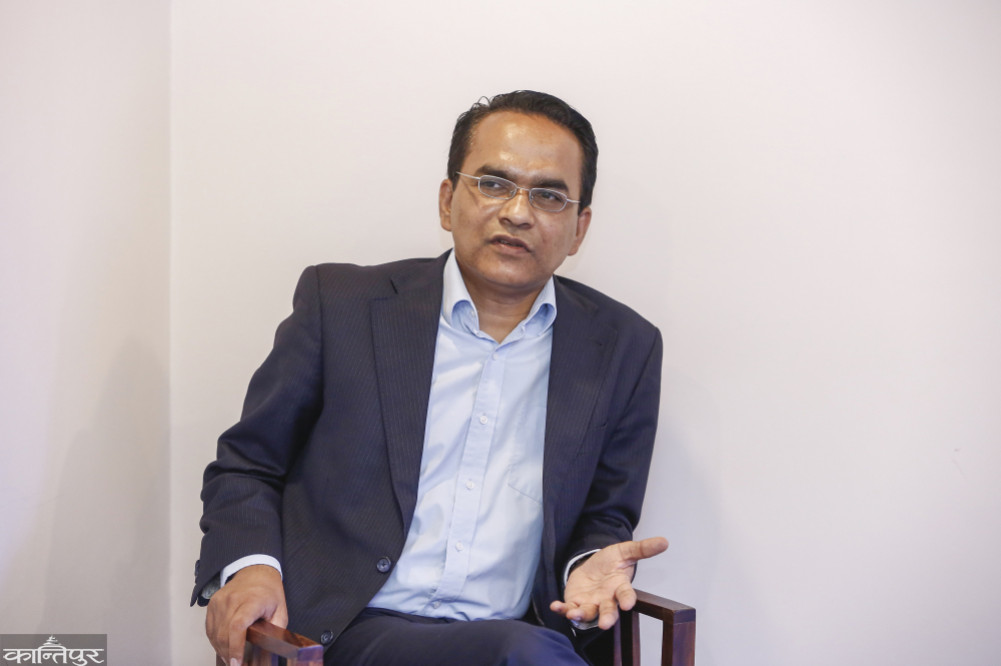
There is no more ego conflict between the Ministry of Finance and Rashtra Bank: Vishwanath Paudel, the newly appointed Governor
We use Google Cloud Translation Services. Google requires we provide the following disclaimer relating to use of this service:
This service may contain translations powered by Google. Google disclaims all warranties related to the translations, expressed or implied, including any warranties of accuracy, reliability, and any implied warranties of merchantability, fitness for a particular purpose, and noninfringement.
The government has appointed economist Vishwanath Paudel as the governor of the central bank. The governor was selected only after 44 days due to the political tussle between the ruling Congress and the UML, contrary to the legal provision that the governor should be appointed one month before the vacancy.
Deputy Prime Minister and Minister of Finance Bishnu Prasad Paudel's recommendation committee has decided to appoint Paudel as the governor for five years from among the three people nominated by the Cabinet meeting on Tuesday. Mahaprasad Adhikari as ex-governor in recommendation committee member And Poshraj Pandey was the expert. The
committee recommended Kamu Governor Neelam Dhungana Timsina and former secretary Dinesh Bhattarai along with Paudel on Tuesday. As the ruling Congress and UML failed to reach an agreement, the chief economic adviser to the government, Rashtra Bank, was without a leader since March 25. When both the parties did not give up their stand to bring their close ones in the governorship, distrust was created at the top level and the alliance was at risk of breaking up. Criticism of the government was increasing for not being able to appoint a governor for a long time.
Prime Minister KP Sharma Oli and Congress President Sher Bahadur Deuba had agreed to make Paudel the governor on Tuesday when doubts were being expressed about the appointment of the governor. Then at 4 pm, the recommendation committee meeting was held and the names of three people were sent to the cabinet. Even though there was talk of appointing the governor on Monday itself, due to lack of agreement at the top level, the regular meeting of the Council of Ministers was also postponed at the last moment. The governor was appointed in a sudden cabinet meeting on Tuesday.
The matter of appointing the governor had become complicated for two months for the ruling party Congress and UML. A member of the governor's recommendation committee formed on 11th March resigned due to the prolonged appointment process. In the committee initially formed under the coordination of Finance Minister Paudel, former governor Vijayanath Bhattarai and Vishwanath Paudel as experts were members. Former Governor Bhattarai resigned as a member of the committee on 9th Baisakh saying that no role was given to the committee.
After that, the government replaced Bhattarai with outgoing governor Mahaprasad Adhikari as a member. Vishwanath Poudel also resigned as a member of the committee on 28 Baisakh after he was offered to become the governor. On 31 Baisakh, the Council of Ministers reconstituted the recommendation committee and appointed Poshraj Pandey as a member. The appointment process, which has gone through political manipulation, has added challenges to the new governor Paudel. The question has also been raised whether he can keep his background separate or not.
Poudel has become the governor in a challenging time to speed up the country's economic and financial sector. Meanwhile, external indicators such as foreign exchange reserves, remittances, and foreign exchange have been steadily strengthening, but the economy has not become viable. In 10 months, the government's revenue collection has increased by only about 12 percent. While capital expenditure is well below target, public debt obligations are increasing rapidly. Banks and financial institutions have been piling up an average of 5 billion loanable amount throughout the year. Although the interest rate is the lowest since 45 months, the credit has not been expanded.
The financial system is affected by the sluggish economy. Bad loans of banks and financial institutions have increased due to non-recovery of loans. There are problems in cooperatives, microfinance and other sectors. Market demand has not increased. Private sector morale is down. Industries are running at less than half capacity. As expected, new investment (domestic-foreign) has not come in. It will not be easy for the newly appointed governor to solve these problems.
Nepal is on FATF's "grey list" because it cannot meet even the minimum standards in terms of financial crime control. Nepal has got two years to come out of this. An action plan has also been made for that. However, looking at the activities of the government and the commitment of the political parties, the possibility of Nepal coming out of the "grey list" at the specified time seems very unlikely. In the process of bringing the country out of the 'grey list', the role of the governor is very important, especially for institutional coordination. Paudel will have to work hard to succeed in this.
The newly appointed Governor Poudel has the responsibility of giving proper suggestions and advice to the government to stabilize the financial sector and make the economy viable. Paudel said that by improving the health of banks and financial institutions through monetary tools, they would maintain financial stability and give creative suggestions for the improvement of the overall economy. "I will not work in such a way that the overall economy deteriorates," he says, "because citizens may have to face big problems even due to a small mistake, I will not allow that situation to happen."
Paudel, who became the 18th governor of Rashtra Bank, graduated from the University of California in 2010. Apart from economics, his subject expertise is in agricultural resources, resource management and labor economics and economic history. He also has experience working as an economic adviser to the International Labor Organization (ILO).
In 2078/80, Paudel, who worked as a senior economic adviser to the Ministry of Finance, became the vice-chairman of the National Planning Commission in 2078/79. He is also the Chairman of the Board of the International Center for Mountain Development (ISMOD) and worked as an economist in Millennium Challenge Account Nepal in 2015/17. Poudel also has the experience of working as a 'visiting professor' in China's Sichuan University, South China Agricultural University, and the University of California, Berkeley in America.
Paudel has published research papers on topics such as micro finance, labor and social economics, and environment and water resources. He also worked on the 'Analysis of Nepal's Labor Market' report done by ILO in 2018. Paudel also wrote a research paper for the Singapore-based International Trade Union Confederation on the activities of labor unions within the informal sector in Asia.
Paudel became a Congress candidate in Chitwan-1 in the House of Representatives election of 2079. In the voting results, he was third after Hari Dhakal of RSVP and UML candidate Surendra Pandey.
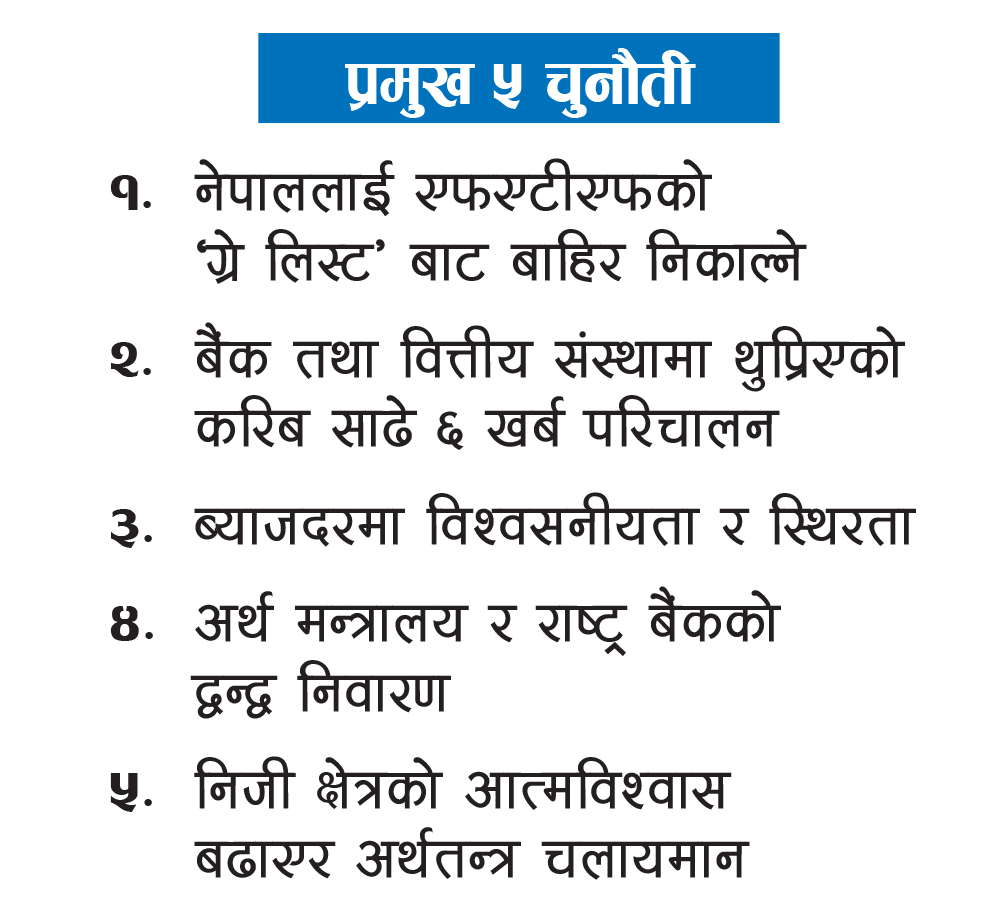
major 5 challenges
1.
to take Nepal out of FATF's "grey list" 2. Banks and financial institutions accumulated about 6 billion operating
3. Credibility and stability in interest rates
4. Resolving conflict between Ministry of Finance and National Bank
5. Economy running by increasing the confidence of the private sector
There is no more ego conflict between the Ministry of Finance and Rashtra Bank
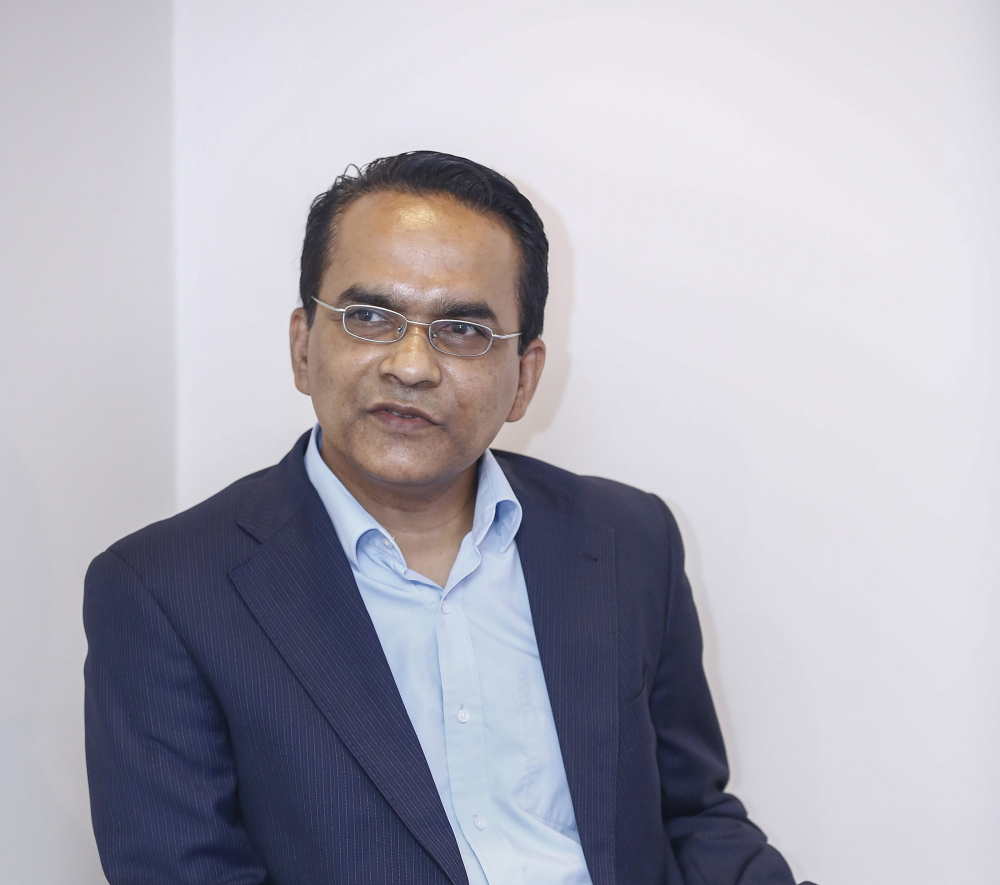 Vishwanath Paudel, the newly appointed governor
In the last parliamentary election, you were a candidate for Congress in Chitwan-1. Now he has been appointed as the governor of an autonomous body like Rashtra Bank. Many have questions about this. What is your response?
Everyone has political opinions. I have not done anything wrong by participating in the elections. If contesting in the elections is taken as a negative thing, we are done. He is going to test his position among the people in the election. Humans are born with caste but ideas and competition are not born. Contested in the election, finished. I carry out the responsibilities that I have been given well. There is no hint of politics in my work. Remember my two things during my five years in office - one is governance based on dialogue and the other is transparency.
But there was a long tussle between the ruling party. What are your priorities for reforming the financial sector in this background?
Firstly, I will enhance the supervisory capacity of Rashtra Bank. I believe that rules should be less and supervision should be more. If there are more rules, there will be a lot of confusion. Banks have some problems. Rashtra Bank is responsible for protecting the savings of citizens and organizations. My focus is on working to protect citizens' savings and the overall stability of the financial sector by solving problems through supervision.
Rashtra Bank's customers are banks and financial institutions as well as the government. In the policies taken by the state, there is effective coordination with the government and banks and financial institutions so that the policies and directives issued by the National Bank cannot be modified within a week. I do everything through dialogue. It works to strengthen the morale of capital market investors. I want the capital market to contribute to the economy as a whole.
You will have to work in coordination with those who are competing, how have you seen it?
I don't think there was any contest for governor. It is not even that the governor is selected by applying. The government has given responsibility to whoever it sees fit. So I don't know who I was competing with. Competition is over now. It is not always a competition. I don't cheat on anyone. I will move forward with everyone included. Until yesterday, Jo-Jo was an aspirant for the governorship, but now it is over. From tomorrow I am the guardian (leadership) of all. My activities will be accordingly.
You have been appointed as the governor of Rashtra Bank, which is being watched with great interest. At present, the situation of the economy and the financial sector is complicated. How have you taken this challenge?
I am familiar with Rashtra Bank. Many of my students are working there. Even when I was in the Planning Commission, I was closely watching the National Bank. So it is not taken as a problem. The situation is difficult but there is confidence that it will improve. It needs everyone's help.
has been keeping a close eye on the economy and the economic indicators of the country. What is your role in untangling the knot in the economy?
Monetary policy does not lead the economy. The job of monetary policy is to help achieve the goals set by the financial policy. If the policy of the National Bank is in conflict with the policy of the government or the Ministry of Finance, I will correct it immediately. "Proactive policy" that has a positive effect on the overall economy should be created by the Ministry of Finance and I am committed to providing all kinds of support and advice. In the existing policies and regulations issued by the National Bank, there are some complaints not only from industrialists and businessmen but also from the private sector as a whole.
I will sit with them and try to find a solution through factual dialogue, study and research. I don't shoot like a hip shooter. It's an economy, everyone suffers if they make a common mistake. Don't let that happen.
Banks have not been able to extend credit. Too much fluid has accumulated in the system. The bad loans of the institutions are increasing and the problem is also increasing. How do you improve it?
I have been saying since 2065 that we should bring in a property management company. Now that topic has also come in the policies and programs of the government. The government should take the lead in establishing this company. I will sit down with the banks in the near future and listen to their problems and try to find a solution. I work to improve the health of banks.
In recent years, the Rashtra Bank has been accused of sometimes bringing too loose a policy and sometimes too tight. Due to such policy instability, the trust of stakeholders is lost. Now what policy should the bank bring?
I do not make any decisions without facts and hastily. I am aware that citizens should not pay interest rates from 8% to 14% in a month or two. I issue policy-instructions only through adequate discussion and dialogue with stakeholders.
Looking at history, there is no good coordination between the Ministry of Finance (Minister of Finance) and the National Bank (Governor). This is the reason why the financial policy seems to have turned to one side and the monetary policy to the other. How to improve this situation?
I see this as a conflict of 'ego'. The Ministry of Finance and the National Bank have their own roles and responsibilities. The head of the regulatory body shall work within the existing policies and rules. We are not going to do politics, fight. Therefore, we should proceed through dialogue rather than conflict with all agencies.
Nepal is now on FATF's gray list. You have two years to escape from it. Rashtra Bank also plays an important role in bringing it out of the gray list. How do you work for this?
I will proceed in coordination with the government in the process of bringing the country out of the 'grey list'.