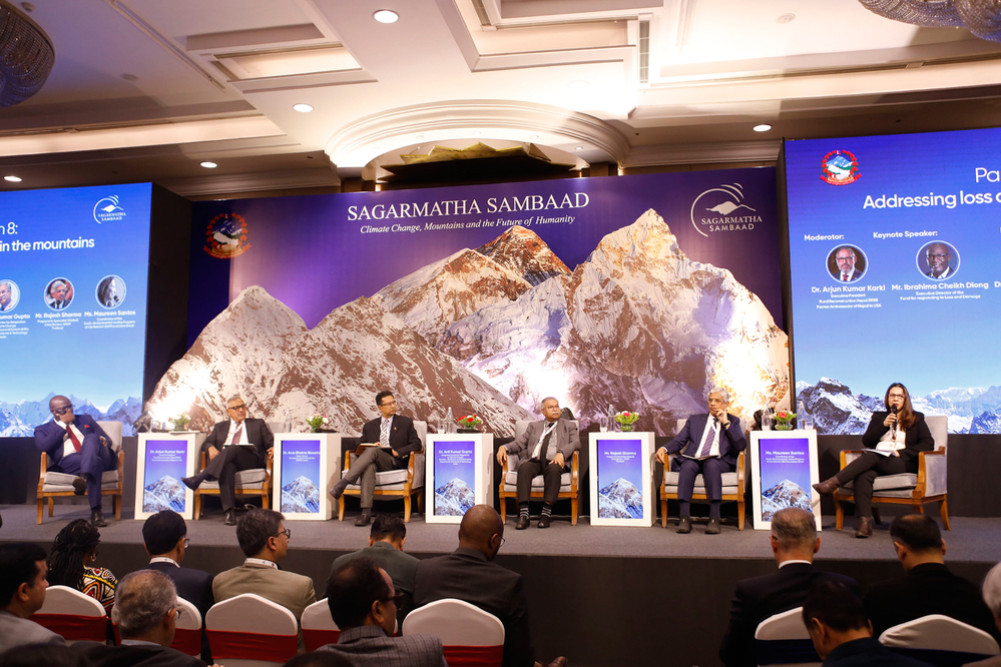
Experts suggest that meaningful efforts should be made for global partnership to reduce the effects of climate change and green economy
We use Google Cloud Translation Services. Google requires we provide the following disclaimer relating to use of this service:
This service may contain translations powered by Google. Google disclaims all warranties related to the translations, expressed or implied, including any warranties of accuracy, reliability, and any implied warranties of merchantability, fitness for a particular purpose, and noninfringement.
While the effects of climate change are affecting the world, its effects are more visible in the Himalayan countries like Nepal. Nepal is facing various negative effects due to increase in atmospheric temperature.
Climatic disasters such as excessive rainfall, lack of rainfall and drought have increased due to the mountains becoming snowless, irregular rainfall, landslides and extreme temperatures. Nepal is a country that emits only 0.027 percent of carbon globally. However, it is ahead in experiencing the negative effects of climate change.
Every year, due to major natural disasters, the impact is huge. According to scientists, the melting of winter snow, lack of rain during rice planting, rain during harvesting of rice, change of silvery mountain peaks into black stone, breaking of glaciers are the direct effects of climate change.
When industrialized and developed countries emit excessive carbon, Nepal is suffering from it. In order to draw the attention of the international community to the fact that despite having a very low contribution to carbon emissions, the government has held an Everest dialogue on the concept of 'climate change, mountains and the future of humanity'.
Forest and Environment Minister Ain Bahadur Shahi Thakuri says that an international conference has been organized in Kathmandu to inform the world about the impact of climate change on the Himalayan region and the problems that Nepal is facing. "It is not possible to reduce the negative effects of climate change by our efforts alone," he said, "There is a need for global and regional partnership." We have emphasized that in this forum.'
On the second day of the Everest dialogue, on Saturday, there was a separate dialogue on the topic of 'global and regional partnership' (Global and Regional Partnership) and green economy (green economy). Experts have suggested that significant efforts should be made for global partnership to reduce the effects of climate change and green economy.
According to economist Nar Bahadur Thapa, Nepal needs 46 billion US dollars to build a green economy. "Nepal's resources cannot create a green economy, foreign aid must be mobilized," he said, "Nepal should be able to present itself strategically in the Everest dialogue."
The Paris Agreement aims to significantly reduce the risks and impacts of climate change. In which it is mentioned that the global temperature increase will not be reduced to more than 1.5 degrees Celsius. There is an agreement to increase capacity and promote low greenhouse gas emissions and climate adaptation in order to adapt to the adverse effects of climate change so as not to reduce food production. It is also in the agreement to flow investments according to the development methodology of low greenhouse gas emissions and climate adaptation.
Nepal is a party to the United Nations Convention on Climate Change. The National Climate Change Policy, 2076 has adopted a policy of using international financial and technical support and opportunities to manage climate change according to national priorities and local needs while fulfilling international obligations. However, experts in this field understand that Nepal is missing out on benefiting from international and regional partnerships.
Sudeep Thakuri, Associate Professor of Central Department of Environmental Science, Tribhuvan University, says that Nepal has not been able to have a strong partnership with its two neighbors, India and China, which are advancing rapidly in industrial development, regarding climate change.
There is a situation where the change in one place is affecting another in the neighborhood. However, India, China or other countries in the region are not cooperating on this issue," he says. "There is no sharing of facts and data related to climate change.
requires scientific data. In addition to increasing it, a joint effort is needed to minimize the negative effects of the changes.' He commented that Nepal is not able to provide the evidence that it is suffering due to climate change on the international stage.
He says that Nepal has not been able to 'lobby' strongly before the international forum and developed nations. Although Nepal is represented in the United Nations or regional forums, it has not been able to increase international understanding because its voice is not clear and articulate.
'Partnerships at the regional level are very weak. Internationally, project-oriented NGOs are active. However, there is a lack of partnership between the government and the government," Associate Professor Thakuri said. "It is important to gather sufficient evidence and evidence that we are victims and present it on the international stage. The global world should be able to convince the international partners with scientific facts/facts and bases.'
scientist Uttambabu Shrestha says that Nepal has not been able to reap the benefits of special geographical features and biological diversity from the international world. What are we trying to do? What are you trying to get? Should have been clear on that. Sometimes there is no clarity on that," he said, "In economic and human terms, the state has invested heavily. But what about after the program is over? That seems to be unanswered.
He says that Nepal has not been able to get help from the global world to reduce the problems it is facing due to climate change. He commented that Nepal has not been able to properly raise its experiences and problems on the international stage.
Climate change is a science-based issue. Science diplomacy is needed for this, not only political diplomacy," he added, "Science has never been a priority for us. No research. That's why there is a weak presentation on the international stage.
Thakuri said that Nepal is not getting the proper benefits of global partnership due to the weakness in its ability to better understand, research, present and advance climate change.
Economist Keshav Acharya says that efforts should be made to get help from the international world through 'carbon credit'. "The changes brought about by climate change have affected agriculture, animal husbandry and people's health, and have made the economy completely bad," Acharya said, "The next option is a green economy. For this, exploitation of natural resources should be stopped. In order to save the forest, you can get help from the funds created by Europe, America and other countries, but it did not work.'