We use Google Cloud Translation Services. Google requires we provide the following disclaimer relating to use of this service:
This service may contain translations powered by Google. Google disclaims all warranties related to the translations, expressed or implied, including any warranties of accuracy, reliability, and any implied warranties of merchantability, fitness for a particular purpose, and noninfringement.
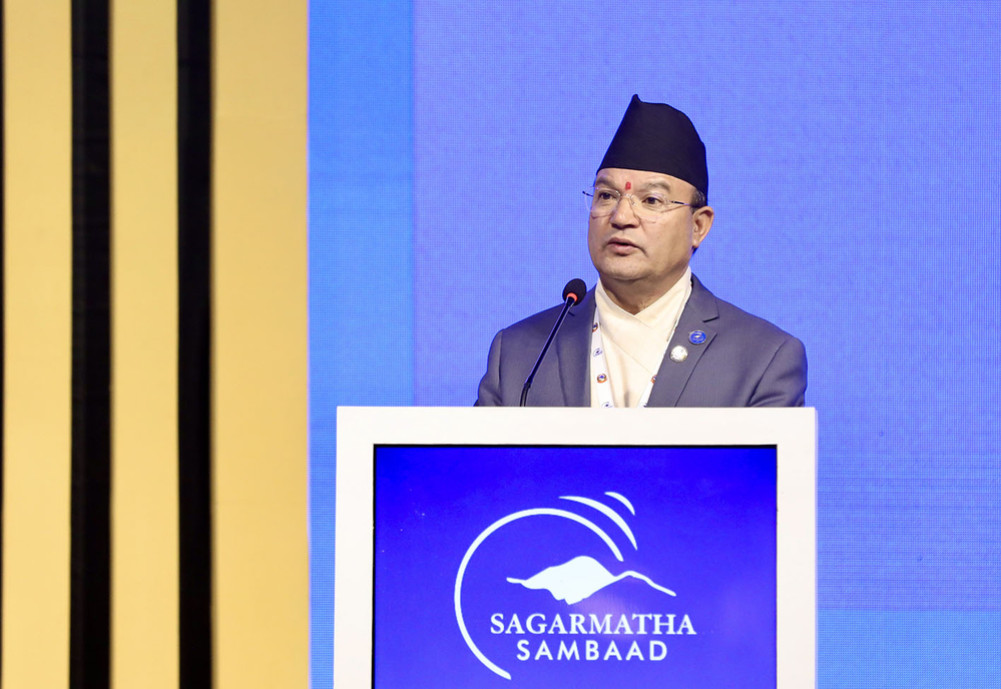
Forest and Environment Minister Ain Bahadur Shahi Thakuri has said that the Himalayas are not only magnificent but also essential climate regulators.
Speaking on behalf of Nepal at the plenary session held after the opening ceremony of the Everest Dialogue, Minister Shahi mentioned that the Himalayan region, including Nepal, is currently at the forefront of the rapidly growing climate crisis.
He said, 'The Himalayan landscape is changing before our eyes. Glaciers are receding. Circumstantial systems are changing. Traditional lifestyles are being reversed. This is not a local but global crisis.'
Nepal, which has eight of the 14 highest mountains in the world, is carrying the sacred responsibility of protecting these natural heritages.
According to him, from the Himalayas to the Andes, from the Alps to the Rockies, the world's mountains are in crisis. Noting that the risk exists from the highlands to the islands, he said, 'What starts in the mountains, gradually flows down to the lowlands and affects the river's influence zone, agricultural plains and even coastal climatic systems. In fact, the future of mankind is intertwined with the future of these mountains. Climate indicators are crossing danger lines. According to the World Meteorological Organization, 2024 was the hottest year in the past 175 years.
The sixth assessment report of the Intergovernmental Panel on Climate Change has confirmed that the temperature in the mountainous region is increasing twice as high as the world average.
Mentioning that these risks are particularly serious for Nepal, Minister Shahi said that the most vulnerable small farmers, women, tribal communities, Dalits, children and the elderly have to bear the burden. "While our contribution to carbon emissions is negligible, we are bearing the full brunt of a climate crisis we did not create. The cost of our socio-economic development is increasing. "Climate change has adversely affected development goals such as upgrading from the LDC group and achieving the level of a developed nation by 2043," he said.
Minister Shahi said, 'In 2023, Nepal's carbon dioxide emission per capita was only 0.57 tons, which is much lower than the world average of 6.76 tons. In addition, our forests, which cover about 46 percent of the land area, act as carbon absorbers and conservation sites for biological diversity.'
Despite the difficult challenges, Nepal is firm in climate leadership, he informed that Nepal has set the goal of net zero emissions by 2045. This goal is five years ahead of the global goal.
According to him, the cooperation of the world community is indispensable to achieve the climate goals. He said that the principles of common but differentiated responsibilities and related capacities should guide.
Minister Shahi said that the commitment to climate finance should be further increased in COP-30, saying that because of the rapid destruction of the glaciers, priority should be given to Himalayan countries like Nepal. He said, 'Addressing loss and damage is not charity, it is climate justice.'
Nepal should see the carbon market as an opportunity and it should be operated on the principles of fairness, environmental integrity and ensuring direct benefits to local communities, he said in conclusion, 'There is still a possibility to limit the global temperature to 1.5 degrees Celsius - but for that, collective, decisive and quick action is necessary.'