The bill was presented to Parliament on Wednesday with plans to pass it from the current session
We use Google Cloud Translation Services. Google requires we provide the following disclaimer relating to use of this service:
This service may contain translations powered by Google. Google disclaims all warranties related to the translations, expressed or implied, including any warranties of accuracy, reliability, and any implied warranties of merchantability, fitness for a particular purpose, and noninfringement.
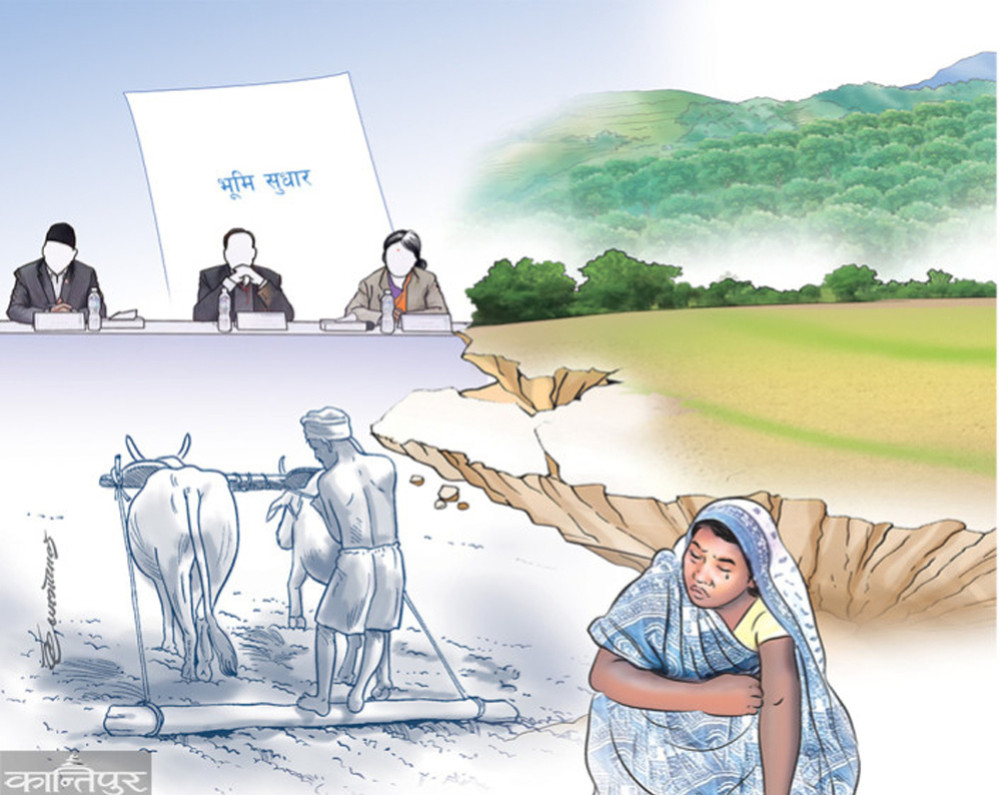
The government has introduced a land bill by including controversial issues such as increasing the misuse of public land and allowing the sale of excess land. Land Management, Cooperatives and Poverty Alleviation Minister Balram Adhikari presented the bill in Parliament on Wednesday with the plan to pass it from the current session.
By keeping the provisions in the Ordinance which became inactive without being accepted by the Parliament, the government has introduced a 'Bill to amend some Nepal Acts related to land'.
The land ordinance recommended by the government on December 29 was stopped by President Ramchandra Paudel for two days. He only issued the ordinance on January 2 after getting the government's promise to agree to the replacement bill. But the ordinance could not go ahead after the ruling party itself objected. Due to the fact that Parliament did not accept it, the Ordinance became inactive after 60 days according to the constitutional provisions.
In the bill registered in Parliament on 23 Baisakh, clause (c) of sub-section 4 of Section 52 'B' of the Land Act has been amended and a provision has been proposed that ``at the time of initial surveying, there will be no obstacle to providing land to squatters or unorganized residents if there is mention of gauchar, haat, haatghat or market in the regional survey book or in the register but the land that is not in use is recorded with the decision of the local executive. In the
bill, a restrictive phrase has been added to sub-section 2 of Section 3 'B' of the Forest Act, which states, "However, the land designated as a forest, forest area or Bhutanese area in the record will not be hindered from being re-mapping for once, separating it from the forest area and maintaining it in the name of the Government of Nepal." In which it is said, "However, while managing or protecting in this way, the land ownership of the local people in that area will not be affected, it will not be a hindrance to remap the land designated as forest, forest area or Bhutan area in the records and separate it from the forest area and update it under the name of the Government of Nepal."
Amending Section 12 'C' of the existing Act, the bill says, 'Despite anything written in this Act, a company that has obtained permission to do real estate business in accordance with Clause (E1) of Section 12, may sell the land within the limits set by the notified order by developing the land in accordance with the prevailing law and building a house or housing unit (apartment) in such a building.'
Exemption for sale and distribution by construction of housing is included in the bill. The government has made a new arrangement to allow the land purchased with permission before the classification of land use area to be sold with the approval of the ministry, including the land classified as residential area and commercial area. The existing law prohibits development of buildings by allocating land other than commercial and residential areas.
President of JSP Nepal Upendra Yadav commented that under the pressure of land mafia, the government kept the provisions of the ordinance in the bill. He said that he will strongly oppose the bill from both the street and the House front. The ordinance was not in the interest of the country and the people. That is why we protested. Now, the government has brought the bill with the same provisions for forest and land," said Yadav. "The government does not have good intentions in this."
Land Management, Cooperatives and Poverty Alleviation Minister Adhikari says that all three laws are going to be amended to manage landless Dalits, squatters and unorganized residents. The Land Act 2076 has said that people who have been living in settlements for a long time will be given land as claimants. Based on that, the bill has been brought," he says, "where does the bill talk about new forest cutting? You have to see that.'
Rights activist and activist Vishwas mentions that there is a tendency to raise the issue of Nepali land but not try to solve it and says that the same situation has arisen even now. "There are 1.1 million applications from landless Dalits, landless squatters and unorganized residents in the records of the National Land Commission," he says. He claims that the
bill will open the door to the land sale and distribution of 'Giribandhu T-Estate' if it becomes a law. Minister Adhikari claims that the bill has nothing to do with Giribandhu T-Estate. He says that the road is going to be opened only for some businessmen who have bought land with the permission of the government since 1974, but have not been able to make housing and sell it later.