We use Google Cloud Translation Services. Google requires we provide the following disclaimer relating to use of this service:
This service may contain translations powered by Google. Google disclaims all warranties related to the translations, expressed or implied, including any warranties of accuracy, reliability, and any implied warranties of merchantability, fitness for a particular purpose, and noninfringement.
Stakeholders have said that the implementation of federalism has not been effective due to the delay in law-making by the people's representatives of the union, state and local levels and the tendency to not measure whether or not the laws have been complied with.
On the one hand, they lamented that the three levels of the government have delayed in making laws, and why they have not been able to effectively implement the existing laws and have not taken any initiatives to improve them. Experts and parliamentarians were of the view that the state minister claimed ignorance about the bill submitted by the minister and that he does not know who will draft the law.
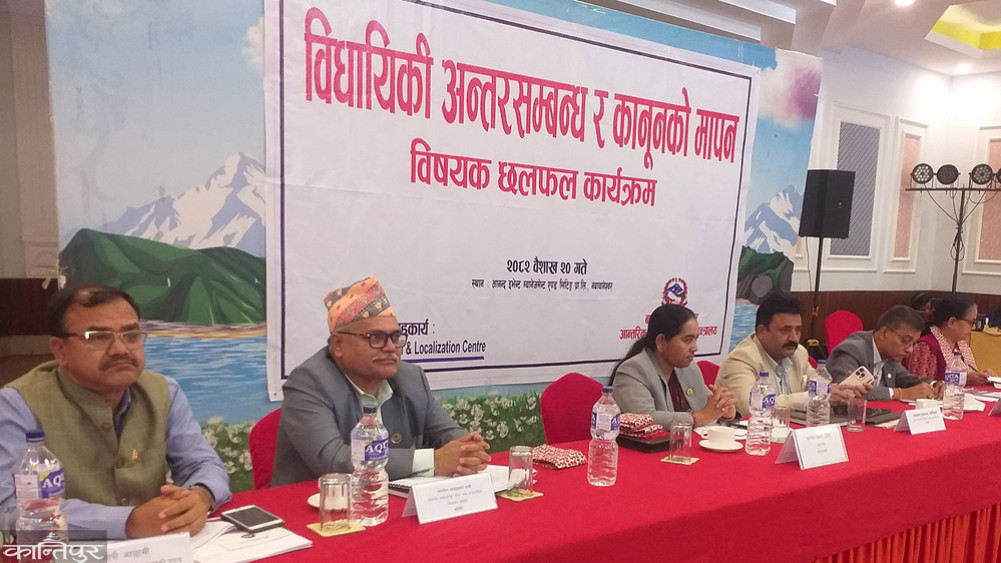
Bagmati Province Ministry of Internal Affairs and Law, organized by the Ministry of Internal Affairs and Law in Kathmandu on Saturday, the stakeholders participating in the program related to academic interaction and measurement of law, said that when the three levels of government create laws in their own way, when there is a problem in implementation, it affects the essence and spirit of federalism. The Deputy Speaker of the National Assembly, the Minister of Law of the Federal Ministry, the Federal Parliamentarians, the Minister of Internal Affairs and Law of Bagmati and Koshi Provinces, the State Parliamentarians, the Chief Secretary of Bagmati Province, the secretaries of the Union and State Ministries and the officials including the Secretaries of the Union and State Parliament Secretariat participated in the program. They questioned themselves saying that there is a tendency not to make laws and not to follow existing laws. They expressed concern over the increased tendency to resort to procedures and guidelines if there is a problem in implementing the law.
Since the constitution of 2072, 214 laws have been issued so far, 146 of which have completed 5 years. According to Section 36 of the Legislation Act, all laws that have completed 5 years should be measured. According to the provisions of the Legislation Act 2081 regarding the measurement of laws, it is mentioned that within one year of the commencement of each law, the relevant ministry must evaluate the state of implementation of the law. There is a provision to submit its report to the Federal Parliament.
Federalism expert Khimlal Devkota said that the Ministry of Law has not prepared the legal measures of the relevant ministries. He said that if there is no measure of the laws made and if the complexity of the implementation of the laws is not resolved, the proper implementation of federalism will not be possible. According to him, there were 359 laws before the new constitution, that is until 2059 Baisakh, but many of them have not been measured.
Vice President of the National Assembly, Vimala Ghimire, said that existing laws should be measured and new laws should be identified. She said that it is necessary to make a basic law for the implementation of the constitution. She said, 'It should be clear why any law is to be evaluated.' Revathiraman Bhandari, Minister of Internal Affairs and Law of Koshi Province, said that rather than measuring laws, there is an increased tendency to govern by procedure. He expressed dissatisfaction that only 62 laws, 26 regulations and 300 procedures were made in Koshi province. He said, "Governing by procedures is a wrong trend." He suggested that there should be an inter-connection 'Dex' in the state and union. He said that the fewer the laws, the better. He said that if some of the laws made by the local level are tested in the court, many mistakes will be found.
In an event held in collaboration with the Federalism and Localization Center, the Minister of Internal Affairs and Law of Bagmati Province, Surajchandra Lamichhane, expressed his displeasure that due to legal complications, the federal government has not been able to work smoothly. He said that the legal way has not been opened for the coordination between the three levels of government to practice federalism correctly.
He said that the powers of all three levels of government and their use should be clear, and there was no legislative interrelationship. He said that due to the lack of legal standards, even the laws that were made could not work in some cases. He said that it is necessary to coordinate the legislative powers between the federal government and the state government. Most of the speakers expressed the opinion that there is a lack of academic interrelationship and legal measurement in the implementation of federalism.
Secretary of the Federal Parliament Secretariat, Rosnath Pandey, said that the state and local levels have not been able to increase their capacity. He said that the government at all levels did not give priority to law making, and said that everyone should take care of the rights given by the constitution. He said that the question of who drafts the bill arises from time to time during law making. He said, "I have personally heard the complaint that the bill presented by the minister in the federal parliament was not seen by him." He submitted an example of how despite the guarantee of fundamental rights in the constitution, no one paid attention to making regulations for implementation.
On behalf of the local level, Rajendra Pyakurel, executive director of the National Federation of Rural Villages, said that some of the laws made by the province were not being used correctly by the local level. He said that the legislative practice at the local level is under the direct shadow of the executive, there is confusion in the process of submitting, discussing and passing the bill and the role of thematic committees is negligible. He said that the local level did not give importance to the legislative practice. On behalf of the federation, he said, 'Just like the federation helped in the operation of the provincial assembly, the province should support the local level. The interrelationship of the legislature at the level is seen to be weak.'
MPs of Union and State Assembly and local people's representatives expressed their opinion about the complications seen in law making and implementation. Parliamentarians of Bagmati state said that it was difficult to make laws because the state assembly meeting was not held. Commenting on the issues raised in the
program, former Secretary General of the Federal Parliament Bharatraj Gautam said that research is necessary to measure the law for the effective implementation of the law. He said that the drafting of the law should be done by a person who has read the law and said that human resources will be needed for this. He said that it is necessary to increase the capacity of the stakeholders for the creation of laws.
The presidents of the municipality said that it was difficult to make and implement laws because the area of single rights was not clear. They said that the laws made by the union are beyond the authority of the local government. In the
program, Federal Government's Minister of Law, Justice and Parliamentary Affairs, Ajay Kumar Chaurasia, said that the ministry has started the process for measuring the law. He said that federalism will be strengthened only by coordination between the three levels of government. He said that the three levels of rights are defined by the constitution so everyone can make laws according to their needs.