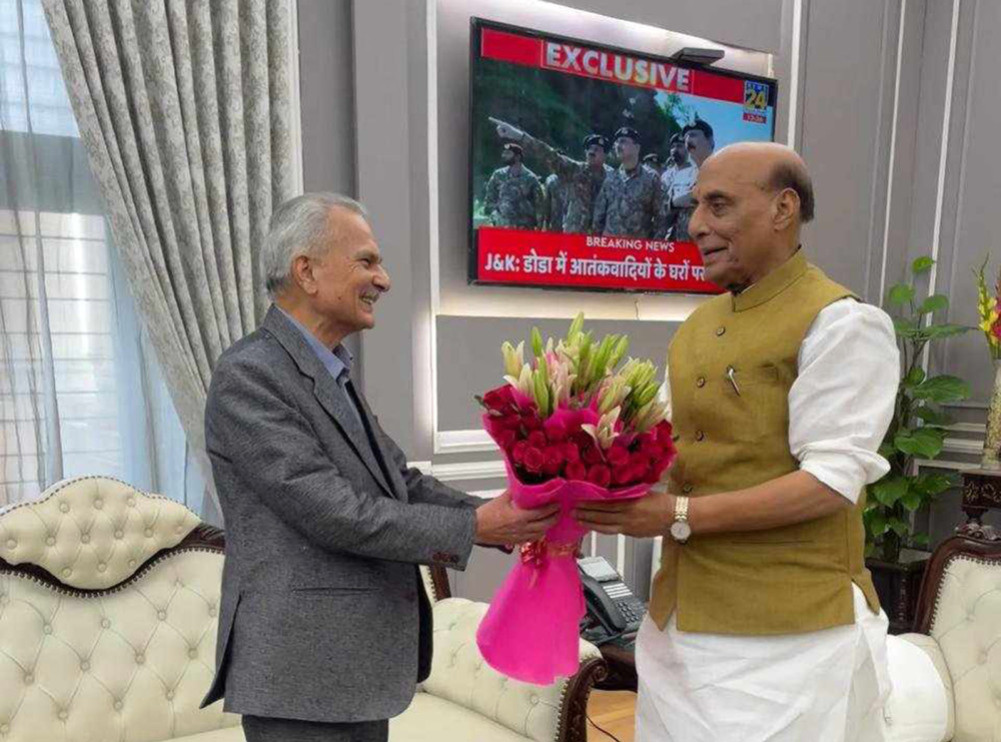
Meeting with BJP leader and Defense Minister Rajnath Singh, former Chief Minister of Uttarakhand and BJP leader Bhagat Singh Kosiari, Congress leader Jairam Ramesh, Janata Dal United leader KC Tyagi, Bahujan Samajwadi Party national spokesperson Sudhindra Bhadauria and former ambassadors to Nepal
We use Google Cloud Translation Services. Google requires we provide the following disclaimer relating to use of this service:
This service may contain translations powered by Google. Google disclaims all warranties related to the translations, expressed or implied, including any warranties of accuracy, reliability, and any implied warranties of merchantability, fitness for a particular purpose, and noninfringement.
Former Prime Minister and Chairman of Nepal Samajwadi Party (New Shakti) Baburam Bhattarai, who is in New Delhi during his unofficial visit, has intensified political and diplomatic meetings. He went to Delhi with his daughter Manushi Yami Bhattarai and met with Indian leaders and diplomats.
Manushi said that the Indian leader was interested in the political situation in Nepal during the meeting. Why is there political instability in Nepal? They were curious as to why the alliance between the major political parties is changing,” said Manushi.
Bhattarai, who reached Delhi on Saturday to inaugurate the conference of Progressive Nepal Society of NESP (New Power), met with Bharatiya Janata Party (BJP) leader and Defense Minister Rajnath Singh on Monday. Manushi informed that during the meeting, the relations of the two countries, economic matters and other issues were discussed. "I had a conversation with Defense Minister Singh about Nepal-India relations as well as development and economic matters," she said, "and exchanged views on development and economic growth by strengthening the relationship between the two countries."
In the meeting with Singh, Bhattarai requested to complete the project in Nepal with the help of India within the stipulated time. Singh asked for suggestions on the assistance to be given by the Government of India. What is the status of projects in Nepal that started with our help? What do we have to do?'' was the question of India's Defense Minister Singh. Manushi informed that Bhattarai emphasized on economic growth. In the meeting that took place for about half an hour at Singh's residence, it was said that strengthening the diplomatic relations between the two countries would be beneficial to both sides.
Bhattarai also met Janata Dal United leader KC Tyagi, Bahujan Samajwadi Party national spokesperson Sudhindra Bhadauria, former Uttarakhand Chief Minister and BJP leader Bhagat Singh Kosiari on Monday. Bhattarai also met opposition Congress MP and former minister Jairam Ramesh. Bhattarai told that Kosiyari raised the issue of Hindu state. I can have my own views on religion and culture. Holding Hindu views is a matter of faith. "Monarchy is an anti-democratic system," said Bhattarai. On Saturday, he met the former president of the Bharatiya Janata Party (BJP) Murlim Manohar Joshi.
India's former ambassador to Nepal, Bhattarai has also discussed with professors who are interested in Nepal. On Monday, former Indian ambassadors to Nepal Shyam Sharan, Rakesh Sood, Ranjit Ray, Manjeev Singh Puri and foreign experts Prof. SD Mooney, Prof. Had an informal meeting with Amitabh Mattu and senior media person Bharat Bhushan. According to Manushi, in the meeting, the former ambassadors expressed their views on the improvement of Nepal-India relations.
While informing about the meeting held in Delhi, Bhattarai said that India is not in favor of making the EPG report public. "Currently, there is some coldness in Nepal-India relations. Indian politicians, diplomats and foreign experts were curious about how to solve it. Defense Minister Rajnath Singh was also interested in how the problem can be solved between the two countries," he said. BJP leaders say that it is not possible to proceed through the EPG report.
Indian leaders are interested in Nepal's political instability: Baburam Bhattarai, Nepal Samajwadi (New Power), President
Political and diplomatic meetings have been intensified in Delhi, what was the conversation? I have come to Delhi for the convention of Progressive Nepali Society of
party. Political and diplomatic meetings were held on Monday. What is the reason for Nepal's political instability seen in politicians and diplomats here? Are you going to go against democracy? It is a curiosity. I said that some instability was observed not against the Federal Democratic Republic, but especially due to errors in the electoral system and government system. Also, I was of the opinion that there is some dissatisfaction among the common people, that should be addressed.
What do you think of the Indian leader about the political situation in Nepal?
There is a suspicion that questions are about to arise about the democratic republic system in Nepal. I made it clear that the anger in Nepal was not about dismantling the old system, but about good governance and economic issues. I emphasized on the need to improve the current system and move forward. India's ex-ambassadors to Nepal, foreign experts had a good review of the relationship between the two countries. They have a deep interest in Nepal.
It is said that the Indian leader is also interested in the Hindu nation.
BJP's Muralimanohar Joshi, Bhagatsingh Koshiyari were interested in whether cultural uniformity in Nepal would be good. But I have my own views on religion and culture. Holding Hindu views is a matter of faith. I emphasized that monarchy is an anti-democratic system, it is not possible to come to Nepal.
What happened to the relationship between the two countries? There is some cooling in the
relationship. Everyone was interested in how to address it. Defense Minister Rajnath Singh openly talked about this. I emphasized that the Prime Ministers of the two countries should have a clear dialogue and solve the problem.
In the discussion with the BJP leader, I suggested that it would be better to proceed based on the EPG report, but the BJP leaders said that it is not possible to proceed through the EPG report. It is their understanding that this report is not for implementation. If that is the case, then everyone was focused on resolving issues such as the border issue between Nepal and India and the 1950 treaty through open dialogue at the Prime Minister's level at the diplomatic level.