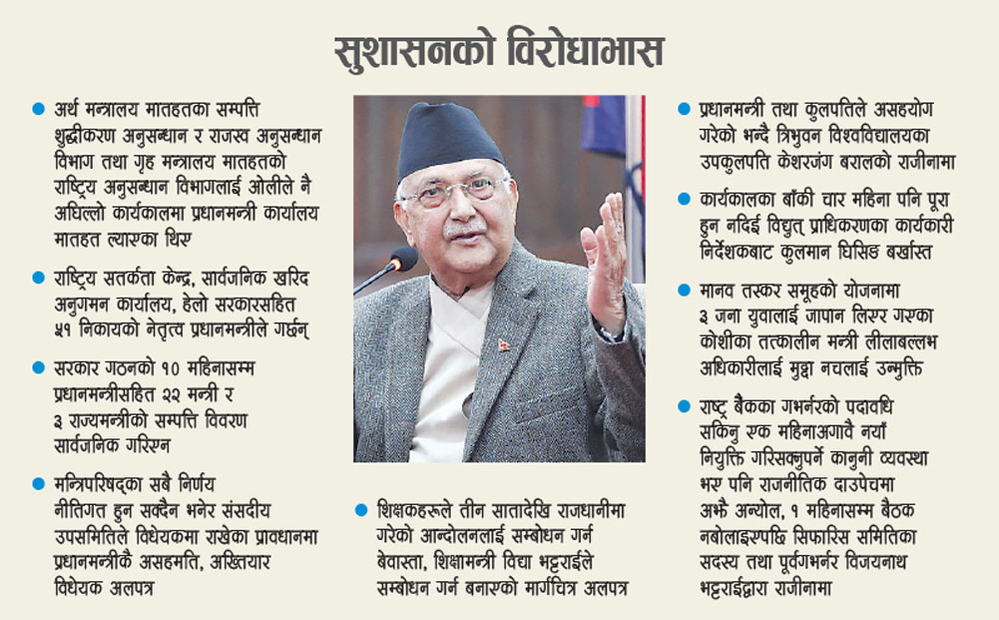
The Prime Minister, who did not even disclose the property details for 10 months after the formation of the government, took a group of 15 ministers and formed the Good Governance Commission under his own leadership.
We use Google Cloud Translation Services. Google requires we provide the following disclaimer relating to use of this service:
This service may contain translations powered by Google. Google disclaims all warranties related to the translations, expressed or implied, including any warranties of accuracy, reliability, and any implied warranties of merchantability, fitness for a particular purpose, and noninfringement.
Instead of making the powerful bodies under the Prime Minister and Council of Ministers active and responsible to maintain good governance by controlling corruption and corruption, the government has formed a new mechanism under the leadership of the Prime Minister.
Monday's cabinet meeting formed a 15-member governance commission under the leadership of Prime Minister KP Sharma Oli, including the ministers of finance, home, law and federal affairs.
The main backbone of good governance is people-oriented administration, accountability, transparency, rule of law, corruption-free society, agile administration, financial discipline and good governance. But the most complicated question of the citizens about the coalition government of the two big parties Congress-UML is about them.
Saying that corruption is the main obstacle to good governance, political circles and civil society are raising voices that a powerful commission should be formed to investigate the assets of people holding public positions. Instead of addressing such voices, Prime Minister Oli formed the Good Governance Commission under his own leadership.
None of the members of the Council of Ministers, including the Prime Minister, who decided to form a separate commission with the aim of maintaining good governance, have yet made public their assets. The details of the assets submitted to the office of the Prime Minister and Council of Ministers are kept confidential.
There are also some young people who are expected in the cabinet, but they have not dared to publicize the property details themselves, nor have they pressured the Prime Minister. As the Prime Minister and Ministers are under the scrutiny of the common citizens, it is already a practice to make the property details public after taking a decision from the Council of Ministers.
The Girija Prasad Koirala-led government formed after the election in 2004 established a tradition of making public the property details of the prime minister and ministers within 15 days of their inauguration. In 074, the Council of Ministers led by Oli also decided to publish the property details of the prime minister and ministers. The then Foreign Minister Pradeep Gyawali had made public the property details even after leaving the post.
In 079, members of the government led by Maoist Chairman Pushpa Kamal Dahal also released the property details. At that time, the RSVP ministers had put pressure on the Prime Minister in writing to make the property details public. This time, Oli has been showing reluctance to disclose his and the members of the cabinet's property details even though the general public and the media have been constantly warning.
Because of Prime Minister Oli, the amendment bill of the Abuse of Authority Investigation Commission has been stalled for a long time. The report of the bill prepared unanimously by the sub-committee headed by Hridayram Thani under the State Order and Good Governance Committee has been stuck since last January. Oli and Congress president Sher Bahadur Deuba disagreed on the definition of political corruption added by the sub-committee, so the bill could not move forward. With the conclusion that corruption has increased in the name of policy decisions, the sub-committee added a provision in the bill that all decisions made by the Council of Ministers cannot be policy decisions.
Although the posts in the constitutional commissions are becoming vacant, the appointment process has been stalled for a long time. Thirteen posts are vacant in various constitutional commissions including the Election Commission.
According to the law, the leadership of the Rashtra Bank must be selected one month before the incumbent governor retires. But two weeks after the retirement of Mahaprasad Adhikari from the post of governor, the tussle between the ruling Congress and the UML is going on for new appointments. The government which formed the Good Governance Commission had amended the procedure regarding the age limit of 65 years to make a certain person the governor. Even after it was overturned by the Supreme Court, the practice continues.
The teachers have been on street protests for three weeks. Due to their strike, the admission drive for the new academic session is affected. SEE answer book test has not started yet. The class 12 exam itself had to be postponed. But Prime Minister Oli has been showing reluctance to listen to the teachers and find a solution.
Education Minister Vidya Bhattarai resigned on Monday due to non-cooperation of the Prime Minister. Tribhuvan University Vice-Chancellor Kesharjang Baral resigned on March 15, citing political interference in an autonomous sector like the university. Last month, the government removed Kulman Ghising as the executive director of the electricity authority without allowing him to complete his tenure of about four months.
The government has kept the reports of several commissions related to impunity and good governance hidden. There is a clamor to form a commission of inquiry into the murders, arson, vandalism and looting that took place during the demonstrations held by Rajawadi in Tinkune area on 15 March, but the government has been rejecting it.
Khemraj Regmi, former administrator and former president of Transparency International Nepal, says that due to the government's actions like this, we cannot be confident that good governance will be maintained even with the formation of the commission. He commented that instead of increasing the autonomy, impartiality and effectiveness of public institutions and bodies working in the field of good governance and making them responsible, by forming a commission under his leadership, the Prime Minister reminded the 'Daudaha team' of the Panchayat period.
'During the Panchayat period, a task force was formed to inspect whether the employees have worked properly and to take action from place to place. Now the commission has been formed to give a glimpse of that," he says, "while the government has not been able to appoint a governor for months, ministers cannot meet the prime minister, they have to wait for hours, due to political interference in autonomous areas like universities, the vice-chancellor is forced to resign, employees are changed every three months in areas and institutions that benefit financially, and can we hope for good governance with such a political leadership?"
There are dozens of mechanisms related to corruption control and good governance. Most of the powerful bodies are under the office of the Prime Minister and the Council of Ministers. Regmi says that the creation of a commission to exercise parallel power for the work done by this mechanism has increased distrust in the state mechanism.
Former chief election commissioner and analyst Bhojraj Pokharel says that although the practice of forming commissions has been in place since 2048, such commissions have not become effective and reliable.
'Administrative Reforms Commission was formed under the leadership of then Prime Minister Girija Prasad Koirala. Even after that, commissions have been formed from time to time," he says, "At this time, they should have been able to win the hearts of the people by making some decisions. There are dozens of agencies when there is a will to work. There is a good governance law, it has clearly arranged what to do, when to do it, and what will happen if it is not done.'
Former administrator Pokharel says that since corruption is the biggest obstacle to good governance, the first priority of the government should be to focus on corruption control. There are also big scandals in corruption, in which common citizens have suspected that the leadership level is involved. The authority should be asked to investigate such cases immediately, only if that happens, good governance will be maintained," he says. "The current political leadership has been accused of taking the leadership of corruption in the name of policy decisions. It would have been a good message if the Prime Minister would have helped to move the bill on authority in the parliamentary committee with more powers.'
Former Chief Justice Sushila Karki mentions that the main challenge in maintaining good governance is corruption control and says that such work cannot be expected from the current leadership.
He says that when the powerful agencies of the state are used as a means to take revenge on those who are against them, the credibility of the political leadership is questioned. "The government itself has confirmed that establishing a commission does not mean giving good governance, because the main task of the government is to maintain good governance," she says.
Oli had brought the powerful departments and agencies of the state under him within a week of becoming the Prime Minister for the second time on February 3, 2074. At that time, the Revenue Investigation and Money Laundering Investigation Department under the Ministry of Finance and the National Investigation Department under the Ministry of Home Affairs were brought under the Prime Minister's Office. Currently, the number of agencies and institutions headed by the Prime Minister is 51. Even now these mechanisms are directly under the Prime Minister.
The Money Laundering Investigation Department is a powerful agency that monitors and takes necessary action against ill-gotten wealth. But it has been accused of making weapons for political maneuvers. Since the department is unable to work autonomously, Nepal has been placed on the 'grey list' by international bodies. The Revenue Investigation Department, which has the main responsibility of stopping revenue leakage, is also under the Prime Minister.
Another agency under the direct supervision of the Prime Minister is the National Vigilance Center, which is headed by the Prime Minister himself. In its organizational structure, the Prime Minister is followed by the Secretary. Its main purpose is to collect complaints related to irregularities, delays and corruption from public bodies and take action.
It is also responsible for regulating, monitoring and giving suggestions, instructions, and monitoring the assets and income of people holding public positions to make the service provided by public bodies effective. The National Vigilance Center is under the jurisdiction of maintaining the quality in the development plan and completing the specified time, cost and quality work, technical testing.
Former administrator Regmi's analysis is that the indifferent government has only created a commission to make the mechanism effective and responsible for spending large resources of the state. Regmi also commented that the prime minister has made his advisers and associates a means of collecting money without making the agencies under him accountable and responsible.
"During Oli's time, the powerful agencies of the state were brought under the Prime Minister, but he could not do anything that would give results," he said, "The DG (Director General) was changed in three months." The prime minister did not initiate the work of setting any standards. There was a transfer panic in three/three months in the area of financial gain. How can you trust such a commission when the first investigation of Bethiti should be in the leadership line?'
The prime minister also leads various universities, institutions, councils, committees, commissions, boards and funds. Within the office of the Prime Minister and the Council of Ministers, there are various branches and divisions related to good governance. Such as: Government Reform Division under the leadership of Joint Secretary, Good Governance, Corruption Control and Employee Support Division under the leadership of Deputy Secretary, Hello Government under the leadership of Deputy Secretary, Asset Laundering and Revenue Investigation Branch, Problem Solving and Disaster Division under the leadership of Deputy Secretary. Even his work is not effective. Instead, such branches and divisions have become a place to keep employees who do not have political coordination.
Monday's cabinet meeting constituted a 15-member good governance commission under the leadership of Prime Minister KP Sharma Oli, including the ministers of finance, home, law and federal affairs. While 22 ministers including the prime minister (the resignation of the education minister) and 3 state ministers have not yet disclosed their property details.
The local mechanisms of the state, the investigation, prosecution of any crime or matter and the provision of services linked to the daily life of the citizens are innumerable mechanisms to make it agile and efficient.
The Paradox of Good Governance
 Corruption is considered to be the biggest obstacle to good governance. How do you see the work of the government in the direction of controlling corruption?
Providing fast services to the people, maintaining peace and security, controlling corruption, getting compensation for people who have been wronged, getting jobs, and getting food are all part of good governance. Corruption control is the main thing. The powerful bodies under the Prime Minister were not made responsible but confused by the formation of the commission.
The leadership also used the bodies that maintain good governance according to their interests. Those who came against him were thoroughly punished. Billions of dollars were looted in the cooperative. Bank issues came up. People's money has been stolen. Even in that only those who were against him were prosecuted, and he protected those close to him. How can there be good governance if the state agencies are not allowed to work impartially?
Has the Prime Minister talked about zero tolerance for corruption?
Those who have committed corruption will be prosecuted, those who are corrupt are being appointed to big political positions. The current leadership is not even in favor of being ashamed. There is no one who knows and is stronger than you. When political leadership is only needed for its own development, the system itself has deteriorated. Corruption is not controlled, it has increased. The corrupt have an opportunity. As long as there is such a trend, no matter how many commissions are formed, nothing will happen.
How do you see the work of the powerful agencies of the state in terms of corruption control?
There is no need to talk about good governance. The main responsibility of the government is to maintain good governance. Isn't it supposed to work in the field of good governance as soon as the government is formed?
How confident are you that the political leadership will maintain good governance now?
It has been shown that the formation of the Good Governance Commission means that there will be no good governance since the formation of the government. It is the government's responsibility to fulfill good governance. It is not surprising that the government has formed a commission to maintain good governance in my country.

