We use Google Cloud Translation Services. Google requires we provide the following disclaimer relating to use of this service:
This service may contain translations powered by Google. Google disclaims all warranties related to the translations, expressed or implied, including any warranties of accuracy, reliability, and any implied warranties of merchantability, fitness for a particular purpose, and noninfringement.
Defense on behalf of 52 constitutional officials, who were made defendants, has begun after the arguments on behalf of the attorney general's office ended on the third day in the Supreme Court against the appointment made to the constitutional bodies by the controversial ordinance.
On Tuesday, Deputy Attorneys General Tek Bahadur Ghimire and Lokraj Parajuli and Associate Attorneys Govind Khanal and Vivek Baral finished their arguments before the lunch time started.
The main claim raised by the writ petitioner was that the then Prime Minister KP Sharma Oli had amended the quorum and skipped the parliamentary hearing in order to get away with the ordinance - the recommendation made by the meeting without notifying the Speaker of the Constitutional Council is unconstitutional. In Tuesday's debate, the judges denied these allegations. They argued that since the ordinance was issued and recommended by the Constitutional Council, the appointment cannot be said otherwise.
The writ petitioners argue that there should be a parliamentary hearing according to Article 192, but the hearing is according to the federal law. Co-judge Govind Khanal said, "The federal law is also a regulation related to the operation of the joint house, which is the same as the law. The same regulation says that if the hearing is not held within 45 days, the recommendation will be approved and the appointment has been made accordingly, so it cannot be said." Senior Advocate Sushil Panth and Advocates Yadav Prasad Dhungana and Sagar Paudel argued on behalf of Chief Commissioner Prem Rai, Commissioner Kishore Silwal and Election Commission Commissioner Ram Prasad Bhandari.
They claimed that all the writs filed against them should be dismissed as they were appointed according to the provisions of the constitution. Senior advocate Pant's argument was that - in order to keep the constitutional organs alive, the appointments were made by bringing ordinances as per the demand of the immediate situation.
'If there is no appointment in the constitutional organs for a long time, the lifeblood of the state will be blocked' he said, 'there may be no parliament, there is a situation where it has not worked for 6-6 months, in such a case, why not make an appointment?'
His argument was that since appointments should be made even at such a time, it cannot be said that it violates the constitution. He claimed that the writ petition should be dismissed as it cannot be said to be illegal.
Now more than a hundred advocates of the remaining 49 constitutional body officials who have been made the opposition have yet to debate . Even if we continue to debate like this at the rate of four people a day, it will take at least a month. Chief Justice Prakashman Singh Raut will go on a foreign tour after Wednesday's hearing and is scheduled to return on Baisakh 23, so the next hearing will be held at least after Baisakh 24. Even after that, if there is a continuous hearing and the debate continues in this situation, the final decision of this case, which was heard after four years, will come in the last week of May .
'When will the next hearing be held, your honor will say after Wednesday's hearing' said Nirajan Pandey, Assistant Spokesperson of the Supreme Court. Earlier, the lawyers had argued that the court cannot give a decision in the case where the case has already ended.
'The ordinances that made the appointments are not alive today, the court cannot say whether the ordinance that is not alive was right or wrong' Deputy Attorney General Sanjivraj Regmi said in Monday's debate, 'There are dozens of such decisions and precedents made by the Supreme Court itself in which it is said that there is no need to make a decision about the context and situation that has ended, that precedent is definitely applicable in this case too.'
According to the principle of criminal justice, as the court does not give a decision about any crime committed by a dead person and the case is dismissed, in the same way, the court does not issue any injunction in the case of a dead person . Attorney General Ramesh Badal, who defended the Ordinance while continuing the debate on the third day of the hearing, also made the same argument.
'Even though the ordinance is dead, the person appointed by the ordinance is alive, what do you say to that?' Judge Sapna Pradhan Malla countered after Deputy Attorney General Regmi also asserted the same. After that, after a moment of confusion, Regmi replied, 'It is a fact, sir, the legal persons are still alive and in office, but this question is not about them, it is about the ordinance that appointed them, which does not exist today.' He maintained that there is no logic in saying that an appointment cannot be made through an ordinance since the ordinance and the law have the same status.
According to the rules of the parliament, if there is no hearing within 45 days, the recommendation of the constitutional council will be implemented automatically, he argued that the government has brought ordinances and made appointments according to the principle of necessity, saying that the provisions of the constitutional council have helped to keep the constitutional organs alive .
Justice Suryaraj Dahal also argued the same before Regmi . He insisted that since the Parliament has made a rule that if there is no hearing from the Parliamentary Hearing Committee within 45 days, the recommendation will proceed, so the appointment made according to that cannot be said otherwise.
'If the work done by the government does not exist now, there cannot be a judicial trial on it' Dahal's argument was, 'The court cannot speak about what will happen in the future so as not to do so in the future.'
In that case, the Constitutional Court said - 'The court will decide only the disputed matter before it, the matter that was said to be disputed at the time of the application by the petitioners has been resolved through the political process and the developed new constitutional system, and it cannot be justified and desirable for the court to speak of the situation as if the matter has been resolved again in a situation where it is not a matter of dispute.'
Dahal After reading it, he recited it to the bench. Before that, Badal argued that since the case has already ended, the writ cannot be issued without the death decree.
He also argued that since Chief Justice Prakashman Singh Raut, who is leading the constitutional bench, is the undisputed successor of then Chief Justice Cholendra Samsher Jabra, he cannot speak or decide against this case. He also insisted that Raut cannot sit on the constitutional bench to hear the case.
After Badal, Dahal and Regmi, another Deputy Attorney General Gopal Prasad Rizal argued for 35 minutes and the time of the bench was over. Rizal also reiterated the arguments raised by his previous colleagues and demanded the dismissal of the writ saying that the appointments were made to avoid leaving the constitutional organs vacant according to the principle of necessity .
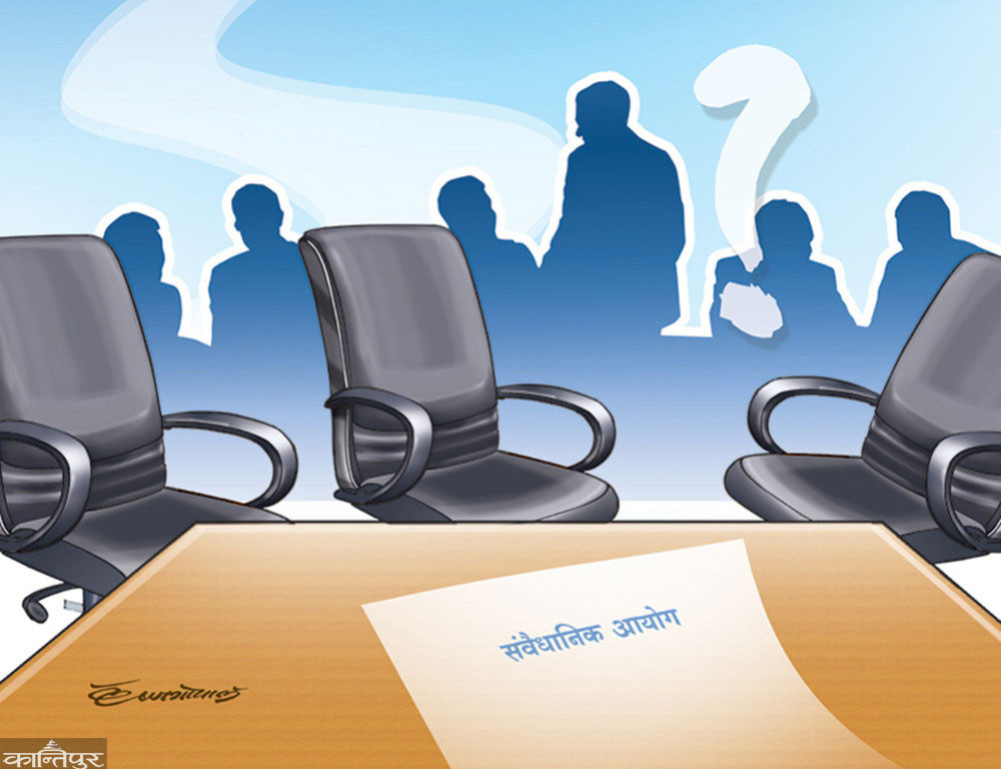
The then Prime Minister KP Sharma Oli brought two ordinances and recommended the appointment of 52 officials in 13 constitutional bodies through the Constitutional Council. As there is a constitutional provision that the presence of 5 out of 6 members of the council constitutes a quorum and the decision of 4 out of the quorum is a majority, then the leader of the main opposition party Sher Bahadur Deuba and Speaker Agni Sapkota boycotted the meeting. The Oli-led government brought an ordinance and recommended that the presence of the majority of members, including the chairman, be a quorum.
Prime Minister Oli, who is also the chairman of the council, the then Chief Justice Cholendra Shamsher Jabara and the then Speaker of the National Assembly Ganesh Prasad Timilsina recommended the appointment to the Constitutional Council. In this way, 15 writs were filed in the Supreme Court stating that constitutional appointments cannot be made on the basis of ordinances. After four years, the hearing has been going on continuously since Sunday.