Locals are worried about the ugly appearance of the forest in Tinjure-Milke-Jalajle area
We use Google Cloud Translation Services. Google requires we provide the following disclaimer relating to use of this service:
This service may contain translations powered by Google. Google disclaims all warranties related to the translations, expressed or implied, including any warranties of accuracy, reliability, and any implied warranties of merchantability, fitness for a particular purpose, and noninfringement.
While the Koshi state government was inaugurating the 'Tourism Year' from Tinjure-Milke-Jalaj area last Wednesday, the locals were worried about the ugly appearance of the forest. In this season, this hill, which is infested with crows, was rough this year.
72-year-old local Gyan Bahadur Karki, who was met at the venue, was visibly disappointed in his eyes.
"I am very worried about seeing this kharang this time, this Pakho, who has seen ratamya guras for years," he said, "those who are worried are not taking it, what am I going to do with my hands on the palate ?" No .' He said that this problem may have come due to lack of water.
This estimate is consistent with the experience of another elderly Weg Bahadur Gajmer . "Not even a single drop of rain has fallen since last month," said Gajmer, "Earlier it used to rain and the forest would be covered with grass in time." "This time it was neither cold, nor rained, nor did the gurans flower," Gajmer said in frustration, "Why is this happening, who will worry about the gurans?"
The forest in this area has worried many people this year when it is devoid of trees. Botanist Kamal Maden claims that not only because of the weather, human negligence is also at the root of this problem.
There are natural reasons such as lack of rain for the non-blooming of grasses, but recently the concrete structures built randomly in the forest area in the name of tourism promotion have also started to have a serious impact, said Maden .
Paved roads have been built in the area of Tinjure. According to him, the change from the permanent structure is harmful for sensitive plants like grass.
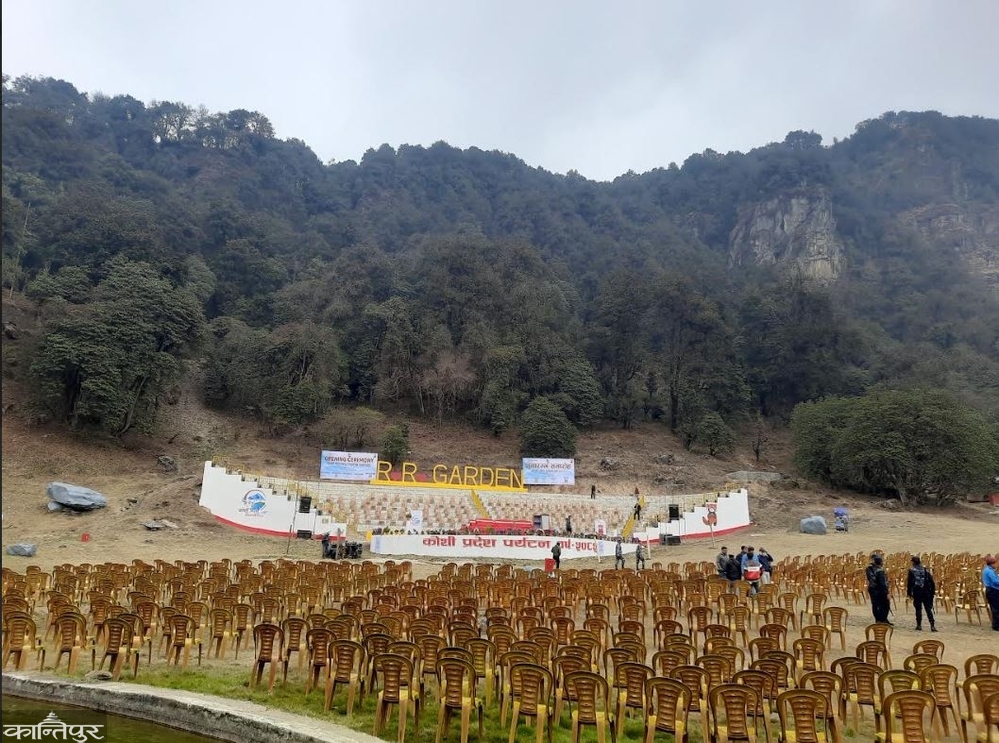
'Especially the forest area should be left as it is,' Maden says, 'In the name of development, concrete has been laid, pavements have been paved, which has a direct effect on the balance of soil, water and air and it affects the vegetation.'
"It is not often seen that the forest is not covered by gurans", Laliguras expert Dr. Keshavraj Rajbhandari expressed his concern, 'It is strange that gurans don't bloom even in the season.'
According to him, gurans should usually bloom around January and February. Dr. Rajbhandari added, "But I was surprised to hear that it didn't bloom this time." I think this problem must have arisen because of the lack of rain.'
According to him, the possibility that the Gurans flower blooms prematurely may be the effect of climate change. But not blooming at all is a problem associated with severe lack of moisture . "If it doesn't rain for a long time, the soil becomes dry, a cold environment is not created, which makes it impossible for the grass to bloom," he clarified.
Especially in the forests of 2,200 meters to 2,700 meters above sea level, gourd should bloom . But this year there are no flowers. "Either below 2,200 meters, or above 2,700 meters, it was heard to bloom only", says Rajbhandari, "this is a clear sign of environmental imbalance ." If not serious about this in time, the problem may become more complicated. Which may even destroy the existence of our national flower.'
Nepal Gurans is one of the countries rich in biological diversity. So far, 1,157 species of birds have been found worldwide, of which only 33 species are found in Nepal.
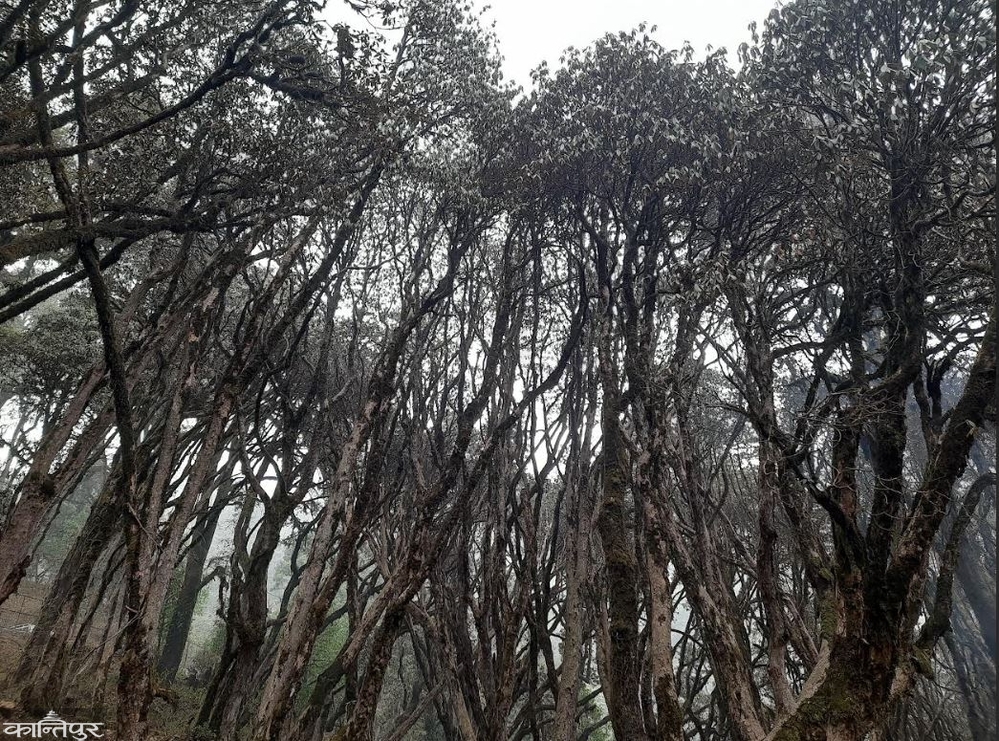
botanist Keshavraj Rajbhandari and foreign writer Mark F. According to the book "Rhododendron of Nepal" published in collaboration with Watson, 33 species of rhododendrons have been found in Kanchenjunga conservation area and surrounding areas.
Gurans are found in the central and high hilly and mountainous regions of 43 districts from the eastern part of Nepal to the far west. According to the data of forest experts, there is presence of deer in about 10 percent of the total forest area of the country.
Apart from Nepal, Gurans are found in China, India, Bhutan, Myanmar, Vietnam, Malaysia, Indonesia, Philippines, North Korea, South Korea, Japan and Australia.

