For 17 years, the government has been collecting pollution charges at the rate of Rs 1.50 paisa per liter for the sale of petrol and diesel, but the government does not have the records of the expenditure.
We use Google Cloud Translation Services. Google requires we provide the following disclaimer relating to use of this service:
This service may contain translations powered by Google. Google disclaims all warranties related to the translations, expressed or implied, including any warranties of accuracy, reliability, and any implied warranties of merchantability, fitness for a particular purpose, and noninfringement.
Last Tuesday and Friday, Kathmandu Valley ranked first in the list of the world's most polluted cities. Every day last week, Kathmandu remained at the top of the list of polluted cities, but the government did not take any initiative to control it. Whereas for the last 17 years, for the sale of petrol and diesel, pollution charges have been levied at the rate of 50 paisa per litre. So far, 25 billion 396 million has been collected from consumers. The government itself is unaware of where this budget will go and how it will be spent.
The concept of collecting pollution tax at the rate of 50 paise per liter on sale of petrol and diesel started from 2065/66. According to the economic law to be brought by the Ministry of Finance along with the budget, this fee will be collected," said Nagendra Sah, Deputy Executive Director of Nepal Oil Corporation. It has been collected at the rate of 1 rupee 50 paisa per liter since four years. So far, 25 billion 39 million 66 million have been collected.'
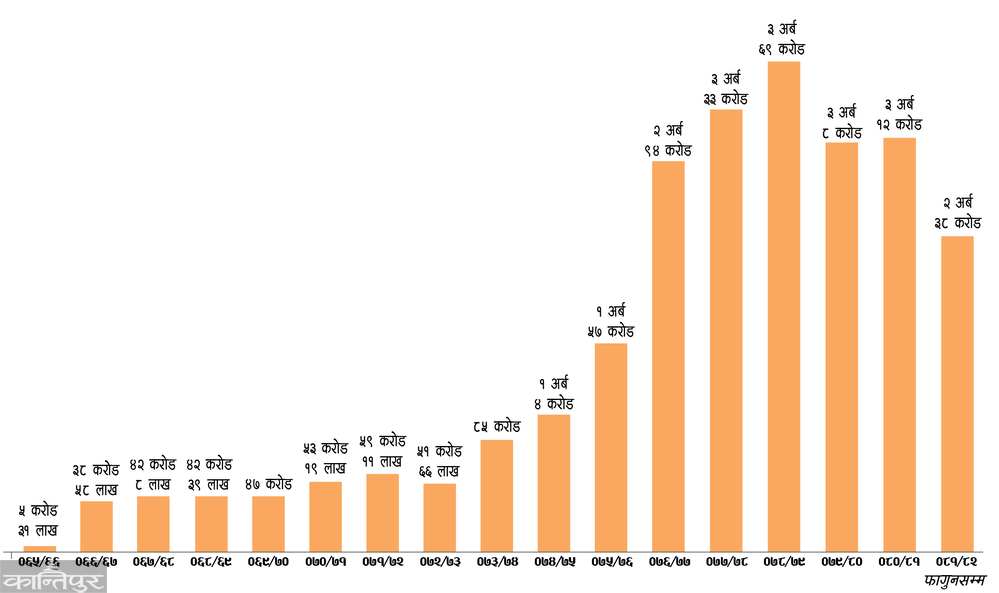
The corporation deposits the amount raised for the pollution fee in the account of the Ministry of Finance on the 25th of every month. But the corporation does not know where the money will be spent. "After depositing in the account of the Ministry of Finance, our responsibility is over. The corporation does not know what the money will be spent on, how it will be spent," said Shah. According to the corporation, the concept is that the amount collected in the name of pollution will be spent by the Ministry of Forests and Environment by creating a program. But the Ministry of Forestry and Environment does not get the amount collected from the public in the name of pollution control, the Ministry of Finance is spending it elsewhere.
Ministry of Finance spokesperson Shyam Prasad Bhandari said that the pollution fee will be deposited in the federal government's main fund. He clarified that the funds will not be spent only for pollution control. A pollution charge is a program designed to protect the environment. The aim is to create a pollution fund by raising money from the general public and control pollution by making a program out of it. Taking money to remove pollution but not spending it according to the purpose of the program is not financial discipline," said air quality expert Bhupendra Das. Where and in what areas was the pollution fee spent? The government should make it public.'
According to him, transportation vehicles that run on petroleum are among the main sources of pollution. To contribute to environmental protection, a fee has been charged from petrol and diesel. The corporation sells petrol and diesel at the pump by adding a duty while determining the retail sale price. The petrol pump charges from the general public.
The Ministry of Finance said that the fee will be collected through the Appropriation Act. The amount is credited to the National Treasury. It is not certain that the amount raised from pollution charges will be spent under this heading. The money accumulated in the National Treasury is mobilized through the annual budget," said a joint secretary of the Ministry of Finance. "It is not only spent in the name of environmental pollution, it can be spent in any area including roads, health, social security." The joint secretary said that even though the Ministry of Environment did not bring a concrete program, the money raised from the pollution fee could not be spent on air pollution.
Environmentalist Bhushan Tuladhar says that the government's priority is not to control pollution, so the budget is not being utilized. "The government has not been able to create a program on what and how to spend. How to spend when there is no plan?'' He said, 'Government has brought Air Quality Management Action Plan 2076 in Kathmandu Valley, pollution can be controlled by fully implementing it. Electric vehicles can be promoted. But the government did not have the will to work for that.
The main reason for the increase in pollution is the smoke coming out of the transport vehicles, the dust flying on the road and the fires. Even if the road is not repaired on time, it increases the amount of pollution. The pollution is also increasing due to the brick industry operating around the valley. Kathmandu's air quality reached a dangerous level of 300 AQI on Tuesday morning and became the most polluted city in the world when the air quality reached 182 AQI at 7 PM on Friday. With the increase in the amount of pollution in the air, the pressure of eye, nose, ear, chest and throat patients has increased in the hospitals of the valley.
In March 2077, the government closed schools for 4 days due to high air pollution. At that time, Kathmandu's air quality had reached 470 acu. After four years, the current air quality has reached the 'very unhealthy' level.
The spokesperson of the Ministry of Forest and Environment, Shivkumar Wagle, said that the pollution fee will not be spent directly by the Ministry of Environment. The Ministry of Forestry does not get that amount. "The Ministry of Finance sends it through the program," he said, "Therefore, the pollution fee collected from the consumers for the sale of petrol and diesel is not necessarily spent under this heading." Shailes Kumar Jha, Deputy Director General of the Environment Department, said that the pollution control program is conducted based on the budget given by the Ministry of Finance. The reason for the increase in pollution is other than human activities. Along with Terai, pollution also enters from neighboring countries. It also increases due to climate change," said Jha. "It increases even when there is no rain, it increases even when the temperature increases. That's why some of our programs have not been able to control pollution.'
The government is going to revise the Air Quality Management Action Plan 2076 in Kathmandu Valley to control pollution, the department said. Similarly, it is said that an air quality management action plan is going to be made at the national level. "It has been decided to make a pollution control plan with short-term, medium-term and long-term plans," he said, "There is no separate fund for the budget." The program is implemented as provided by the Ministry of Finance.'

