How much customs from Sri Lanka to China?
We use Google Cloud Translation Services. Google requires we provide the following disclaimer relating to use of this service:
This service may contain translations powered by Google. Google disclaims all warranties related to the translations, expressed or implied, including any warranties of accuracy, reliability, and any implied warranties of merchantability, fitness for a particular purpose, and noninfringement.
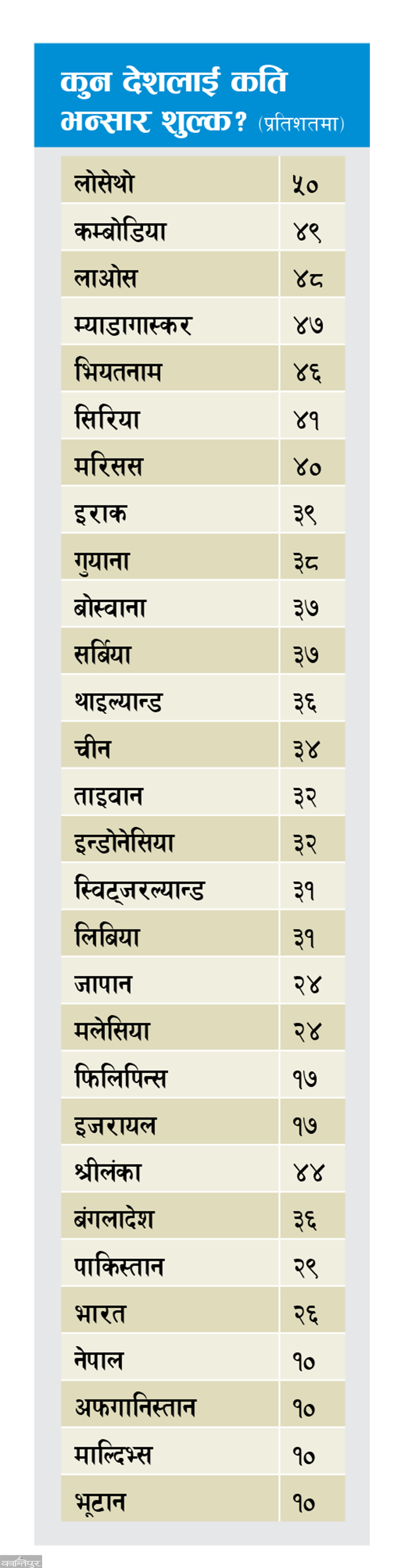
US President Donald Trump, who has vigorously promoted the 'America First' policy since the election campaign, has announced high customs duties on all foreign goods entering the US. Trump's new announcement will affect the trade of 185 countries including Nepal.
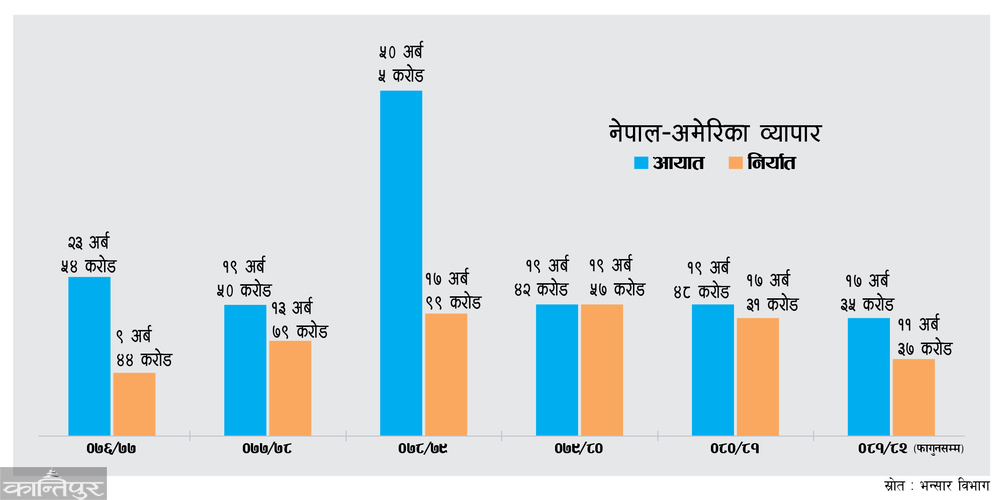
Trump has included Nepal in the list of countries subject to 10 percent customs duty. Currently, Nepal is exporting more than 100 items to the US at zero duty. According to the data of the Customs Department, in the fiscal year 080/81, products worth 17.31 billion were exported from Nepal to America. Likewise, goods worth 11.37 billion have been exported to America by February of this year.
According to the data of the American government, the trade between Nepal and America in 2024 was equal to 24 million 1.4 million US dollars (about 34 billion rupees). Out of that, goods worth 12.9 million dollars (about 16.92 billion rupees) were imported by Nepal, while goods worth 12.5 million dollars (about 16.87 billion rupees) were exported to America.
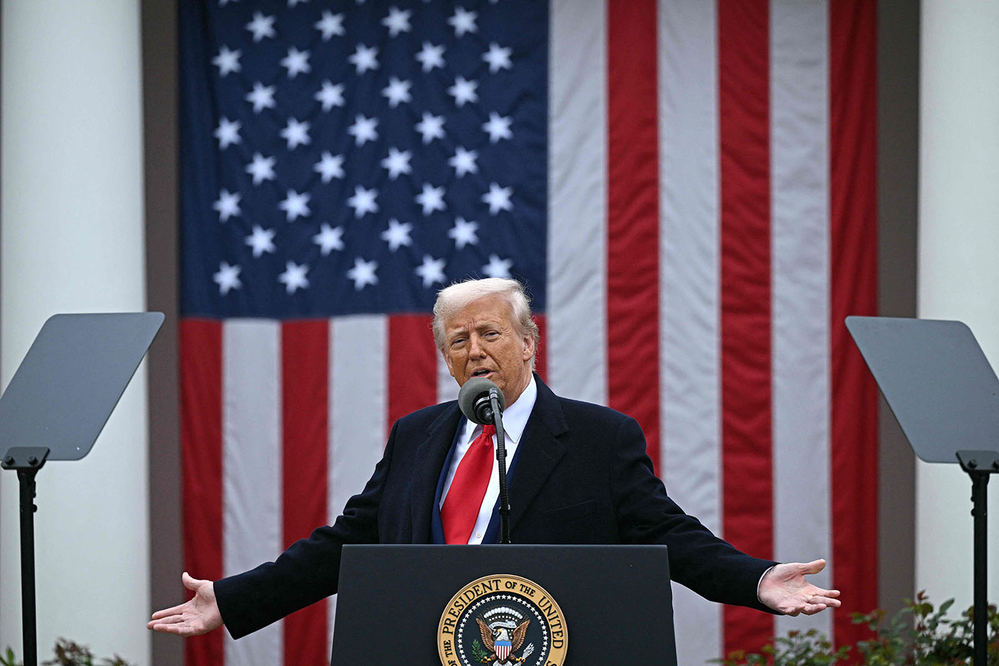
President Trump has said that the US has imposed retaliatory tariffs on imports from about 90 countries. All imports from other countries are taxed at 10 percent. Trump said that the United States has imposed tariffs on about 60 countries that are about 50 percent of the tariffs they impose on American products. The 10 percent levy will be applicable from April 5 and other levies from April 9.
Economist Bishwa Poudel claims that even now, even with the imposition of zero customs rate, Nepal will not be able to make a big profit. "Earlier, even with zero customs rate, we were not able to benefit as expected. Even if 10 percent customs duty is imposed now, international trade is not likely to be affected much, he said.
Economist Keshav Acharya says that the American decision to impose 10 percent customs duty on goods passing through Nepal has given Nepal more opportunities than losses. There is a good aspect, our competition is with Sri Lanka, India, China and Bangladesh. The goods that those countries are exporting, even if they are small, are the same goods that we export to the US,' he said, 'Now other countries have benefited from exporting those goods as they have to pay more and we have to pay less customs.' 26 percent customs duty has been imposed on Indian products.
Trump's historic tariff announcement seems to have a long-term impact on South Asia as well. India has said it is studying the impact of the 26 percent tariff imposed by the US and will try to conclude a trade agreement within this year. The Ministry of Commerce says that a detailed assessment of the impact of tariffs will be done in consultation with Indian industry and exporters.
International trade affairs expert Poshraj Pandey says that the US decision to impose customs duties on imports is likely to lead to a recession in the global market. According to him, exports from Nepal to other countries will also be affected after the recession in the international market. "With this decision, indirectly, Nepalese goods get priority," he said, "We can sell goods at a cheaper price than our competitors, this is an opportunity for Nepal." He said that there is a risk that countries such as China, Bangladesh, India and other countries may dump unsold goods in Nepal.
Trump has announced a 44 percent tariff on Sri Lanka and 36 percent on Bangladesh. After Trump imposed import tariffs during his first term, some companies shifted their supply chains away from China. Trump's latest move will also affect exports from countries that have been increasing investment in recent years. According to Trump's announcement, the US will now impose a 25 percent tariff on foreign-made vehicles. Previously, the United States used to charge only 2.4 percent customs duty on motorcycles imported from other countries.
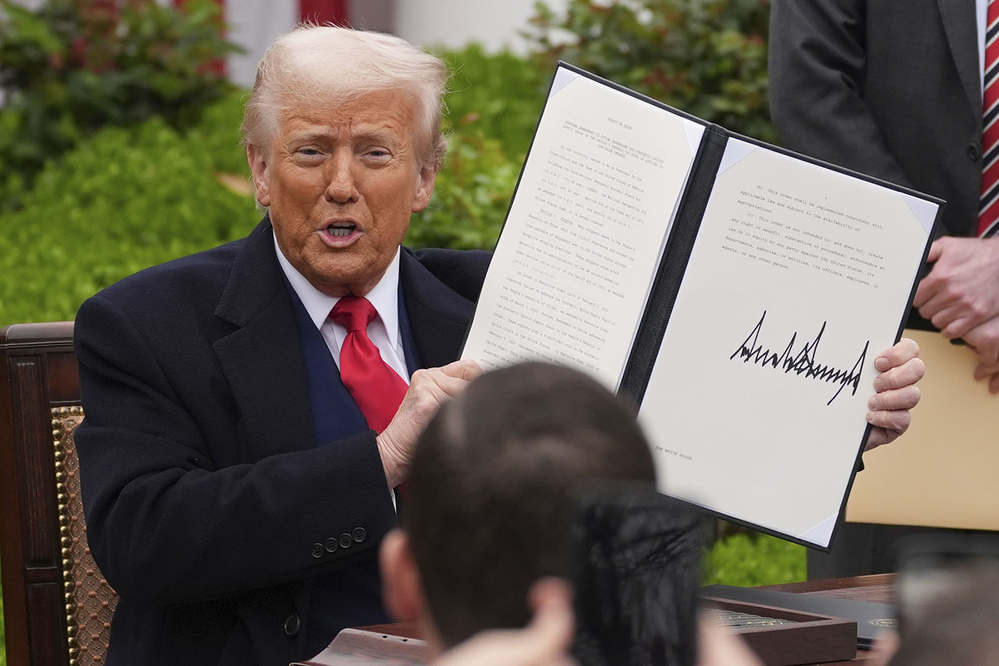
Describing the new tax announcement as 'liberation day', Trump said the new tax policy was necessary to end trade deficits between the US and other countries, from China to the European Union. "This is our declaration of economic freedom," Trump said.
Trump has declared a national emergency, claiming America has been pillaged for five decades by friends and foes alike, near and far. Trump claims that America will become the richest country in the world with the new tax policy. "Today we are standing up for American workers and finally putting America first," Trump said. According to him, in order to avoid customs duties, the goods that he wants to sell to Americans must be produced in the United States. "Anyone who wants exemption from customs duties will have to produce in America."
He claims that the new tax policy will add industries and create jobs in America. Trump claims that many countries have enriched themselves by taking advantage of the American market and closed their markets for American goods.
He says Canada has imposed excessive tariffs on dairy products and that is unfair to American farmers. Stating that the US is giving subsidies to countries like Canada and Mexico to protect their industry, Trump has now expressed his commitment to stand up for the rights of American farmers and ranchers.
US President Donald Trump announcing new customs duties on foreign goods entering the US at the White House. Photos: AP, FP/RAS
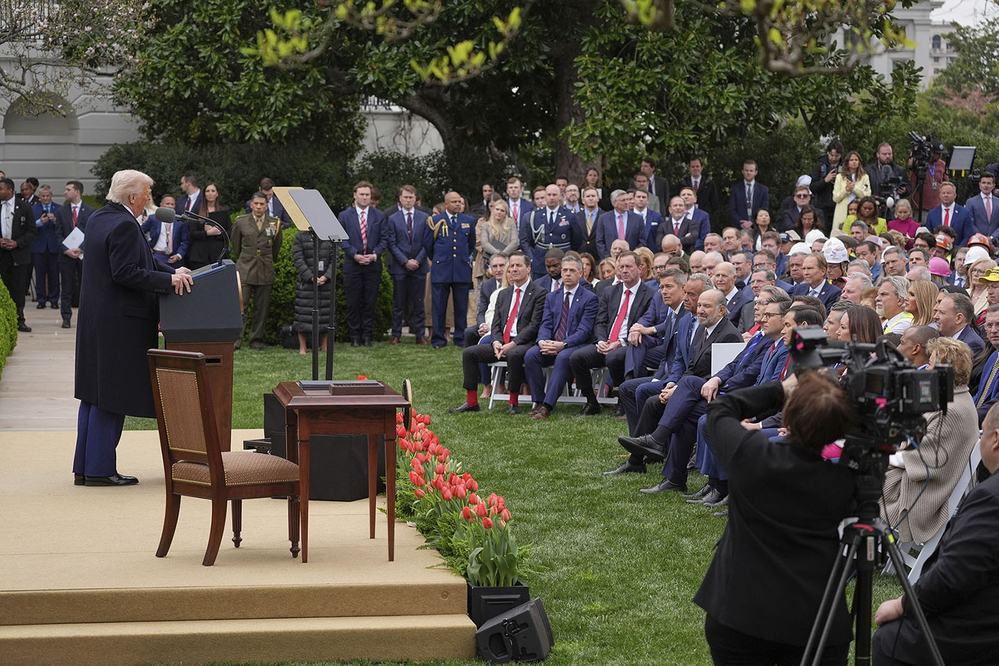 Trump had been saying that he would solve the trade imbalance of the US with both friendly and enemy countries through customs duties. But Trump's new announcement is seen as the biggest shake-up of the international trade order since World War II. As importers pass on the cost, not only will American consumers bear the brunt, but experts say it will increase the risk of a damaging recession at home and abroad.
Economist Paudel says that Trump's move will make goods more expensive in the US and other markets. Trump needs a lot of money. It is a policy to give tax exemptions to the rich by collecting money from customs duties.
But since tariffs will immediately increase the price of goods in the US, there may be high inflation. Industries may not be established immediately, Paudel said.
The former head of the International Monetary Fund and economist Ken Rogoff has predicted that the probability of the world's largest economy going into recession has reached 50 percent with the new announcement. "President Trump has dropped a nuclear bomb on the global trading system," he told the BBC.
Similarly, there is a risk that Trump's latest move will increase the trade war with other countries and distance the relationship with the ally that the US wants to strengthen. The US has sought the help of countries including Japan and South Korea against China's global ambitions. But those countries have said that they will respond to the trade policy of the United States together. Acting President of South Korea, Han Deok-soo, responded that "the global trade war has become a reality".
Similarly, countries with major economies including the European Union (EU), Britain, and Canada have also said that they will take countermeasures. The EU said it hoped to find a negotiated solution but responded that "all the necessary tools are on the table" to retaliate.
The union said it would respond to the new US tariffs "by the end of April". EU chief Ursula von der Leyen said Trump's move would have dire consequences for millions of people around the world. British Prime Minister Keir Starmer said he spoke with Trump about "productive talks" towards a UK-US trade deal.
China says it will take 'strong countermeasures' against US moves. China's Ministry of Commerce said the US move was a "unilateral threatening act" and "will resolutely retaliate to protect its rights and interests".
Canadian Prime Minister Mark Carney has said that 'action with purpose and force is essential'. "We will be very careful about the measures we take to fight on behalf of Canada," Canadian Prime Minister Mark Carney said.
Italy's Prime Minister Giorgia Meloni has said that the US tax is "wrong" and could lead to a trade war. Australian Prime Minister Anthony Albanese has responded that Trump's actions are not the actions of a friend.
The Prime Minister of Switzerland, Karin Keller-Sutter, has said that her country will also "determine a response decision soon". Similarly, countries like Germany, Belgium, Norway, South Africa have also criticized Trump's move. Vietnam said it will reduce customs duties on various goods to please Trump, according to the BBC.
During last year's presidential election campaign, Trump promised a new era for American prosperity and said he would use it to increase production. The White House said Trump announced the new import tariffs only after a lengthy preliminary review. According to the nonpartisan Congressional Budget Office, import tariffs could increase US revenues by $22 trillion by 2034.
President Trump had already raised import duties on goods imported from China, foreign cars, steel and aluminum. He also increased the tariff by 25 percent on some goods coming from Mexico and Canada. Trump's latest announcement does not mean any immediate change for two of America's closest trading partners, Mexico and Canada.
US Treasury Secretary Scott Besant has warned other countries not to retaliate. Sit in one place and think. Let's figure it out and see what happens next. Because if you retaliate, the tension will increase,' said Besant.
With Trump's announcement, the American stock market has seen a sharp decline. Apple, which manufactures most of its products in China, as well as most sportswear retailers, whose products are concentrated in Asian countries, have also seen a sharp drop in the stock market. Shares of Nike, Lululemon, Gap, Best Buy, Target and others have fallen. Likewise, the stock market of Asia-Pacific and Europe has also declined.
Talking about the rapid fall in the American stock market, Caroline Levitt, press secretary of the US President's Office & nbsp; White House, asked "everyone on Wall Street to have faith in President Trump". Asked if Trump could reconsider the new tax before it takes effect on April 5, Levitt told CNN, "Tariffs are not a negotiation."

