Self-interested polarization in murky politics: Krishna Pokharel, Professor of Political Science
We use Google Cloud Translation Services. Google requires we provide the following disclaimer relating to use of this service:
This service may contain translations powered by Google. Google disclaims all warranties related to the translations, expressed or implied, including any warranties of accuracy, reliability, and any implied warranties of merchantability, fitness for a particular purpose, and noninfringement.
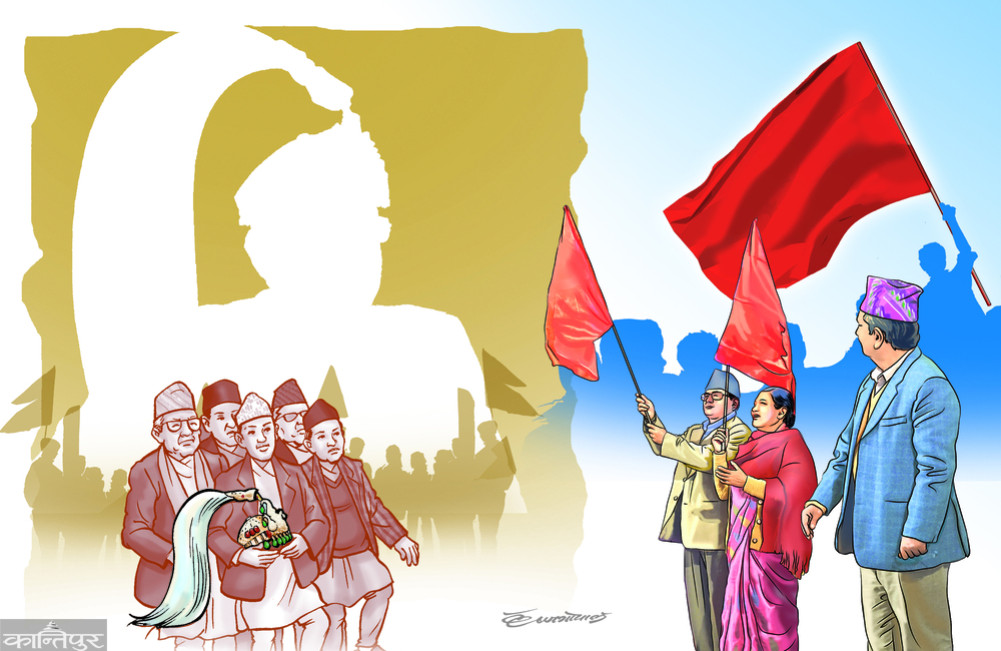
At the moment, a sharp polarization is seen in the Nepali political scene. There is polarization not only between the republican and the monarchist, but also between the ruling party and the opposition. The power alliance, the opposition and the monarchists are engaged in polarization focused on their own interests.
The intense polarization between political parties and power has made the common man more angry than excited. In both the sittings of the Parliament, the ruling party and the opposition parties face each other . The opposition party blocked both the Houses regarding the removal of Kulman Ghising from the Executive Director of Nepal Electricity Authority. They blocked the parliament demanding that Prime Minister KP Sharma Oli should answer about this.
The front of the opposition consists of the Maoist Center, the National Independent Party, and the Integrated Socialists . Although not in the front of the opposition, the Rashtriya Prajatantra Party has also supported blocking the parliament on the issue of Kulman.
The commander of the front of the opposition party has become the chairman of the Maoist center Pushpa Kamal Dahal . After the Maoist stopped the Terai Madhesh Jagran Abhiyan in Chitwan on Chait 11, he returned to Kathmandu and blocked the opposition's front and led the front of the parliamentary movement.
Prime Minister Oli, Congress Chairman Sher Bahadur Deuba and Maoist Chairman Dahal jointly inaugurated a conference on transitional justice on Thursday. On Monday, they agreed to form a committee to recommend the appointment of officials of two commissions on transitional justice. After the three top leaders expressed their commitment to end the transitional justice, Dahal reached the parliament meeting in New Baneshwar to block the parliament. Prime Minister Oli did not appear in the Parliament building to answer the opposition. The leaders of the ruling party and the opposition, who were seen on the same platform some time ago, came face to face when they reached the parliament meeting. This is a scene that leaves the common man speechless.
Why are the opposition parties raising the issue of Kulman's removal so loudly? Government can appoint and remove any employee . But the role played by Kulman as the Executive Director of the Electricity Authority is deeply rooted in the hearts of the people. They are trying to win the hearts of the common people by making it a national issue. Along with this, the Prime Minister wants to make Oli a representative of the parliament.
Dahal was forced to step down from the government when the UML turned its back on him last June when he was the prime minister in the coalition of UML, Maoist, RSWP, and United Socialists . After the formation of Congress and UML coalition government, Prime Minister Oli and Dahal have been at loggerheads. After Oli shook hands with Deuba saying that 'heaven and hell go together', Dahal's anger has not subsided even after eight and a half months . Dahal Oli is still angry with the government. He is in the strategy of taking revenge on Oli as soon as he gets a proper opportunity. That's why he is constantly firing verbal bullets at the government like during the war.
Dahal has staged a protest in and outside the parliament at the same time. Dahal has also given equal importance to the street struggle by waking up the inactive Samajwadi Morcha on January 2. He has taken the policy of using the front against the monarchists and the government by including the militant Netravikram Chand, who separated from the Maoists in 2069 and formed the Nepal Communist Party. Samajwadi Morcha has prepared a big demonstration in the capital on Friday 15th of Chait. The Maoists in the Parliament, the Unified Socialists, the Nepal Samajwadi Party and the CPN on the streets are in the Samajwadi Front. The main work of this front, which has left-wing ideas, is the policy of street struggle .
power coalition in defense
Electricity Authority's executive director Kulman Ghising was removed when four months were left, there has been widespread protest from the parliament to the streets . Rebellion against the government is on the social media. Not only this, there has been a visible opposition to the removal of Kulman within the ruling party Congress. Congress senior leader Dr. Shekhar Koirala and Chief Minister Gagan Thapa and Bishwaprakash Sharma said that removing Kulman was a mistake and created a problem by force.
to such an extent that there is dissatisfaction within the UML over the removal of Kulman . But within the UML, there is no position to speak against the decision of the party president and the prime minister. Because the leaders of UML have experienced that internal democracy has reached the weakest stage in the history of the party. In the UML secretariat meeting held last week, most of the leaders also suggested Oli not to take a decision that would cause a big protest among the public. In that meeting, a leader informed that Oli said that the government will work to strengthen the democratic republic by taking the opposition party into confidence. Why did Oli dismiss Kulman after ignoring the suggestion of the secretariat meeting? It has become a topic of discussion within UML. According to a leader close to Oli himself, who has reached the mindset of "not running Kulman when he leaves". But in the Cabinet meeting on Monday, he could not reject the proposal of Energy Minister Deepak Khadka. Minister Khadka says that Oli Kulman was forced to take action after Foreign Minister and Deuba's wife Arju Rana Deuba strongly supported him. The proposal of Energy Minister Khadka is not enough to take action against Kulman. Arju's stance is directly linked to Oli's government. Kulman's dismissal is directly linked to the residence of Congress President Sher Bahadur Deuba. The main reason why Oli was forced to remove Kulman is to try to preserve power.
Oli knows very well that there is no ease from the southern neighbor India . Oli has been watching closely whether India is involved in the activities against the government. Therefore, Oli does not want to upset the government by rejecting the proposal from Deuba residence Budhanilkanth. Budhanilkanth 'connection' is also the main reason for the Kulman dismissal case. Deuba is the main support for Oli.
After the Kulman dismissal case, the Oli government has become more unpopular. Earlier, the republicanists who were in the opposition, the monarchists in the house and on the streets have dug in against the Oli government . In a way, he is immune from the siege and attack from the houses and streets of the republican and royalist . But Oli is not of a nature to bow down from opposition and criticism. He has been creating an image of 'rather breaking but not bending'. Lately, he has had to face some difficult situations due to the siege of opposition republicans and royalists on the streets.
Excited royalists
Former king Gyanendra Shah took to the streets in the last week of February after disagreements between republicans, poor performance of the government and unfavorable national/international situation for Prime Minister Oli. This has encouraged other monarchist forces including the RP .
The Oli government's inability to directly influence the common people during the period of eight and a half months, there is intense dissatisfaction with the inability to create a commentary on the work that awakens hope. On this occasion, the royalists announced the Sari movement for the restoration of the monarchy and the demand for a Hindu nation.
Monarchists who have been cornered in the past have become polarised . There seems to be some power involved in getting them excited . The Rajtantra Prakashdhar Party in Parliament has announced a protest under the leadership of President Rajendra Lingden. Another movement has also been announced under the leadership of Purpanch Navraj Subedi. It seems that the monarchy took the policy of making its own 'space' when there was a division between the republicans.
Self-centered polarization in murky politics
- Krishna Pokharel, professor of political science Although there is a struggle between the ruling party and the opposition in democracy, Krishna Pokharel, a professor of political science, says that the recent tripartite polarization has made people confused and angry.
What is this polarization for? Is the polarization between the opposition to topple the government or for some other purpose? It is not clear," he said, "How much power is behind the activism of the royalists? Has the monarchy been restored in the country? In the recent tripartite political polarization, their interests are hidden.'
He said that political polarization will increase anger rather than instill hope in the common people. His analysis is that the government makes unpopular decisions, the opposition tries to take political advantage of it, and at the same time, the monarchists take a policy to weaken the system.
'Politics of the country is blurred . All the political forces have been active to take advantage of this," he said, "The ruling party, opposition, republican and royalists have tried to steal the hearts of the people in this murky politics. But uncertainty is also the same in murky politics.'