Forming a recommendation committee for the appointment of officials under the coordination of former Chief Justice Mishra
We use Google Cloud Translation Services. Google requires we provide the following disclaimer relating to use of this service:
This service may contain translations powered by Google. Google disclaims all warranties related to the translations, expressed or implied, including any warranties of accuracy, reliability, and any implied warranties of merchantability, fitness for a particular purpose, and noninfringement.
After an agreement was reached between the Congress, UML and Maoist on the division, the appointment of the officials of the two commissions related to transitional justice has been resolved. Prime Minister KP Sharma Oli, Congress President Sher Bahadur Deuba and Maoist Chairman Pushpa Kamal Dahal have agreed on the sharing of ten officials of the two commissions on Monday.
After the agreement between the top leaders, the Cabinet meeting on Sunday itself decided to form a five-member recommendation committee for the appointment of office bearers under the coordination of former Chief Justice Omprakash Mishra. Home Minister Ramesh Ukhar said that according to the agreement between the top leaders of the three parties, the earlier committee has been reconstituted under the chairmanship of Mishra to recommend the names of officials.
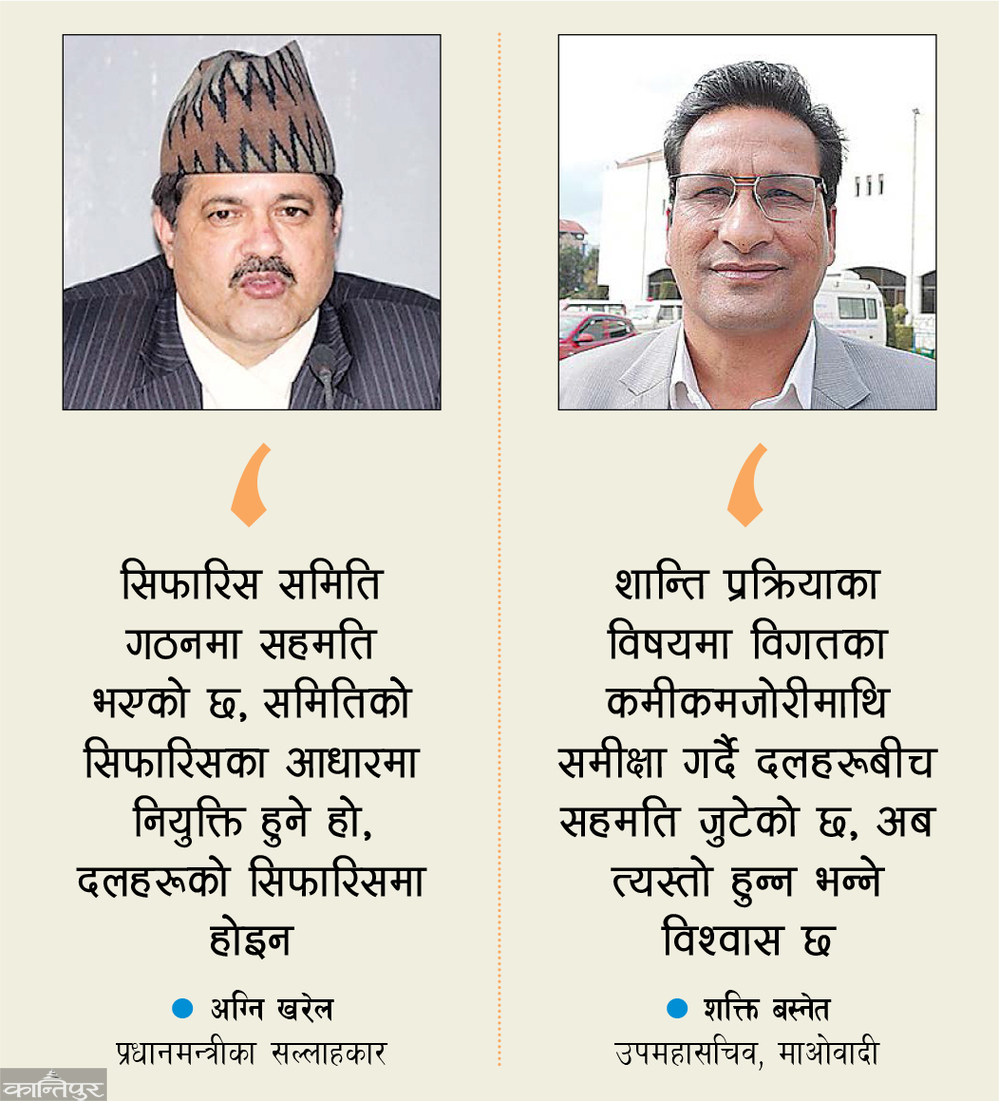
Prime Minister's advisor on human rights and transitional justice, Agni Kharel, did not want to say anything about the issue of shareholding, saying that there was only an agreement on the formation of a recommendation committee in the meeting. "Regarding the appointment of officials of the commission, it will be based on the recommendations made by the committee, not on the recommendations of the parties," he said.
According to sources in Baluwatar, an agreement was reached with the Maoists after an agreement was first made between the ruling Congress and the UML. Earlier, it was agreed that the Congress would get two members including the chairman of the Truth and Reconciliation Commission, the UML three members including the chairman of the Investigation Commission of Disappeared Persons and the Maoists three members.
Maoist Chairman Dahal claimed that the party directly concerned with transitional justice should get one of the two commission presidents. However, sources claim that Dahal has become inflexible in moving forward with the work related to the three-member transitional justice. The recommendation committee shall consist of the Chairman of the Human Rights Commission or one member appointed by him. The commission had earlier sent Manoj Dawadi to the committee. The Commission has said that this time it will be decided within a day or two whether to send him again or to give another name.
Due to the tussle between the top leadership of the three main parties, both commissions have been without officials since July 079. Due to non-appointment of officials in the commission, all the work of adjudication, including investigation of victims' complaints, was being blocked. There are more than 64,000 complaints made to the Truth and Reconciliation and Missing Persons Investigation Commission.
The bill passed by both Houses to amend the Commission for Investigation, Truth and Reconciliation Act 2071 was approved by President Ramchandra Paudel on August 15. According to the law, the appointment of officials should be completed within two months of the bill being passed by the Parliament. After the
committee selected 40 people through open application and conducted interviews, there was a dispute during the selection of officials. There was no consensus in the committee after the members in the recommendation committee on the party basis took a stand for the selection by representing their respective parties. The process of appointing officials has been blocked for a long time because it is said that taking decisions based on majority and minority will not have credibility in the work of the peace process and it can have far-reaching effects.
Maoist leader Shakti Basnet claimed that even though officials could not be selected due to differences of opinion among the members of the recommendation committee, such a situation will not be repeated. The members of the previous committee did not agree. It was natural that there was an opinion among the major parties that going to the minority and the majority on issues like the peace process would not be beneficial in the long run. That's why it was stopped at that time," said Basnet, "Now, a consensus has been reached after reviewing the shortcomings of the past. I believe that will not be the case now.'
According to an official of the Congress, ever since the bill was passed by both the Houses, efforts were being made to arrange the share of commission officials. The recommendation committee could not choose a name because the first batch was not agreed. To facilitate the recommendation committee, this time, the allocation has already been arranged. It will not be like before," said the leader of the Congress, "even the matter of the people in office has been almost decided."
Former Attorney General Khamba Bahadur Khati, former ambassadors Arjun Kumar Karki and Stella Tamang were appointed as members of the previous committee under the coordination of Mishra. The government formed the recommendation committee on November 2. The tenure of the committee expired on January 1.

