Preparation for the formation of another search committee to recommend the names of officers for the formation of the commission
We use Google Cloud Translation Services. Google requires we provide the following disclaimer relating to use of this service:
This service may contain translations powered by Google. Google disclaims all warranties related to the translations, expressed or implied, including any warranties of accuracy, reliability, and any implied warranties of merchantability, fitness for a particular purpose, and noninfringement.
Former Attorney General Agni Kharel was appointed by Prime Minister KP Sharma Oli as his adviser on transitional justice. Kharel, who has held positions such as MP, Minister and Attorney General, was considered as a contender for the chairmanship of the Truth and Reconciliation Commission, which had not been formed before.
Why did Prime Minister Oli appoint Kharel by setting up a new position of adviser? Why did he agree to go to the adviser of the prime minister who is not considered to have a big role? Various assessments and discussions have started about this among individuals and organizations interested in conflict victims and transitional justice.
The National Human Rights Commission has analyzed whether Prime Minister Oli's creation of a new position and appointment of a consultant on transitional justice is trying to change the government's careless attitude towards transitional justice.
Just last week, the Commission wrote to the Prime Minister and asked him to immediately proceed with the stalled process of transitional justice and to form a Truth and Reconciliation Commission and a Commission of Inquiry into Disappeared Persons . Before sending the letter, the Commission called Foreign Minister Arju Rana and asked why the transitional justice was blocked, saying that there are too many questions about Nepal's accountability in the observance of human rights at the international level.
According to commission sources, Rana replied that now the government is in a position to proceed with the work soon. Surya Dhungel, the most senior member of the commission, said, "The right of the victims to get justice has been delayed for two decades. The most senior member of the commission, Surya Dhungel, said, 'Since the government is as ignorant as it is to move forward with the process of transitional justice, we have written a letter not to delay and have called the foreign minister to discuss it.' The commission is of the opinion that yes. The victims have also watched with interest the new post created by the Prime Minister and the appointment of Kharel in it.
'There is no hope that anything will happen as the government has cheated many times and trampled on the rights of the victims to get justice' Suman Adhikari, founder president of the conflict-affected Common Chautari, says, 'However, we have taken interest in the appointment of the Prime Minister's advisor when the government has no mechanism to contact about transitional justice.
According to the Supreme Court's order eight years ago to make a law to address the transitional judicial process, the Truth and Reconciliation Commission and the Investigation of Disappeared Persons Act were amended and issued by President Ramchandra Paudel last August. However, despite the promulgation of the law, the government has not been able to appoint officials in both the 33 vacant commissions.
Under the coordination of former Chief Justice Om Prakash Mishra, the government had formed an office recommendation committee last November, whose mandate was to recommend five candidates for the appointment of five candidates including the chairperson for both commissions within two months .
The committee made an open call and selected 40 people from applications ranging from former judges to commissioners of constitutional bodies and interviewed them for recommendations. However, after the parties put pressure on the chairman and other officials to appoint the person they wanted, at the end of last November, the chairman of the committee, Mishra, said that they had failed to recommend the name of the commissioner and asked the government to restart the process from the beginning.
Even after three months have passed since then, the government has not shown any concern about the stalled transitional process. Human rights organizations and the victims themselves have been raising their voice saying that the government cannot ignore the rights of the victims for a long time. In this background, after the Prime Minister appointed Kharel as a consultant to advance the work on transitional justice, the interest in the victims and human rights activists has increased.
Kharel himself also said that now the stalled work will proceed quickly. "Now, the work will start from where the problem has come from," he said, "I have started discussions with stakeholders about this."
"Transitional justice will now proceed"
Agni
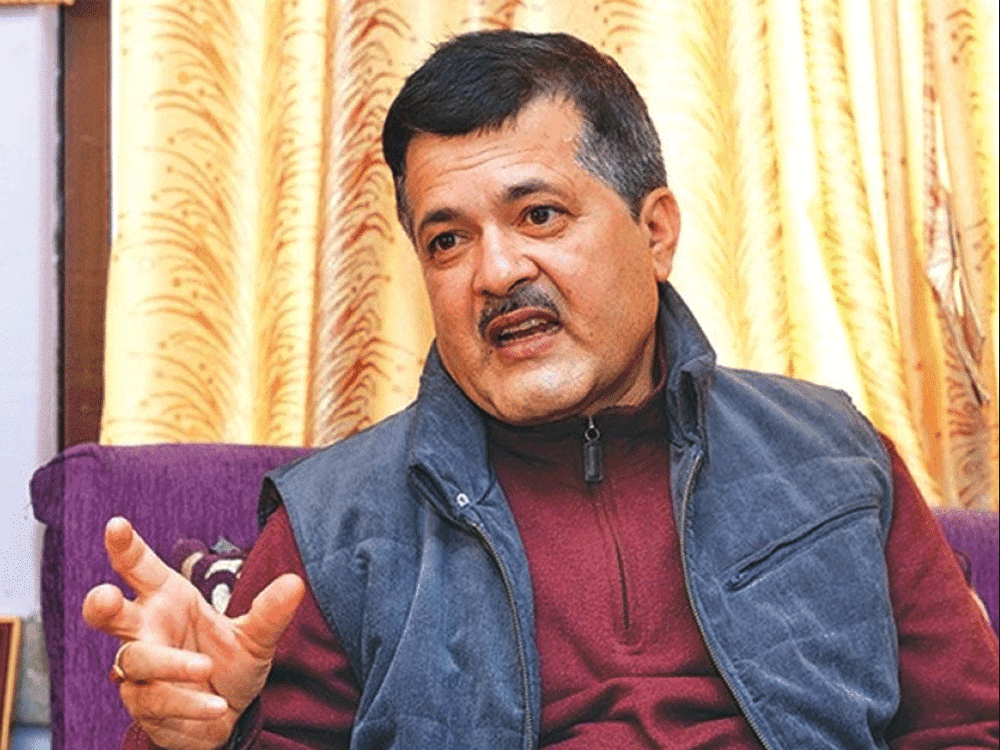 Kharel, Prime Minister's Adviser on Transitional Justice The Prime Minister has recently appointed you Adviser on Human Rights and Transitional Justice. What is its political meaning?
This means that the government is now serious about transitional justice and the work will go ahead.
Was this post before ? There was no
. There was no mechanism for the government to proceed with the stalled transitional justice process . Therefore, the discussion could not proceed . Now I will be on it regularly . My office is in a sense the Prime Minister's Liaison Office for Transitional Justice.
What do you mainly do now?
I will now be in discussions with all stakeholders . I listen to their interests and concerns . It has already started this morning with an important informal discussion.
Now the recommendation committee will be formed again ?
. The recommendation to stop the work is from the committee. So now it has to be formed . And, after the formation of the committee, the government will form both the commissions based on the recommendations given by it.
There was talk of making the chairman of the Truth and Reconciliation Commission before, right?
Yes, I was urged . If necessary, I could also fulfill that responsibility . However, the current situation is different. The Prime Minister asked me to proceed with the blocked process. This is no less important.

