With the support of democratic forces across the country, we will stop the regression, but when will the ruling friends improve? : Pushpa Kamal Dahal Leader of the main opposition party
We use Google Cloud Translation Services. Google requires we provide the following disclaimer relating to use of this service:
This service may contain translations powered by Google. Google disclaims all warranties related to the translations, expressed or implied, including any warranties of accuracy, reliability, and any implied warranties of merchantability, fitness for a particular purpose, and noninfringement.
The parties in the ruling party and in the opposition have said that the government's style of governance has strengthened the monarchy. They say that they are united to move forward by protecting the republic and the constitution.
The ruling party UML and the Congress and the main opposition Maoist unanimously committed in favor of the constitution and the republican system in the Tuesday meeting of the House of Representatives, explaining that the demonstration on February 25 by political parties and groups including former Raja Gyanendra Shah, RPRPA is a threat to the current system. Along with the opposition, the leaders of the ruling party have also raised questions about the governance style of the government.
The leader of the main opposition party, Pushpa Kamal Dahal, in a special address to the House of Representatives, said that the political achievements achieved by various movements in the Parliament are now being seen as 'dreams of wielding the sword of regression and counter-revolution'. The republican system achieved by the people through struggle Claiming that efforts are being made to reverse the
, he added, 'Now we have a unique situation where we have to fight against the wrong actions of the government on the one hand and against the regressive tactics on the other hand. The government's recklessness, indiscretion and failure have made the people disillusioned with the system.
He said that regardless of the support of any party, the monarchy will not be restored in Nepal. However, he said that the parties in favor of the constitution should self-examine their weaknesses. He said, "We will stop the regression with the support of democratic forces across the country, but when will the ruling party improve?" The horse of misrule that you run on the arrogance of two-thirds is now becoming the biggest crisis on democracy.'
Maoist Chairman Dahal recently complained about the meter business victims, Guthi victims, microfinance victims, cooperative victims, community school teachers, dairy farmers, vegetable producers, builders, sugarcane farmers, Dalits and women's movement. Has every class and community stopped seeing any other option than the movement? Has the government lost the ability to communicate with the people or does it not want to communicate?, Dahal asked.
He said that because the government did not listen to the voices of opposition, the monarchists felt that the credibility of the government was over. "Those who were afraid to dream of restoring the monarchy even in closed rooms for years have come down to the streets and started challenging the restoration of the monarchy from the streets," said Dahal. Dahal said that the leaders and workers of the ruling party have brought impunity in the country. "Democracy has been made like the river Ganga, destroying each other. The fake Bhutanese refugee scandal was washed away in the Ganga river, but democracy became dirty. The children's temple was washed, but the garbage was piled up in democracy. "Giribandhu washed away, Tribhuvan University lands were washed away, but in the eyes of the people, democracy was seen as dirty," he said. He said that people's anger towards the government is trying to pour out against the system.
Gagan Thapa, the general minister of the ruling Congress, who addressed the parliament immediately after Dahal, also said that his party is fully committed to the republican system. "Congress appreciates the commitment of the opposition party towards the Constitution and Federal Democratic Republic of Nepal," said Thapa after Dahal, "We are all equally committed to this system. We are equally committed to strengthening the system of the constitution to protect this democracy brought together by all.
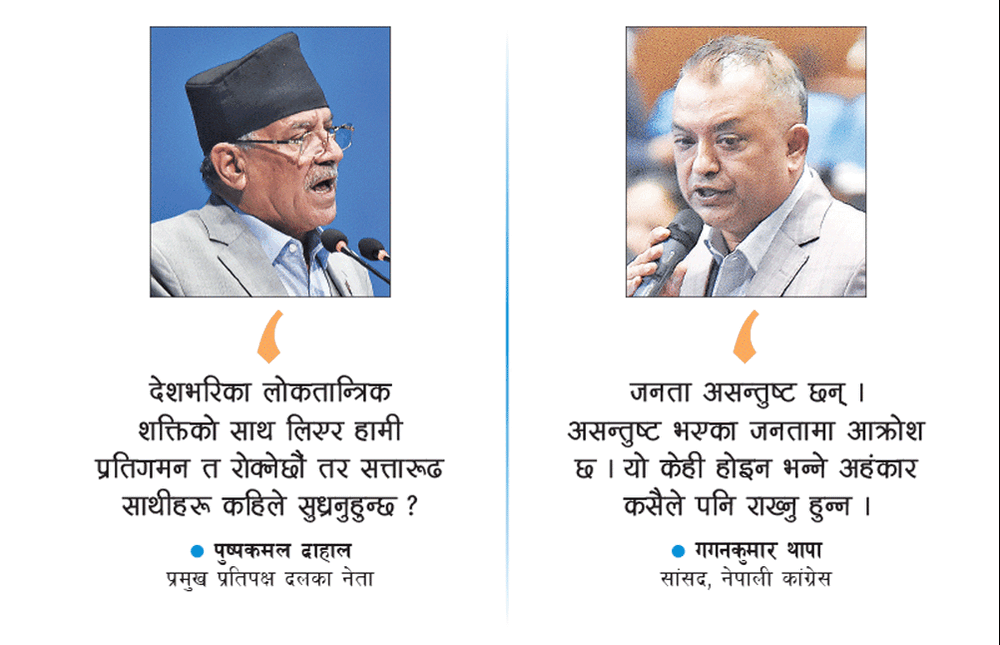
Thapa said that better work can be done than the current political governance style. "It can be done much better than this. So my advice to young friends is to embrace the opportunities that come before us. For that, the opportunity of the current open environment has to be covered. Stating that the country has gone through various political movements, wars and political transitions in the last three decades, Thapa said that the next decade should be made of economic development.
Chief Minister Thapa said that state administrators should listen to citizens. Stating that listening to the people is a democratic system, Thapa said, "Those who don't listen will go." He also said that the government is listening to the demands raised on the streets. He said, "People are dissatisfied. There is anger among disaffected people. I also believe that anger should not be ignored. Nobody should have the arrogance that nothing has happened, this is nothing. Thapa said that there is a need for an understanding between the supporters of the constitution to strengthen the
system. Stating that the fundamentals of the constitution should not be used, Thapa said that the constitution will be amended after discussing with the Maoists, Madheshists and the new party.
UM MP Gokarn Bista said that the republic was brought to end the situation of being punished by the state for demanding rights. "Students should have gone to jail rather than being able to study." Women should have been sued rather than given rights. Teachers and workers should have gone to jail rather than get paid. From this type of government, we have gained democratic practice through the people's movement," Bista said. "If it cannot be used properly, the country cannot move forward. It is necessary to seriously review and cooperate with the forces that have contributed to achieve democracy in order to preserve the achievements. Through this republic, we have established participatory, inclusive, responsive and accountable governance. We have established sovereignty over the people by ending the practice of centralizing the government in which one family is born.'
Bista said that it is time to bring uniformity in the words and actions of political party leaders. It is necessary to improve the politics of Nepal so that we do what we say. It is necessary to enrich the politics of Nepal. Today, whether in political appointments or in other types of work, we can only instill hope in Nepali politics if we can develop a system of merit-based work and work-based evaluation," he said. They only want to get result-oriented work within Nepal. Today, even if there are some shortcomings for this, the alternative to democracy cannot be regression, the alternative to democracy cannot be monarchy. He said, "In my personal life, I have been imprisoned for more than six and a half years." During the period of three kings, I faced the royal case three times. Pandey also said that Jahanian rule, the system of becoming a king as soon as a person is born, no one gave us boxis.' "Two-thirds of the government has not been able to innovate, corruption has become institutionalized, the government has completely failed to control corruption and punish the corrupt, ministers, employees and high-ranking people, heads of various institutions appointed by the government have been killed in one incident of corruption, and there has been widespread bias in governance," he said.
RPP MP Dhruva Bahadur Pradhan expressed his happiness saying that the parliament was shaken in the name of monarchy. Mentioning that the former King Gyanendra Shah expressed his views as a parent on February 7, Pradhan said, "The current system that is taking its own way cannot protect the country, cannot benefit the people, so all Nepalis have absorbed the message that we should all come together in this regard." Sunday's performance is a sign of that. On the return journey from Pokhara on the 24th, spontaneous people marched from the airport to Nirmal Niwas to welcome them.'
Jaspa, Nepal MP Rajkishore Yadav said that there was no need to visit Purvaraja Shah on his way home from the airport. When listening to the debate in this House, it is not a debate, it is not the voice of the people, but the murmuring and crying of the leader. I think it was a kind of symbolic expression of self-doubt,' said Yadav, 'If only talking for the sake of talking, when one person goes to his home from the airport, the state power has to be worried, worried and the time of the entire House has to be spent.'

