Salak is considered very important for the ecosystem as it eats only ants and beetles. It is scientifically estimated that a salamander eats more than 70 million ants and wasps in 1 year.
We use Google Cloud Translation Services. Google requires we provide the following disclaimer relating to use of this service:
This service may contain translations powered by Google. Google disclaims all warranties related to the translations, expressed or implied, including any warranties of accuracy, reliability, and any implied warranties of merchantability, fitness for a particular purpose, and noninfringement.
Kumar Paudel, a Nepali conservationist who has been active in salak conservation for a long time, will receive a prestigious international award of 50,000 euros. The Future for Nature Foundation of the Netherlands has announced the 'Future for Nature' award to 3 people including Paudel.
Paudel, along with conservation activists Anthony Waddle and Rathmarie Pilko, were selected for the award from more than 300 international competitors. Anthony Australia Rathmarie is active in environmental conservation in Peru . The
award will be presented at a special ceremony in the Netherlands on May 16. So far, 54 people from 35 countries have received this award. Earlier last year Rinjin Phunjok Lama and Manoj Gautam in 2015 received the award . Similarly, British researcher Geraldine Werhan received the award for her studies in Nepal in 2018.
Paudel, who is running a salak conservation campaign, will get 50 thousand euros (about 76 lakh rupees) to work in the field as he wants. M.Sc in Environmental Science from Pokhara University and MPhil from Cambridge University Poudel has been active in the field of salak conservation for about 15 years. He is working in the conservation of endangered wildlife and plants of Nepal. He met people involved in wildlife poaching and smuggling in Nepal and asked, 'Why does anyone become a wildlife smuggler?' He also did research on the subject. Giving information about the investigation, Paudel says, 'I went to the prison and met the people involved in wildlife crime.'
Why are they involved in such crimes? Paudel says, 'They do not get involved in smuggling and trafficking only because of poverty. One is thinking that money is easily earned. Another thing they know is illegal action But then they have not been able to assess the impact of the punishment on family and society.' From 2015 to 2017, he interviewed 165 people. In which there were people involved in the hunting and smuggling of wild animals such as rhinoceros, salak, red panda, leopard and tiger. The discovery was also published in the journal 'Conservation Science and Practice' in 2020.
Paudel also established the Greenhood Nepal organization in 2012 for the protection of endangered wildlife and plants including tortoises, salaks, rhinoceroses and lions. He is also the vice-chairman of IUCN's Salak Specialist Group-Asia. He is active in various campaigns for salak conservation in South Asia and Asia. Why is
important?
There are 2 types of salak in Nepal, black and copper. There are 2 other species of salak in South and Southeast Asia. 4 other species of Salak are found in Africa. The latest study says that 2 more species of salak have been found, but it is yet to be confirmed. Paudel says that although they look the same at a glance, they are different depending on the weight, color and size of the coat that covers the body.
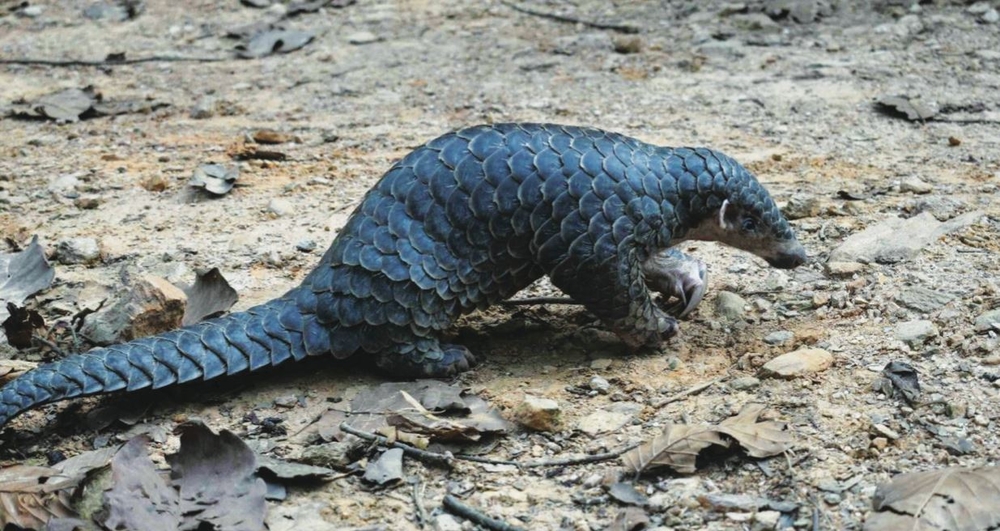 Photo Courtesy : Kumar Paudel
Salak has been included in the endangered list by IUCN as it may become extinct in the near future if it is not specially protected. Salak is a protected wildlife of Nepal. According to the National Parks and Wildlife Protection Act-2073, a person who kills, buys, sells or transports salak can be fined from 5 lakh to 10 lakh rupees or imprisoned for 5 years to 15 years or both.
Salak is the most trafficked mammal in the world, conservationist Kumar Poudel says. In addition, salak is considered very important for the ecosystem because it only eats ants and beetles.
It is scientifically estimated that a salamander eats more than 70 million ants and beetles in 1 year. Paudel also said that it plays a role in creating ecological fertilizer by eating ants and moths in nature. 'Recently, a research by scientists in China has been published. The research revealed that salak plays a major role in reviving the forest after the fire. Even after the fire, salak helps to make the soil fertile by digging up the dung, which makes it easy for new plants to grow . It is easier for animals to stay,' he says .
Why is salak smuggling??
In December 2023, a large quantity of salak was recovered from Kimathanka area of Sankhuwasabha. About 208 kg of salak was recovered from the Makalu Varun National Park area . Poudel said that about 350 old men may have been killed for the khabata. 2 people were arrested with Khabata. A few days ago, 2 people were arrested from Machhapokhari in Kathmandu along with the salak's khabat.
Salak's cuticles are made of keratin (a substance found in nails and hair). According to Paudel, the demand has increased worldwide because salak bark is used in natural medicine in China. It is being hunted from all over the world and brought to China for medicinal use.
Paudel himself is also focused on how to reduce the international smuggling of Salak in cooperation with the Central Investigation Bureau (CIB) of Nepal Police and Interpol. Salak has been found in more than 50 districts in Nepal. It is found especially in grasslands, steep land, red soil, places where ants and ants are found and at an altitude of 2500 meters above sea level.

