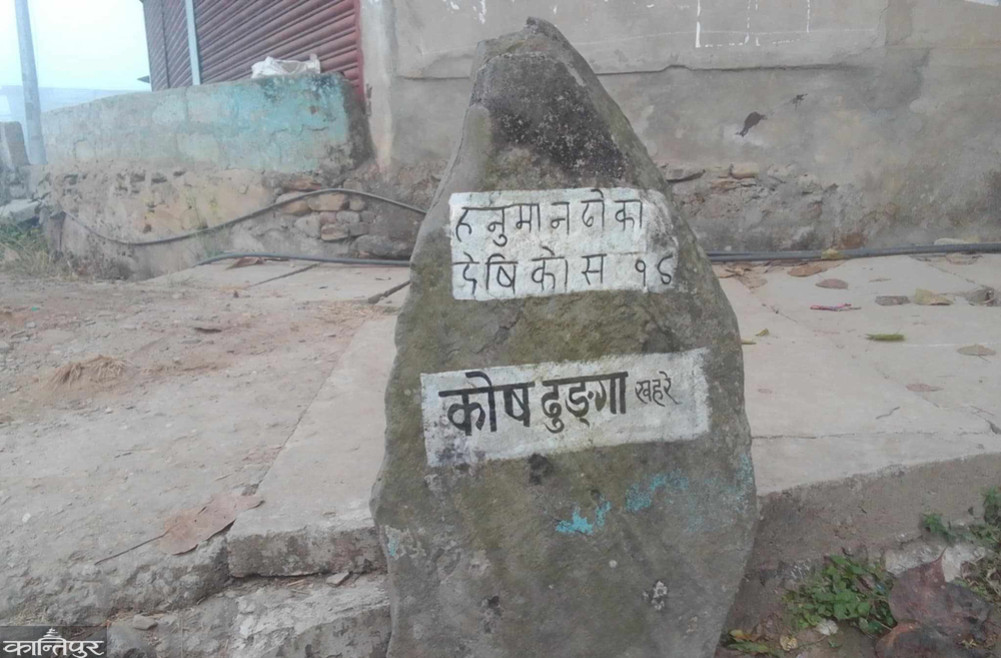
Some of the tombstones found as far as Kathmandu, which is 26 tombstones away, have also been protected. More than half of the cells have been identified.
We use Google Cloud Translation Services. Google requires we provide the following disclaimer relating to use of this service:
This service may contain translations powered by Google. Google disclaims all warranties related to the translations, expressed or implied, including any warranties of accuracy, reliability, and any implied warranties of merchantability, fitness for a particular purpose, and noninfringement.
On the Gorkha-Kathmandu historical trail, 13 'treasure mounds' have been found according to the traditional practice. Some hundred-year-old koshedhunga on the footpath to Kathmandu, which is 26 koshes away from Gorkha, are stranded due to lack of protection.
On the Gorkha-Kathmandu historical footpath, 13 'treasury mounds' have been found according to the traditional customs. Some of the hundreds of years old kosher stones on the footpath from Gorkha to Kathmandu, which is 26 kosas away, are stranded due to lack of protection.
The Dharche Manaslu Tourism Development Committee had spent a week studying the condition of the Gorkha-Kathmandu unification road where the Nepali Army is trekking every year on the occasion of Prithvi Jayanti. Sane Gurung, Chairman of Manaslu Tourism Development Committee, said that during the on-site study conducted from January 27 to February 4, it was found that traditional structures such as koshedhunga need to be protected in order to attract tourists.
During the study, fossils have been found in Hanuman Bhanjlyang, Gorkha Municipality-2 Deragaon, Taple, Worlang and Ghatbensi of Bhimsen Thapa Rural Municipality. He said that one cell was found near Salyantar, Khare Katunje, Tharpu, Gharyanghurung, Bhogteni, Samribhanjyang and Nuwakot post office in Dhading.
"The Nepali army and the municipality have also searched for some treasure stones and protected them, some still need to be protected," he said, "just like kilometers today, treasure stones had a special significance at that time, there was a practice of knowing the distance by placing a stone on the base of the stone.'
When there was no road, it was a practice to measure the distance and keep a cell to make it easier for pedestrians. Navaraj Adhikari, who works at the National Museum Camp, says that during that time, the cells were connected with daily life. "The method of measuring the distance of Koshedhunga is traditional, we find that stones are placed for a distance of about four and a half kilometers," he said, "Koshedhunga is a unit, Koshedhunga is a sign, it was directly related to daily life at that time, the importance of objects connected with such traditions is increasing in the current context."
He said that some of the cells on the Gorkha-Kathmandu footpath have been erased along with the timeline. "Even during the expansion of the highway, it could not be preserved, due to the time sequence breaking, cracking and breaking, not all the cells were preserved," he said .
Gurung, Chairman of Manaslu Tourism Development Committee, says that Koshedhunga is also useful for identifying places. "At that time, roads were not expanded as they are now, it is a practice to keep stones to know the distance of the walking path," Gurung said, "It is a practice to decide the journey to reach the place of residence based on these stones."
He says that cells were found at a distance of 3100 meters on the Gorkha-Kathmandu footpath. More than half of the koshedhunga have been lost on the 26 kosheduri road to Kathmandu. Gurung said that even during the road expansion, the identity of some cells was erased. Gurung also said that the report will cover the management of drinking water and the construction of toilets near the place where the treasure was found. "This is the road that the king used to walk, it is also a popular footpath from a commercial point of view," he said, "goods from China, salt from Bhotkhola, Dhading's Salyantar, Trishuli, this is the road that reaches Kathmandu. At that time, the koshe dhunga became a basis for marking a place on the very busy road. It is necessary to preserve the remaining koshe dhunga to show the future generations and explain their importance." He said that a dilapidated plant was found. Similarly, he said, the historical tank in Khare can also be chosen by pedestrians. Gurung said that under the footpath, the Dhading watershed and the Ranipauwa in Tharpu need to be repaired. The historical footpath has been studied through Hanumanbhanjya, Borlang, Dhading's Khare, Post Office, Trishuli Tinpiple to Kathmandu. 27 traditional squares have also been found in the Padmarg area.
'Some of the stones of Chautara are in a state of disrepair, they need to be repaired,' he said, 'alternative footpaths can be made where the road has blocked the footpath, the preservation of historical structures and the development of the footpath in places where there are roads for pedestrians will make it easier for pedestrians.'
Gurung also says that it seems that Gharbas program should be conducted in five places of the padarg area. "In some places along the road, hotels have also opened, if you can operate a homestay in the densely populated areas, you can earn income, and there is no shortage of places for hikers to stay," he said.
The study team has pointed out the possibility of making a four-day trail from Gorkha-Kathmandu. The team that has completed the study has prepared to submit a report to the Tourism Board, the concerned rural municipality and the association/organization related to tourism. The condition and number of monasteries, monasteries, koshedhunga, thanti, poti in the padayatra area has been studied. In the
study team, the chairman of Dharche Manaslu Tourism Development Committee, Gurung, and technicians from Trekking Agency Association (TAN) participated.