We use Google Cloud Translation Services. Google requires we provide the following disclaimer relating to use of this service:
This service may contain translations powered by Google. Google disclaims all warranties related to the translations, expressed or implied, including any warranties of accuracy, reliability, and any implied warranties of merchantability, fitness for a particular purpose, and noninfringement.
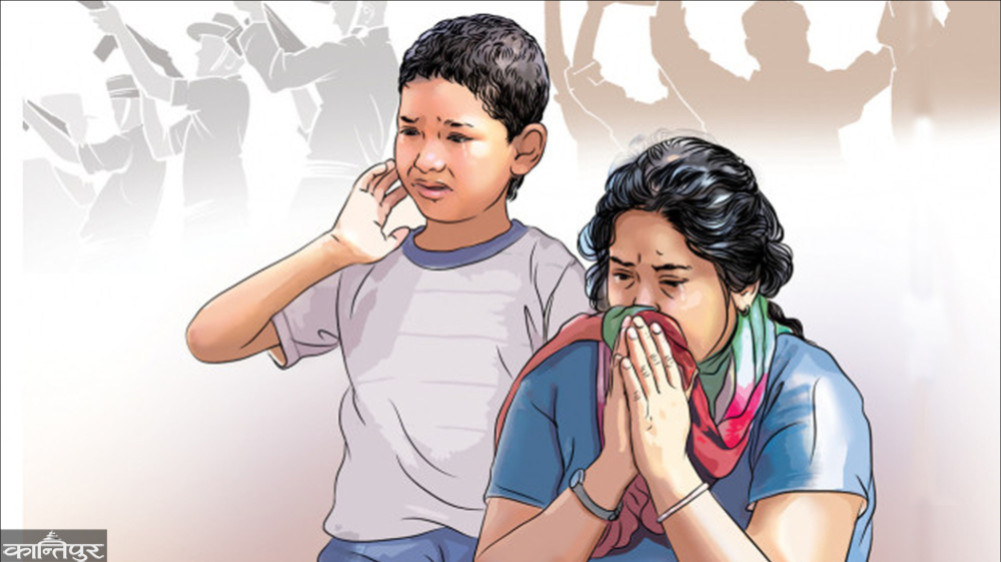
38-year-old Sudha Chaudhary of Raptisonari-3 Baisa in Banke is injured in the armed conflict. His left leg is still unable to fold below the knee. When it is cold, it is difficult for him not only in his legs, but also in breathing.
At the age of 17, the effects of the bullet in the head and chest are still there . The left rib is broken . It is also strong to go up and down . Sudha's husband, who earns his living from farming, was also injured in the conflict. Because of the shrapnel all over his body, he faints from time to time.
"There is no account of how much money has been spent while treating both people," she says. He is teaching his 13-year-old son. What to do even after telling your problem . Everyone laughed when they went to register their names for disability allowance. Even if nothing is visible from the outside, no one can see that the body parts are not working inside . We have been getting disability allowance for almost two years", he said. She says that now when she has problems with her body, she has to continue treatment with the same allowance.
Parvati Budhathoki of Baijnath rural municipality-4 in Banke still shuddered when she remembered the brutal torture and inhumane treatment she had to face in the past. She does not even want to remember the brutal torture given by the state party in 2061 as Maoists. ``Rod used to beat the legs . He used to bury his head in a big drum of water,'' she said remembering those days, 'maybe because of that, now she has trouble speaking, her voice is also dry . I can't even hear because of my ear injury . I can't get up in the morning unless I take painkillers.'
Parvati's husband is working abroad. Her husband's income is not enough as he has to take medicine regularly. Parvati says that if the state government provides free health insurance for health treatment by including the conflict-affected families in the target category, living will be easier.
Baijnath-2 Dhankali Budha, who is living, has also passed away for years . During the conflict, she was beaten and tortured by the state in Jajarkot. The army took him from his house and beat him up on the charge of giving food to the Maoists. She managed to survive after being beaten to death but the injury is still causing pain.
Now she can't even get up from walking, let alone get up. In winter, his limbs do not move, he has to walk with the help of a stick. Even if one day of medication is missed, it is very difficult. The jugular vein is torn. "She would not have survived without the help of medicine," she says. The money earned by the husband working in India has to be washed away.
The victims have been demanding that the state provide medical treatment to those injured during the conflict. But their demand has not been heard anywhere . Lumbini state government has made a procedure . But the Ministry of Internal Affairs and Law of the state government said that it could not be implemented as it was amended only recently.
According to Gangadhar Pandey, a senior branch officer of the ministry, the procedure has not been implemented as it has been revised recently. Many people don't even know. Now we are preparing to publish a public notice," he said, "the limit of health treatment equal to 30,000 has been determined. Treatment facilities will be provided on the recommendation of the administration.' But in the event that more than 30,000 will be required, there is a provision in the procedure that the approval of the ministry is required.
68-year-old Chandrakala Adhikari, who lives in Ward No. 5 of Kohalpur Municipality of Banke, is having a lot of trouble getting medicine for her son. V. No. 2059 on 14 Baisakh from the state side, The eldest son was beaten and injured. The son who was left for dead was found alive. But still not in Hos . Even the mental balance of the son who was unconscious due to the beating is weak,' Chandrakala expresses her pain, 'He feels sad even when he sees a crowd of people . Medicines should be administered regularly. But the economic situation is not strong and there is a problem.'
Kali Damai, who lives in the Kohlpur squatter village, has the same pain. In the year 2061, her husband was made missing by the state. Her husband disappeared and she was beaten to death. Now his life is running on medicine. On the one hand, the pain of losing a husband is going on, On the other hand, it is difficult to pay the expenses for your treatment.
``It takes about five thousand medicine in a month . Earning is nothing . Always asking how much to use,' she says, 'If the government at least provides free medicine to the victims like us, it would be a lot of relief.' The municipality has made a procedure. According to the same procedure, the budget is allocated for the victims of conflict every year,' said Chairman Shahi, 'They themselves discuss what to spend on education, health, income-generating activities.' "Union and state governments are only advocating and not working," he said, "we local governments have also been doing what they can." He said that if the state government wants, it can unite the number of conflict victims and help them in treatment. But he says that there is a problem if it is not prioritized.