We use Google Cloud Translation Services. Google requires we provide the following disclaimer relating to use of this service:
This service may contain translations powered by Google. Google disclaims all warranties related to the translations, expressed or implied, including any warranties of accuracy, reliability, and any implied warranties of merchantability, fitness for a particular purpose, and noninfringement.
33 years ago, there were 1,112 doctor posts in Nepal. Since 2048, the position of doctors has remained the same. After the implementation of federalism, the province has added 704 doctor posts.
The population in 2048 was 18 million. According to the latest census, the population has increased to 29.1 million.
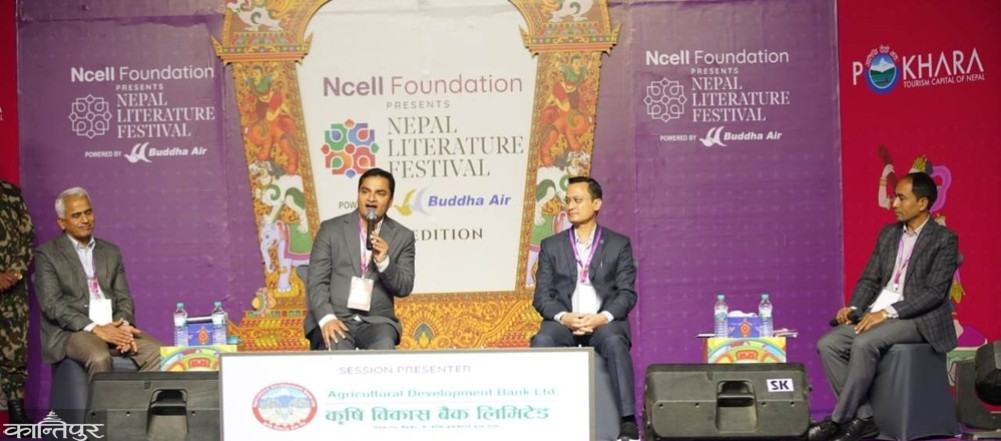
In the last four years, the number of doctors registered in Nepal Medical Council is 8 thousand 624 . Out of the three, 6,368 people have taken good character certificates to go abroad. Presenting these data, journalist Yogesh Dhakal started the dialogue on 'People's access to health care' at the 12th edition of the Nepal Literature Festival in Pokhara.
On Thursday morning, participating in the first session of Bhupi room, Health and Population Minister Pradeep Paudel, Cardiologist Dr. Lord Koirala and Diabetes and hormone disease specialist Dr. Santosh Shakya .
Dhakal asked Health Minister Paudel, 'What did you diagnose in 225 days from the laboratory of the Ministry of Health? Did you see that it should be cured by taking pain killers or surgery?'
Paudel's answer was, 'Surgery should be done.' He claims that there has been some improvement in terms of service expansion. It takes some time to get the feeling. Surgery should be done in many places in terms of giving cetamol or surgery. In terms of policy, management and investment, it seems that we have to do surgery.
He said that although the state has increased manpower in all sectors, it has left out the health sector. "The state increased everyone in the meantime." However, health was missed. Missed the part that should not be missed . It should be corrected', he said, 'Now that we have come, the O&M has been approved by the Council of Ministers to increase manpower in the ministry. I believe that in some time we will create a situation where public service will advertise 500 doctors.' Koirala insisted. For that, he suggested to go for public private partnership model. It is not possible to open the posts of five hundred doctors. In terms of resources, this post cannot be created from the government portfolio. In that case, either you had to run away or you had to find an alternative from here', he added, 'running away does not mean leaving the country . Why public-private partnership is important, we can give examples of organizations that have successfully run in Nepal.'' He said that the government of Nepal has not been able to implement this policy on paper.
Minister Paudel said that along with manpower, improvements are also necessary in terms of equipment and infrastructure. His insistence was, "Let's not despair, not much has been completed". Not managed .'
He said that although the population and the city have increased, the hospitals have not increased. Now the city has become more. It is true that we have not been able to add the hospital and other aspects needed by the hospital", he argued. Minister Paudel emphasized that hospitals should be added in proportion to the population.
To increase people's access to health, emphasize on financial management. Koirala insisted . Who bears the cost along with the treatment? How much does healthcare cost these days? 54 percent of the expenses are paid by the people during the treatment by taking them out of their pockets, this is a national issue.'
He says that the challenge is how to remove people from having to pay from their pockets. Abuse of health workers is also due to financial management. He said, "Unless we can manage the economy, the access to health cannot be increased in the people".
In Nepal, the services of private hospitals are expensive due to the import of equipment and medicines from abroad. Sakya said . In our constitution, basic health should be arranged by the state. Similarly, it is said that there should be equal access to health services, he said, while saying that, it is necessary to have equal health services, concessions, affordable rates and easy access in our private hospitals He claimed that the private sector has invested a lot in health. "You get more in big cities because private hospitals are serviceable for equal health." "Private hospitals have become very expensive due to the cost of infrastructure and land," he said, presenting the reason, "There has been a lot of investment." Modern devices are based on rectangles. Only about 45 percent of medicines are produced in Nepal. The rest is imported from abroad. Private hospitals have become more expensive due to the tax imposed on imports from outside.'