We use Google Cloud Translation Services. Google requires we provide the following disclaimer relating to use of this service:
This service may contain translations powered by Google. Google disclaims all warranties related to the translations, expressed or implied, including any warranties of accuracy, reliability, and any implied warranties of merchantability, fitness for a particular purpose, and noninfringement.
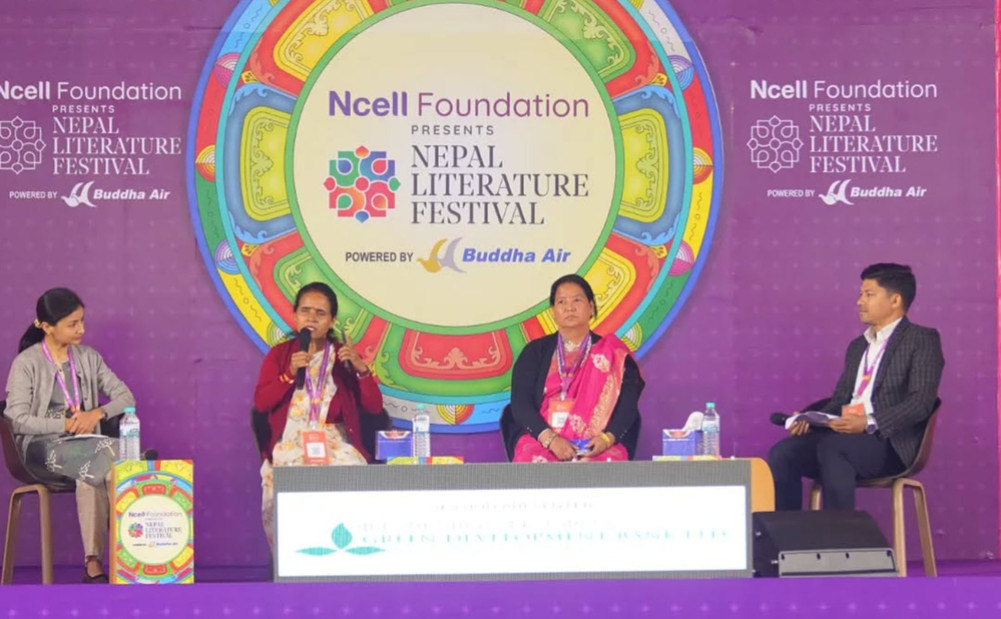
The speaker pointed out that the three-level budget should be inclusive in order to follow the concept of equal development by adopting the inclusive development model. On Friday, the second day of the Ncell Foundation Nepal Literature Festival in Pokhara, 'Kasto Bikasa? Whose development?'' The speaker who spoke at the session said that only three levels of coordination will lead to planned development.
In a conversation with Deepak Pariyar, a Kantipur worker, Lakshmi Pandey, president of the National Village Federation, said that due to the lack of coordination between the government in planning and budget allocation, the budget is allocated to one plan. "We have said that the province should make a regional plan, the Union should make a program of national pride, we will make a program that will touch the hearts of the little ones," said Pandey, president of Hoopsekot Rural Municipality of Nawalparasi (Bardghat Susta) East, "We want to help the Union and the province. It had to be matched. The path is to make one.'
Yesterday, she claimed that village-friendly federalism was brought about because only the union government did not reach the villages. She said that it is necessary to recruit technical manpower from the association to identify the condition of the village by making a geography-friendly policy. "We are going to make a geography-friendly policy," she added, "You can't see the mountains through the binoculars of the lion palace. It can be said that the broken bridge is not visible. After the expert comes, we make a plan. Let's introduce the geography.'' However, she said that there should be less warning where there is warning, where there is no need to warn, it should not be promoted.
He said that it is necessary to focus on inclusive budget allocation for equal development. Local government resources are not available all at once for inclusive development. There are no remote villages and towns like Pokhara metropolis, which have great resources, or Kathmandu metropolis. The need for inclusive development should be met," she said, "therefore, attention should be paid to equitable budget allocation. That is equalization grant of constitutional rights.' She said that the Rural Municipality Federation is running a campaign to ensure that there should be well-governed villages and towns.
Manjudevi Gurung, deputy head of Pokhara Metropolitan City, says that they are prioritizing proportional development, but sometimes the subject comes up without understanding. She claimed that the Pokhara Metropolitan City has given priority to distant wards and old villages. It is giving priority to remote wards, old villages. We have given the billion budget of the World Bank there," she said. We have given plans, connecting roads, and distant wards to bring the worst wards closer to each other.
She claimed that although the municipality has worked, it has not been able to realize the expectations of the citizens. She said that she has done a lot of work including bringing programs in the field of disability, providing access to education and empowering women to connect them with income generation and training. A lot of budget has been allocated only for infrastructure. It has 54 percent. Then there is tourism. If we talk about education, technical education has been given priority," she added, "in agriculture, we have to connect production and tourism here. We have done retail branding of Jheto Budho and Dhondvansi. Citizens' desires and aspirations have increased a little. I could not do as I wanted. But it has happened.'' She said that priority should be given to development and construction based on the needs of geography, population and revenue collection.
Pragya Pradhan, Nepal-based program manager of UN Heavitat, said that before building physical infrastructure, we should pay attention to its needs and effects. It is interesting that the current concept of development is focused on infrastructure. "Physical infrastructure has become a tool," she added, "For whom, why and where to build it, the impact it will bring to the environment, the resources needed to build it and what the impact it will bring should be understood when proceeding with any development."
She emphasized that the concept of 'smart city' should be different from city to city. She said that it should be conceptualized considering the needs of the respective cities. We have to understand what is smart for us. A smart city is a city that makes its own decisions. Smart city makes it easier in terms of services, facilities, health, education,' she said about smart city and added, 'The concept of smart city is to make the city itself. My personal opinion is that a smart city is to make what the city needs, what the people need.' She said that cooperation and coordination between municipalities is also necessary in the work of development and construction, product marketing. He said that there is a problem in development and construction work due to lack of manpower needed to implement the plan at the local level. She said that if there is a subsidy cut like the US subsidy that was recently cut, the country that is moving from underdeveloped to developed will have resource problems.