We use Google Cloud Translation Services. Google requires we provide the following disclaimer relating to use of this service:
This service may contain translations powered by Google. Google disclaims all warranties related to the translations, expressed or implied, including any warranties of accuracy, reliability, and any implied warranties of merchantability, fitness for a particular purpose, and noninfringement.
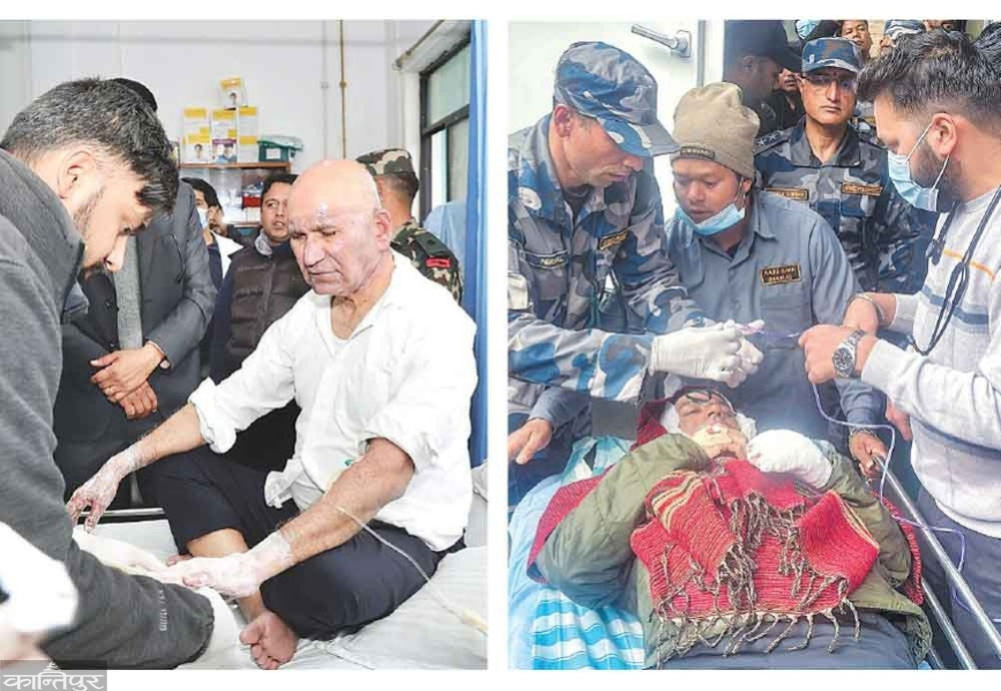
Unpleasant incidents are repeated when security standards are not followed in public events attended by high-ranking people of the state. An example of this is the balloon explosion that took place on Saturday at the opening of Pokhara's tourism year.
Unpleasant incidents have been repeated when high-ranking officials of public positions did not take into account the standards to be followed by the security agencies, the organizing party and the concerned people themselves in the program.
There have been incidents of slapping and slapping public officials before. Due to similar developments, the government changed the norms regarding the event venue and bodyguards to be adopted for the protection of 'special' people.
Last time in November, the government has revised the procedures related to the protection of specific persons and implemented it by changing the system of providing protection to whom and in what form. The Ministry of Home Affairs has formed an 8-member investigation committee under the leadership of Chief District Officer of Kaski, Bharatmani Pandey, to investigate the truth of the Pokhara incident. The
committee has been asked to submit a report with suggestions within 15 days. The committee will find out the cause of the incident and submit a report with suggestions on the precautions to be taken in the future.
Security experts say the incident occurred due to disregard of precautions and safety standards at Saturday's event. Binoj Basnyat, a former commander of the Nepali Army, says that special people who have received security and other facilities from the state have a tendency to view the program they are involved in only politically, and sometimes unpleasant incidents happen.
'Nowadays, it is seen that people who have taken the facility as VVIP/VIP take the public programs they participate in politically and personally rather than from the point of view of security, this thinking is wrong,' he says, 'if a specific person is scheduled to go to a public program, the program schedule and rationale are looked at. The security arrangements of the program, the benefit to the state is looked at, and the specific person goes there and becomes a time-bound format. This is the procedure and recognition, but now I see that the organizers are turning specific people to suit themselves, the incident in Pokhara where the minister was in a balloon explosion is also a result of this.' According to Kaski police chief SP Shyambabu Olia, Kamlesh Kumar has given a statement during the initial interrogation that he has been selling balloons filled with hydrogen gas for the past 12 years.
SP Olia said that the fragments of the exploded balloons have been sent to the forensic laboratory for testing and only after the report comes in will it be known which gas was filled. According to the security agency, the main cause of the incident was the fact that the concerned businessman admitted that the balloon was filled with hydrogen gas, and that the balloon filled with highly flammable gas was kept in a place where it could catch fire.
The former AIG of Nepal Police, Devendra Subedi, says that the incident happened because there was no common sense of what would happen if a balloon filled with highly flammable substances caught fire.
'The Pokhara incident is the result of negligence in following the safety protocol, looking at the background related to the explosion, it seems that the organizers did not even keep a general awareness of the safety protocol,' says Subedi. He said that it is necessary to learn lessons from this incident and pay attention to 'safety protocol' in the future.
Police Spokesman DIG Dinesh Acharya says that security arrangements are being made by making a protocol for 'special persons (President, Vice President, Prime Minister, Chief Justice, Speaker of the House of Representatives and Speaker of the National Assembly)' and general security checks are being carried out for the rest.
"We make a protocol for VVIPs, for the rest, there is a general security check at the venue, usually the organizers make arrangements for the events and matters," he says, "It is not possible to go to every place and monitor the police." Because programs are happening simultaneously in many places. It is not possible for the police to reach every place in every event, so the level of security is decided, the rest is arranged by the event organizer.'
UML President KP Sharma Oli, who was on a Sankalp Yatra on the central hilly highway, was attacked in Dhankuta. On November 28, 2080, Mahesh Rai, who was standing in the reception line, tried to assault Oli. Before that, on February 18, 2076, shoes were thrown on Maoist Chairman and former Prime Minister Pushpa Kamal Dahal in the National Assembly.
Ratan, the son of Mohan Thiruwa of Jumla, who was killed in the armed conflict, threw a shoe at him. Dahal was returning to the sofa after finishing his speech when the shoe was hit. Dahal was slapped by Padam Kunwar of Baglung on November 1, 2069 at Bhrikutimandap.
UML's then President Jhalnath Khanal was slapped by Devi Prasad Regmi after entering the hall in a program held in Sunsari on 8th March 2067. Former Prime Minister Sushil Koirala was attacked in 2068 by Congress worker Pravesh Basnet at an event held in Kapan. In the
event, Basnet hit Koirala with a wooden frame from the front while he was serving food in honor of him. On November 22, 2073, Sanjiv Bhattarai threw a shoe at former Prime Minister Baburam Bhattarai in Pokhara. On December 7, 2080, Ravi Lamichhane, president of RSVP, was attacked with a corn cob in Pokhara.