After being without a chairman in the Securities Board for a year, the application for IPO is slow, since the appointment of the new chairman, only three companies have received permission.
We use Google Cloud Translation Services. Google requires we provide the following disclaimer relating to use of this service:
This service may contain translations powered by Google. Google disclaims all warranties related to the translations, expressed or implied, including any warranties of accuracy, reliability, and any implied warranties of merchantability, fitness for a particular purpose, and noninfringement.
The number of companies applying to the Nepal Securities Board for initial public offering (IPO) has reached 82. The number of companies in the pipeline for IPOs has increased as the approval process stalled for almost a year. That company is preparing to issue an IPO worth 51 billion 11 crore rupees.
After the Securities Board became chairmanless in December 2080, the approval process for the IPO was halted. The government appointed Santosh Narayan Shrestha as the president only last November. Since Shrestha became the chairman, Nepal Laghubima, Crest Microlive Insurance and Om Megashree Pharmaceuticals have received permission for IPO. There is a legal provision that shares must be issued within two months of getting permission from the board.
Applications filed with the Securities Board for IPOs are up to two years old. The related companies complain that the capital planning schedule of the projects has been affected due to the lack of share issuance permission for a long time. In the ordinance brought by the government a few weeks ago, it is mentioned that the performance of the government will be made faster and more efficient. In the Good Governance (Management and Operation) Act 2064, which was amended through the Ordinance, it is mentioned that the concerned officer shall make a decision within seven working days after receiving the information, evidence or document, considering the nature of the matter.
According to the amended act, the board has not expedited the process of giving permission for IPO. Niranjay Ghimire, the spokesperson of the board, claims that the applications that meet the criteria will now get permission quickly. "Applications that meet the criteria have been allowed to issue shares," he said, "some companies have already received permission."
An official of the board said that only those whose net worth per share is above 90 rupees, who have applied to issue shares at face value and there are no disputes, have been proceeded with the process. Earlier, the Public Accounts Committee of the Parliament had instructed not to proceed with the share issuance process of companies with a net worth of less than 90 rupees.
After the board amended the rules and made it possible to calculate the net worth for the purpose of issuing IPO by revaluing the company and increasing the price, the parliamentary committee instructed to maintain the limit of net worth after the companies that were going for liquidation also started issuing IPO by increasing the valuation on their own. The
committee's instructions given in December last year said, "The board is instructed to adopt a book building process where the price is determined by the competition of investors and to allow only companies with a net worth of more than 90 rupees to issue an IPO without revaluation." Based on that instruction, the board has started the process only for companies with more than 90 net worth, said the official.
According to the
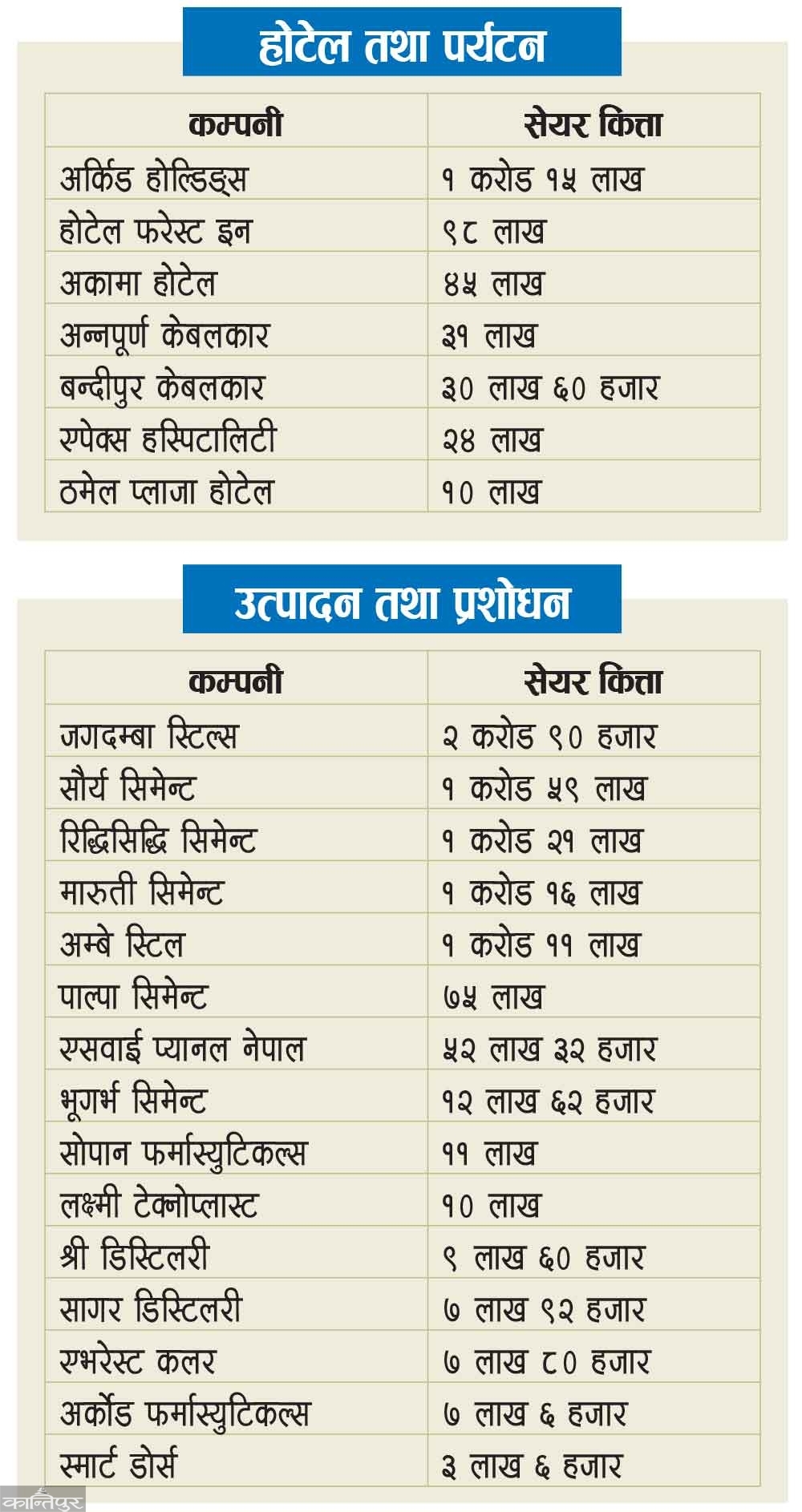
board, 82 companies have sought permission to issue 355 million 37285 shares (IPO) to the general public. Seven companies in the hotel and tourism sector have applied to issue 353,600,000 shares of IPO worth 3.311 million rupees. 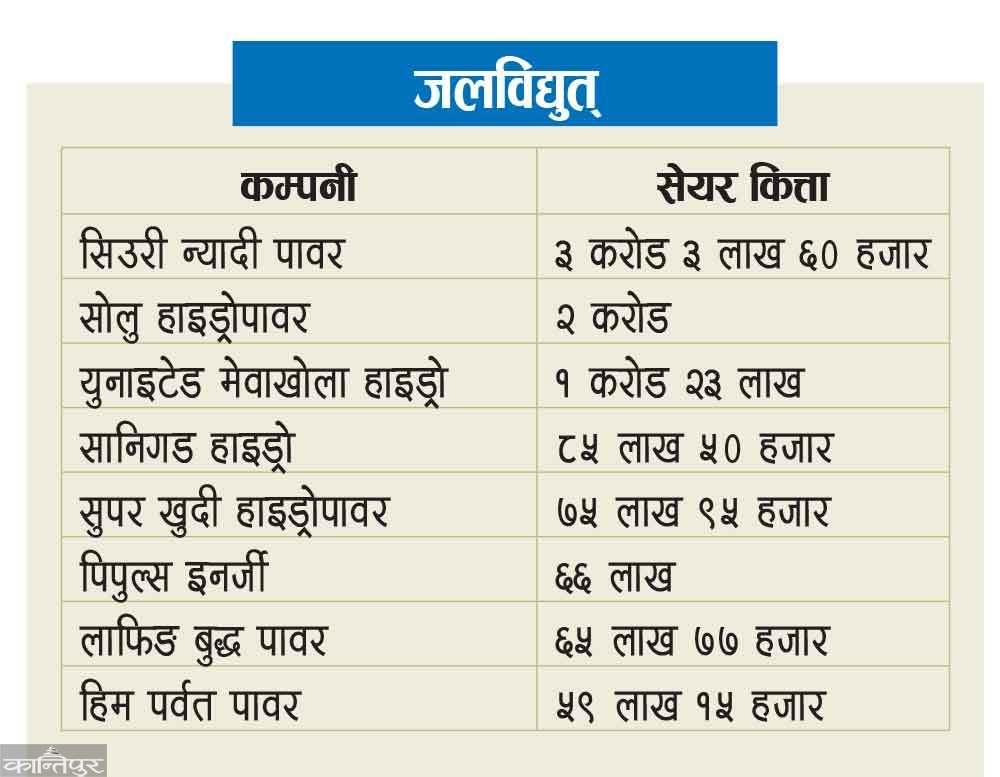
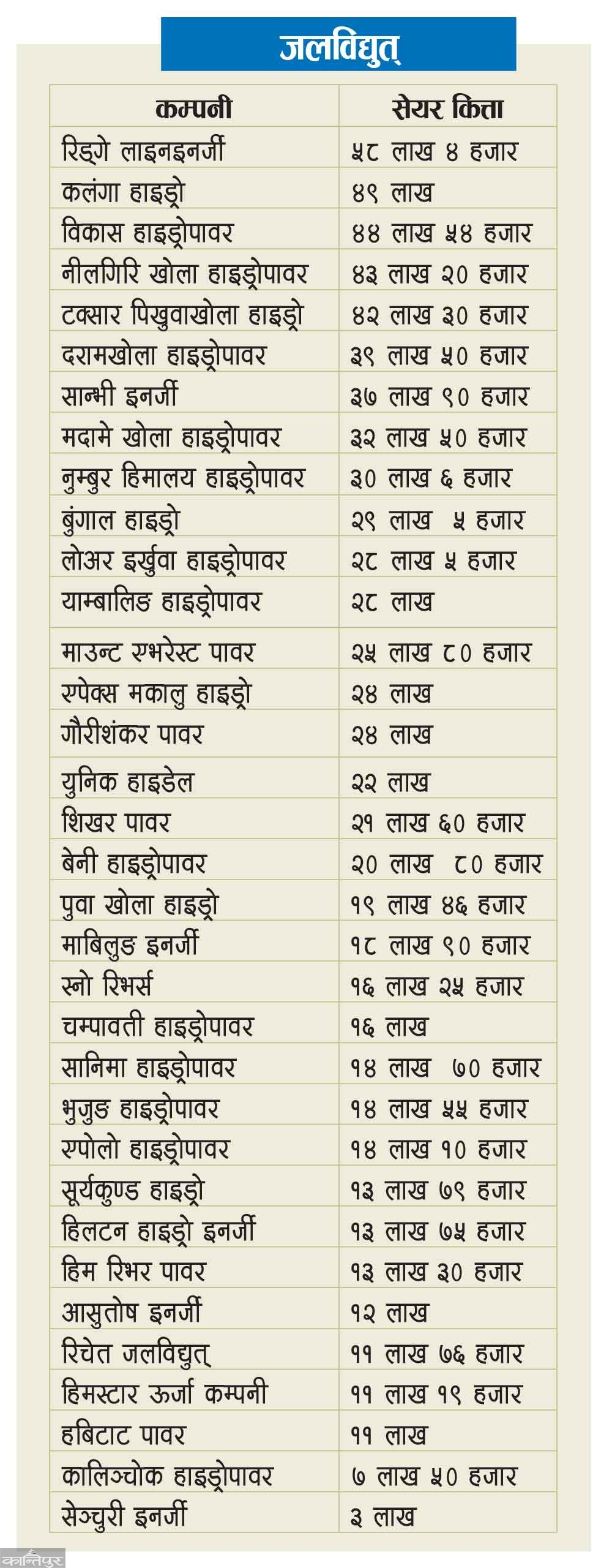
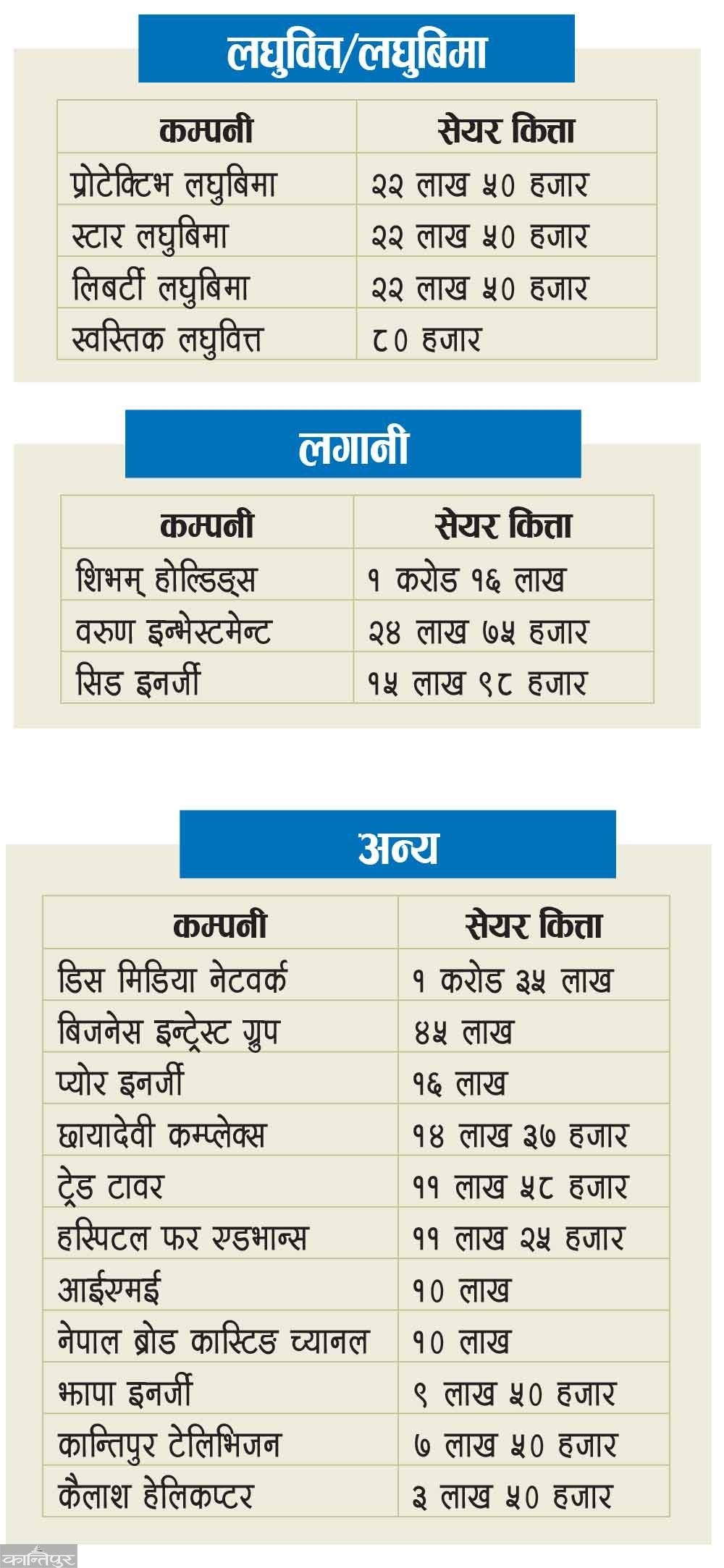
Similarly, an application has been made to the board to issue 179 million 61 thousand shares worth 18 billion 33 million 33 million 83 thousand rupees from 42 hydropower projects. Three companies under the investment group have applied to issue 1 crore 56 lakh 73 thousand 500 shares of IPO worth 2 billion 84 crore 33 lakh 50 thousand rupees.
15 companies are in the process of issuing 96 lakh 55 thousand 684 shares worth 22 billion 54 crore 37 lakh 76 thousand rupees towards production and processing. Ganesh Karki, Chairman of Independent Energy Producers Association of Nepal (IPPAN), said that the capital planning schedule of the hydropower project has deteriorated due to the lack of share issuance permission for a long time and this has caused problems in the hydropower system itself.
Investors are said to invest 70 percent of the capital themselves while building a project and raise the remaining 30 percent through the sale of shares (equity). 10 percent of that share is distributed to the project-affected locals. 20 percent is distributed to other general public.
President Karki said that there was a resource problem in the project because the shares could not be issued at the specified time. "When we submitted the capital plan blueprint to the bank, it was promised that we would invest 70 percent of the capital, and the remaining 30 percent would be held by selling shares to the local people and the general public within this time," he said. Banks are going to say that the IPO will not go, anyway, they have to put in the remaining 30 percent of the money. This has added more problems to the project.'
According to Ganesh Karki, president of IPPAN, a project takes a short-term loan from the bank on the condition of paying the loan after issuing the IPO. "These companies have not been able to issue IPO, now the bank is pressuring them towards loans." There is a legal provision for credit rating before issuing shares even for hydropower projects. Along with that, underwriting (agreement that I will buy the shares if they are not sold) should be done.
One time underwriting period is only for 6 months. Chairman Karki also said that since the Securities Board did not allow the issue of shares for a long time, the project had to re-underwrite every 6 months, causing a huge financial loss.
The number of companies listed in Nepal Stock Exchange (NEPSE) has reached 267 as of last December. Among the listed companies are 129 banks and financial institutions and insurance companies. There are 91 hydropower, 22 manufacturing and processing industries, 7 hotels, 7 investments, 4 commercial organizations and 7 other group companies, according to NEPSE data. In December 2080, the number of listed companies was 271.
Among listed companies, banks and financial institutions and insurance companies account for 59.2 percent of the securities market capitalization. The share of hydropower company is 14.7%, the share of investment company is 7.9%, the share of production and processing industry is 5.6%, the share of hotels is 2.8%, the share of commercial organizations is 0.5% and the share of other group companies is 9.3%.

