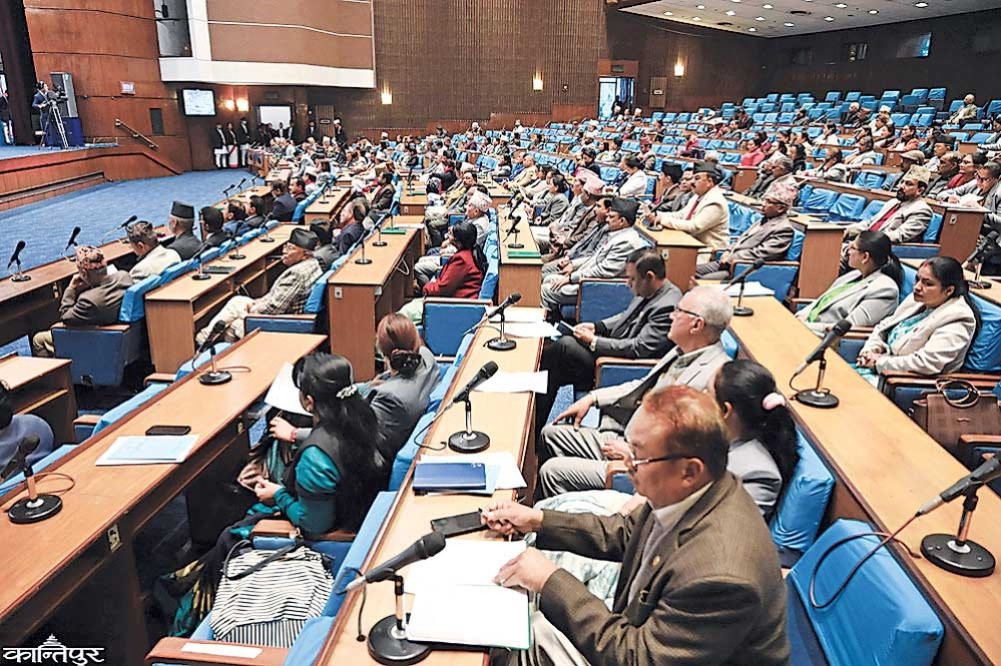
In the bill session, the discussion on the bill stalled, parliamentarians only raised issues of government and people's concerns in the House.
We use Google Cloud Translation Services. Google requires we provide the following disclaimer relating to use of this service:
This service may contain translations powered by Google. Google disclaims all warranties related to the translations, expressed or implied, including any warranties of accuracy, reliability, and any implied warranties of merchantability, fitness for a particular purpose, and noninfringement.
Although two weeks have passed since the beginning of the winter session, the Parliament has not been able to speed up the legislative work. As the majority in the National Assembly is not assured, the government has not proceeded with the ordinance approval process, and the House has not received other "business" related to law making. Parliament has become only a place where parliamentarians raise issues of government and public concern.
In the first meeting of the winter session, the government submitted 6 ordinances. An agenda was also made to submit the ordinance to the meeting of the National Assembly and the House of Representatives on January 24. After the majority of the National Assembly was not reached, the agenda of 'submitting a motion to accept the ordinance' was removed from both houses at the request of the government. Since then, the government has been involved in the homework of getting a majority in the National Assembly.
In the agenda of Tuesday's meeting of the House of Representatives, it was mentioned that the anti-corruption bill would be advanced. It has also been removed suddenly. The State Order and Good Governance Committee has completed the discussion on the bill and prepared the report. At the last moment, the main opposition Maoist protested in the Parliament after the Prevention of Corruption (First Amendment) Bill was removed from the agenda. Earlier, on January 25, the legislative bill was removed from the agenda.
Maoist's chief whip Hitraj Pandey says that it is clear that the government does not care about the parliament after looking at the arrangement of the six parliament meetings held in Magha. "The facts say that, sometimes things that have been put on the agenda are being removed in the name of minister's lack of free time and sometimes in other names," he said. The bill passed unanimously by the committee has been amended in the assembly by the strength of the majority.'
The law, justice and human rights committee unanimously passed the report of the legislative bill and brought it to the assembly. The Assembly has already passed the bill with the revised proposal on the basis of majority. Pandey says that the arrogance of the majority has been shown by ignoring the efforts of consensus in law making.
Even though there is a majority in the House of Representatives, the ruling Congress and UML do not have a majority in the National Assembly, due to which the future of the six ordinances brought by the government is in doubt. The government introduced the Ordinance on Cooperatives, Economic and Business Environment Improvement and Investment Enhancement, Good Governance Promotion and Public Service Delivery and amending some Nepal Acts related to Land, Privatization (First Amendment) and Economic Procedures and Financial Responsibility (First Amendment) Ordinance. Among them, the land ordinance has become the most complex.
Before the start of the winter session of Parliament, the government announced that the ordinance would be passed on a 'fast track' basis. The ruling LOSPA and the ruling party JSP Nepal, which is outside the government, have already decided to reject the land ordinance. Dissatisfaction has also been seen within the ruling Congress regarding the land ordinance.
That is why the government has not moved forward with the ordinance. The ordinance is not included in the calendar of the possible agenda prepared by the Parliament Secretariat for the meeting till February 13. Maoist leader Pandey said that instead of winning the trust of the Parliament and approving it, the government brought 6 ordinances by circumventing the Parliament and insulting the Parliament. He mentioned that the problem is because the government is trying to run the parliament only according to its interests.
Government spokesperson Prithvisubba Gurung, Minister of Communications and Information Technology, said that the ordinance is currently being discussed between the political parties, so there is no situation as to whether it has been approved or rejected. According to the constitutional provision, the ordinance must be passed by both the House of Representatives and the National Assembly, so efforts are being made to get the support of the parties, he informed.
All ordinances have been tabled in Parliament. The proposal of the ordinance will be placed on the agenda of the Parliament to be passed by the entire National Assembly," he said. There is a constitutional provision that the Ordinance will automatically become inactive after 60 days of the meeting of the House if both Houses do not accept it or the House meeting does not take any decision on it.
Although the prime minister and government ministers blame the parliament for the delay in legislative work, the government itself is the reason, says Santosh Periyar, the chief whip of the Rashtriya Swatantra Party. "There has been a public discussion on behalf of the government that the parliament has been slow in making laws," he said.
Pariyar says that the government seems indifferent to make the parliament effective and to establish the rights of the people through the parliament. "The government is devaluing the parliament by putting the issues on the agenda and dropping them," he said.
The government had announced that the winter session would be a real bill session. The government announced in the early days of the parliament that it is ready to take many bills to the parliament and pass them as soon as possible.
Prime Minister Oli himself addressed the House of Representatives meeting and said that the bill submitted to the Parliament should be passed within 60 days. He also complained that Parliament takes too much time in making laws. Parliamentarian Pariyar said that the government has not played a role in making the parliament result-oriented as Oli expressed. "Looking at the current pace, it does not seem that even this convention can produce results in the legislative sector," he said.
29 bills including 20 submitted in the previous session and 9 recently brought by the government are in the parliament. From that, two non-governmental bills are also pending in the parliament. Ekram Giri, the spokesperson of the Parliament Secretariat, said that the session was in its early stages and accordingly, there was no lack of 'business'.