”This is the third year in a row, 80 percent less rain has fallen in winter, it has increased the temperature in the Himalayan region and the snow has melted.”
We use Google Cloud Translation Services. Google requires we provide the following disclaimer relating to use of this service:
This service may contain translations powered by Google. Google disclaims all warranties related to the translations, expressed or implied, including any warranties of accuracy, reliability, and any implied warranties of merchantability, fitness for a particular purpose, and noninfringement.
As the early sunlight was falling on the peak of Machhapuchhre, 65-year-old Bishnumaya Adhikari of Astham village in Kaski was sitting on the dill of Toribari last Tuesday.
'Even when winter was about to end, there was no snow on Machhapuchhre,' she said, 'Yesterday the old man (Sashi) saw a little snow on the top, he said that the black iron-like mountain looked white even though it was a little white, but today that snow has also melted.' -break Foreign and domestic tourists come to Astham Thakura to see the beautiful view of Machhapuchhre and Annapurna Himal from up close. Tourists going on Mardi trek via Dhampus also come and go from here. A local baama like Bishnumaya said to the tourists who were walking through Pahenalpur Toribari to capture the first glimpse of sunlight on the top of Machhapuchhre, 'Machhapuchhre has never been seen so black before.' Vishwa Adhikari, the owner of Eco Village, said, 'The fish tail has a beak, it is long Time cannot stand still, it must fall. There was no snow this year because it did not rain.
From the area around Pokhara, you can see 12 mountains including Annapurna, Mardi and Machhapuchhre. Ganesha and Manaslu are also visible when the weather is clear. Although there are many mountains, the identity of Pokhara is the fish tail. 60-year-old Asim Gurung, a businessman who has been running Gurung Cottage in Ghandruk for 25 years, says, "The first question of tourists is why the fish tail has become like this."
Climate change expert Dr. Dharmaraj Upreti said that this happened because the rainfall in winter was very less than the average for the past three years. "When there is no rain, the temperature of the Himalayan region increases and if the existing snow melts, a new snow system cannot develop," he said. According to
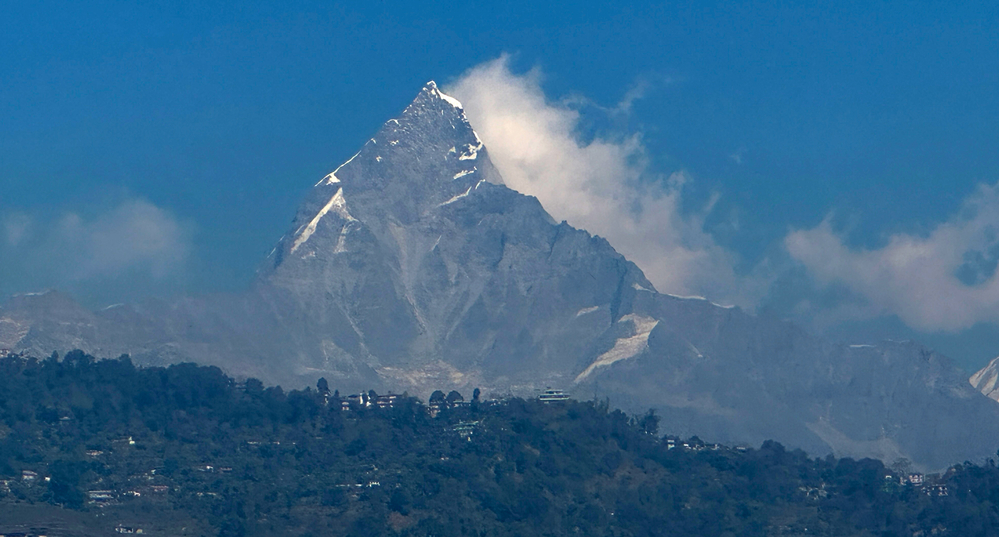
Upreti, this is the third year in a row that winter rainfall has been eighty percent below average. This has caused the temperature in the Himalayan region to be higher than the average and the snow has melted. "The system that needs snow, the westerly wind must be strong to develop, but it is weak," he said, "The temperature of the Mediterranean Sea is below average, so the system that should develop from there and come through Afghanistan and Pakistan, it Couldn't be active and it didn't rain, it didn't snow on the mountains.'
He said that there is a possibility of slight improvement as there are signs of light rain on January 19. "During the period of three years, only 5 percent of rain has fallen during winter, this year it seems that there will be less rain than the previous two years," Upreti said, "Hocha Himal has been more affected, where the snow cover has not melted already, some snow has been seen on it. But the mountains that continue to melt the snow are bare.'
Tourism businessman Gurung says, 'If there is no snow, it is not only a matter of surprise for the tourists, but for the locals living in the foothills and laps of the mountains, there is a big concern about the life cycle.' The experience is local. Gurung adds, 'Earlier, global warming was thought to be strange, now we have to see its effects in front of our eyes.' "The provincial government is doing the work of making the development and infrastructure work from the local level environmentally friendly," he says, "but it seems that the powers that have caused the problem due to more carbon emissions are trying to retreat from solving this problem." story- break American President Donald Trump has already announced that he will cut the subsidies given by the United States in the climate sector after taking office. Concerns have been expressed that this will affect the climate change program.
The Himalayan region is the most affected by climate change due to carbon emissions by powerful nations. We are directly affected by it, the effect seen in Machhapuchhre is the result of that,' Chief Minister Pandey said, 'To save Himal, a provincial government, the federal government does not just want to, national and international initiatives are needed.' With the expansion of new 'trekking routes' being developed in and around Machhapuchhre, the 'eco system' of the Himalayan region is being affected as sheep sheds are being converted into hotels/restaurants with modern facilities. He thinks he's gone. He said that due to the increasing development of hotels/restaurants on the trekking route, it will affect the 'eco system' of the Himalayan region and from the next fiscal year, it has been forbidden to light fires in Machhapuchhre Rural Municipality, Annapurna Conservation Project (ACAP) and local businessmen.
"On the one hand, the mountains are melting, on the other hand, the use of firewood is being tried to be stopped as human activities affecting the eco system are increasing," Gurung said, "It takes 15/20 years to grow a tree in the Himalayan region. If the use of firewood increases, the forest will disappear, and our mountains will not survive.'
Machhapuchhre Rural Municipality is the third largest among the five local levels of Kaski. From the minimum height of 1026 meters above sea level, the maximum height of Machhapuchhre Himal within this rural municipality is 6988 meters. The scenic view of Machhapuchhre and the Annapurna Himal on the south lap is the tourist attraction here.
Machhapuchhre Rural Municipality extends from the junction of Seti and Mardi in the south to Annapurna III in the north. The main river is the Seti flowing from its southern foothills. Modi, Mardi, Idin, Saiti, Kuibang/Raka, Siding, Chumdi, Valundi, Batase, Dhiprang, Bhurjung, Sardi, Sadhu/Dangdunge rivers flow through this area. All of them go to the seti and get mixed. Small and medium capacity electricity is being produced from these rivers and streams. Irrigation and the main source of drinking water in Pokhara city is the river/river flowing from Machhapuchhre.
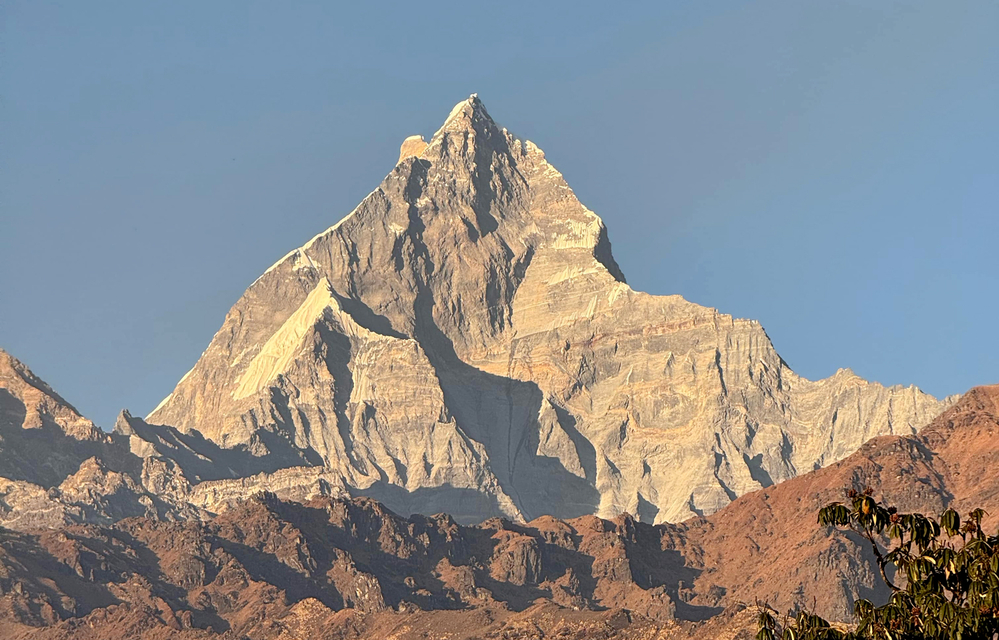
Ward Chairman Gurung says that even the river is drying up due to increasing human activities and changes. "When we were children, it used to snow up to 10/15 feet in Ghalel village, now there is no snow in Machhapuchhre even in winter. The glaciers are gradually drying up," he said.
Ganesh Gurung, a businessman from Kaski Naudanda, who is also a state MP, expresses his concern that the human life cycle could be damaged if Himal becomes blackened. In his own experience, Machapuchhre was covered with snow twice a year. Rivers and streams also flooded twice a year. Once by rainwater and another time by melting snow. "Machhapuchhre now looks like a woman without a bulaki on her nose, it has not been seen like this until now," he said.

