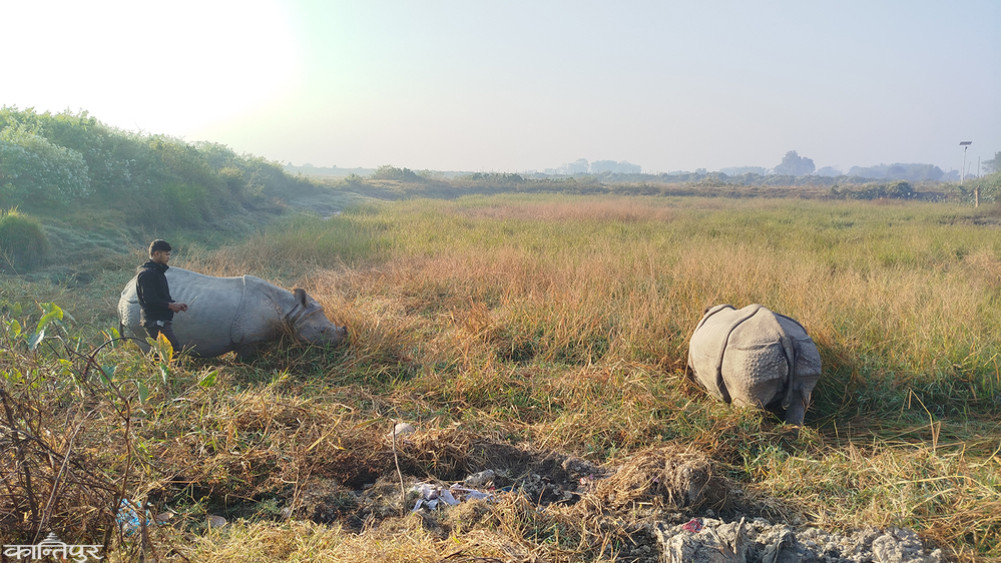
”The habitat here is suitable for them and they are happy. There was not much difference between living in Chitwan and living here, they became 'adopted' easily.” - Birendra Gautam, Koshi Conservation Center
We use Google Cloud Translation Services. Google requires we provide the following disclaimer relating to use of this service:
This service may contain translations powered by Google. Google disclaims all warranties related to the translations, expressed or implied, including any warranties of accuracy, reliability, and any implied warranties of merchantability, fitness for a particular purpose, and noninfringement.
The winter sun spread far and wide from early morning. However, the grass had not been covered by frost at night. Pushpa and Anjali did not care to graze. According to their morning routine of grazing until their stomachs are full, drinking water and resting, they were absorbed in raking green grass in the drought-dried grass.
This scene is on reaching Pathri sector of Koshi Tappu Wildlife Reserve in the second week of December. Pathari Sector is located on the banks of Triyuga River, 12 km northwest of Kankalini Temple at Saptari, near Mahendra Highway.
Wildlife technician Durganand Yadav was taking care of Pushpa and Anjali in a three-hectare enclosure (large cage) within the reserve. According to Birendra Gautam, head of the National Nature Conservation Fund, Koshi Conservation Center, arrangements have been made inside the enclosure surrounded by tarpaulin, a cage for keeping at night, grazing area/grassland, a pond for drinking water, and a pond. Ever since Pushpa and Anjali were transferred from Chitwan National Park to Koshi Tappu last year, Durga has not left their side . They take care of him from the morning to the night until he goes to the cage.
Now that it is winter season, they open the cages around 6 o'clock in the morning. Both rhinoceros go out to graze . They open at five o'clock in the summer season. An hour and a half after Pushpa and Anjali go out to graze, Durga also walks together. "I have to go out together to see whether they are grazing well, their health, and their habits," he said. They graze till 8/9 in the morning and come to call stream to drink water. To drink water, water is poured into large vessels. There are also pools. Then they rest for two hours. After resting and waking up, they feed water again, take a bath . After this, they come to graze in the pasture again. Then they play in the pool for half/an hour . They get up and graze from there. After evening, Durga calls both the rhinoceros by name and brings them to the cage and locks them. While sitting in the cage in the evening, the doctors like Peepal, Khair, Kadam, Swami and others put grass for Khan.
Pushpa and Anjali were rescued and brought up after being separated from their mother and orphaned in Tamaspur and Kujauli area of Chitwan. Since Koshi came to Tappu, Durga has also been included in this daily life of Pushpa and Anjali. He had never been able to see a rhinoceros directly while he was grooming an elephant. After bringing it from Chitwan, he was given the responsibility of taking care of the rhinoceros. At first he was scared because neither he knew the customs nor the rhinos knew him . Not knowing the nature of the rhinoceros, it tried to hit it two or three times when it approached.
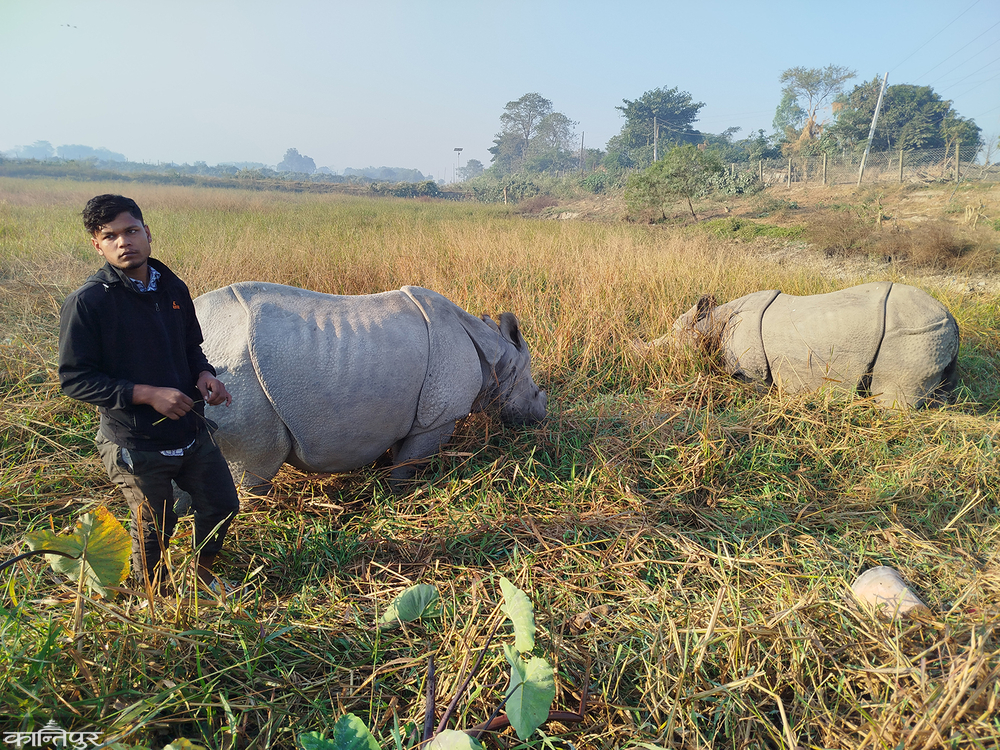 'The first time I saw a rhinoceros was after I brought it, before that I had never seen it, at first I was afraid, it used to stay far away,' he said, 'The elder brother who came from Chitwan taught me to approach little by little, to give fruits when I leave the cage in the morning, now. Lal Bahadur, a wildlife technician from the Biodiversity Conservation Center who came to bring Pushpa and Anjali from Chitwan. Mahatara stayed in Koshi Tappu for a month and took care of it . From him, Durga learned the behavior of a rhinoceros. He has come close to the habits of Pushpa and Anjali, which environment they prefer, how they express happiness and anger.
Durga says, "Pushpa and Anjali have blended into the environment of Koshi Tappu". They eat and sit happily.' They are starting to look stronger than before. "5.5-year-old Pushpa and 4.5-year-old Anjali are exactly like sisters together, they graze together, swing together, have fun together," added Gautam, head of the Koshi Conservation Center of the National Nature Conservation Fund.
If they are happy, they will come wherever they are called . Even if you call by name, even if you call with a hand gesture, Durga will reach you. They graze with joy. If they are angry, they make their eyes red, climb on each other's legs, bite, bite the soil, blow their noses, run, go outside the enclosure . If they are angry, they are likely to attack people, so they should stay away . Shouting from afar, driving away. Due to the drought, the grass comes out after drying up, so Durga shows the grass and brings it back inside .
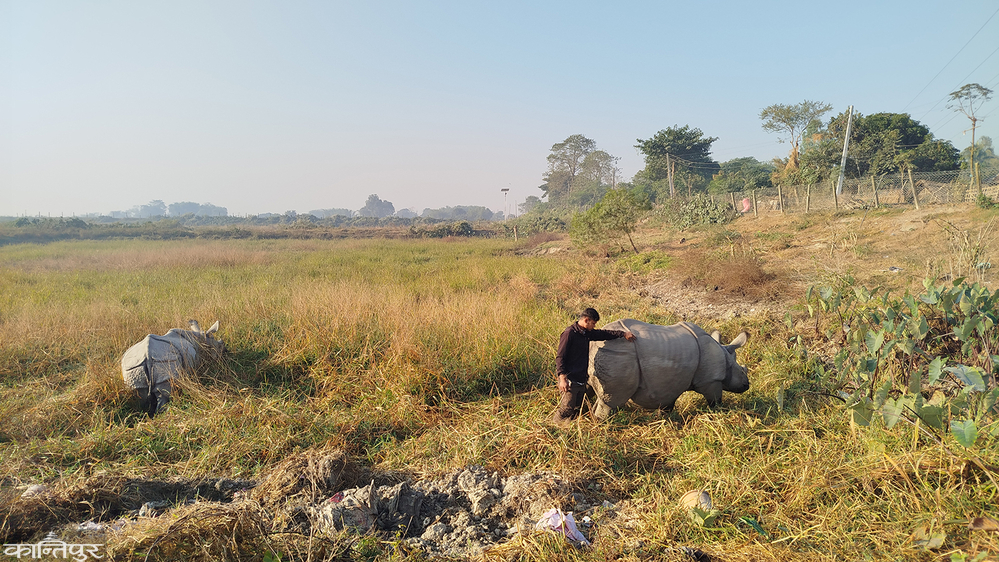 Pushpa and Anjali were brought here from Chitwan National Park on October 10 last year on the occasion of World Tourism Day. It was relocated from Chitwan three years ago after a study by a technical committee of the National Parks and Wildlife Conservation Department recommended that Koshi Tappu has a suitable environment for rhinos. Gautam said that since both the relocated Koshis are mixed with Tappu's environment, now the aim is to expand the lineage of rhinoceros and develop the tourism and reserve here. "The residence here is suitable for them and they are happy. There was not much difference between living in Chitwan and living here, they became 'adopted' easily," he said.
Although Pushpa and Anjali are kept in an enclosure, they are sometimes taken with elephants to roam in the forest of Koshi Tappu. Gautam said that they enjoy going to the forest with elephants. As it is likely to be unsafe outside, it has been brought and kept in the enclosure in the evening. He said that the work is being done according to the plan of the Ministry of Forest and Environment, which is to be left open in the forest while expanding the number. "In the Koshi Tappu Reserve, only rhinoceros can be seen, but now rhinoceros can also be seen," he said. .'
There is a plan to develop the rhinoceros conservation area by adopting two-stage security measures to release the rhinoceros in the wild. Preparations are being made from this month to release the rhinoceros living in an area of one and a half square kilometers in an area of four square kilometers in the first phase and in an area of 16 square kilometers in the second phase. Gautam said that it may take four to five months to make the first phase structure.
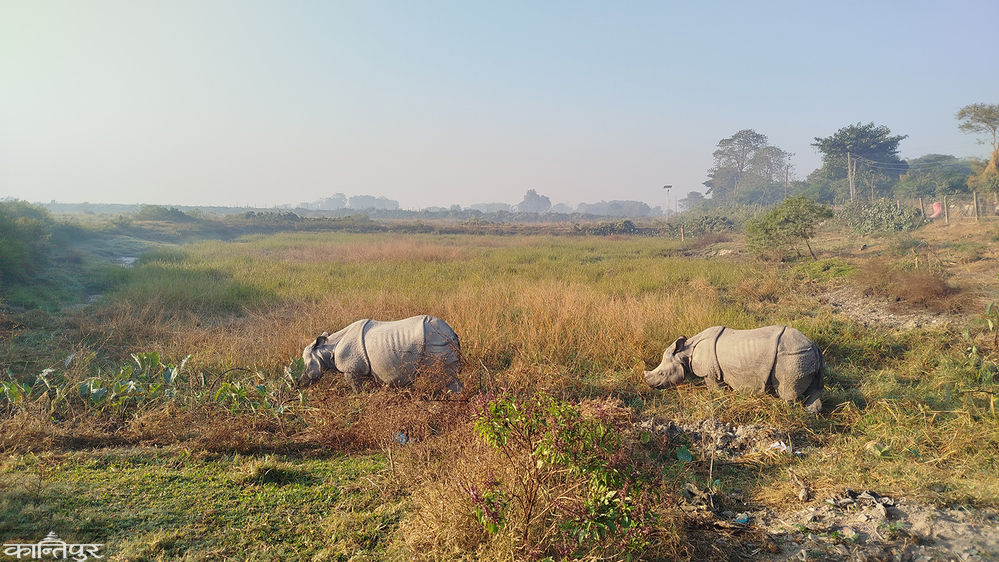 6 months after Pushpa and Anjali were brought to Koshi, a male rhinoceros named Meghauli was taken from Chitwan and left in the enclosure to expand the lineage. However, the rhino had a habit of going to the market town instead of the forest and the risk of getting sick after not eating food was increased, so it was taken to Chitwan within a few days . Gautam said that since Pushpa and Anjali have started to see the 'maturity' of expanding their lineage, they had to bring a male rhinoceros.
Domestic tourists have been coming to see Koshi Tappu, which is considered to be the capital of wild buffaloes, since it was found that rhinos have been brought to them every day. This has created employment at the local level by opening food and snack shops. Homestays have also been developed in Pathri sector. Koshi Tappu Wildlife Sanctuary was established in the year 2032 for the conservation of wildlife. The reserve is spread over 175 square kilometers of Sunsari, Saptari and Udaipur.