We use Google Cloud Translation Services. Google requires we provide the following disclaimer relating to use of this service:
This service may contain translations powered by Google. Google disclaims all warranties related to the translations, expressed or implied, including any warranties of accuracy, reliability, and any implied warranties of merchantability, fitness for a particular purpose, and noninfringement.
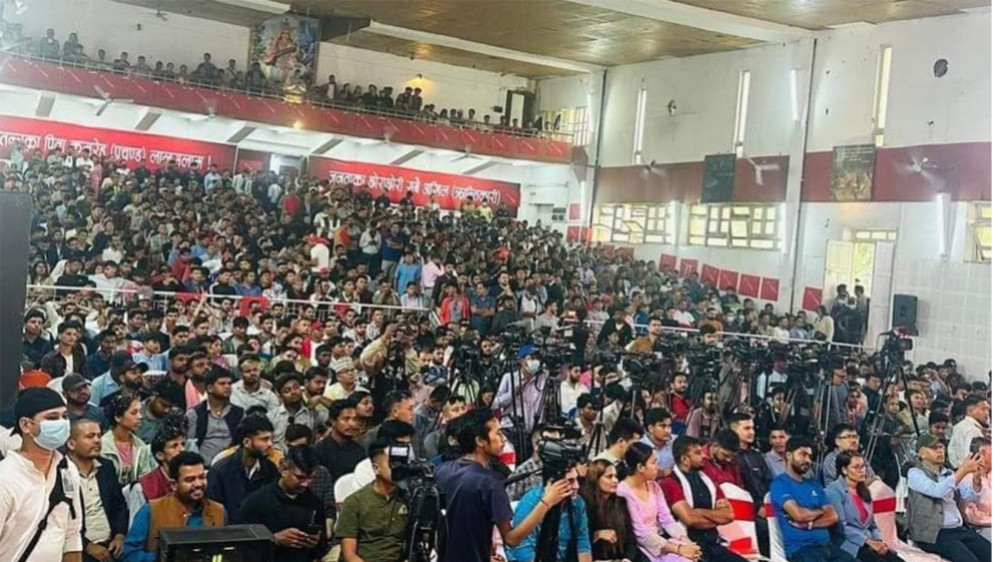
There is a fierce competition between President Pushpa Kamal Dahal and Deputy General Secretary Janardan Sharma for the leadership of the student organization of the Maoist Center. Even though the founding party tried to select the leadership unanimously, there was no consensus, so the intense competition intensified.
The founding party has nominated Vijay Sapkota as the president, while the Sharma party has nominated Hemant Rai as the president. Senior vice-president Narayankaji Shresthanikat leader Upadesh Yadav has also nominated for the post of president. Within the establishment party, discussions are going on to make a common candidate. Yogendra Bahadur Budha, Bishwamani Thapa, Sudin Paudel have also nominated for the post of president.
For some time now, when the inter-conflict between Dahal and Sharma has been raging between Dahal and Sharma, it has been evident in the leadership selection process of the student organization.
In the last central office meeting, Dahal said that it would be appropriate to elect the unanimous leadership of the students, but he said that open competition should not be stopped. Sharma's stand was that the leadership should be selected through direct elections in the student organization when the debate about open competition was going on in the party.
The election for the leadership of the student organization within the Maoists, which decided to postpone the inter-struggle and go on a nationwide campaign in the last central committee meeting, has seen a two-line struggle. After the Sharma party set up another panel at the official level against the establishment party, a clear two-line struggle has erupted in the Maoists.
In July 2081, Sharma questioned President Dahal saying that the party was not democratic and that the party should be built and the leadership handed over. After that, the issues raised by him were discussed in consultation meetings in all seven provinces. After repeated discussions between Dahal and Sharma, the Central Committee meeting held in the third week of December decided to hold a political campaign on Hulaki, Mahendra and Madhyapahari highways keeping the inter-conflict at bay. But after the establishment of the student organization and different panels of Sharma, the conflict came to the surface.
According to a leader of the Maoist center, Sharma has made a candidate against the establishment party in the style of a show of power. Maoist central member and student in-charge Himal Sharma mentioned that the students were candidates independently and claimed that there were not two or three panels.
"Student leaders are competing independently," he said, "this or that panel has not been announced." He said that efforts to reach consensus will continue until the candidates are withdrawn. But another student leader has mobilized the leaders to win the organization and the Sharma party in their panel (official level).
But another student leader has mobilized the leaders themselves to win the organization and the Sharma side in their panel (official level). "Both sides are making internal preparations to win their candidates," said the leader, "It is also a kind of power struggle." Tirsna Hamal, Roshan Khadka, Shiv Basnet and Shyam Roka have nominated themselves as general secretary from the
organization side. The Sharma party has made Roshan Thapa Magar the candidate for the general secretary.
According to the constitution of All Revolutionaries, one president, 4 open, 5 inclusive, 9 vice presidents, one general secretary, 9 deputy general secretaries, 12 secretaries and 1 treasurer will be elected.
There are more than a dozen candidates for vice president. Lal Bahadur Pandey, Atal Acharya, Jeevan Khadka, Mamta Adhikari, Samip Kharel, Tulsiram Neupane, Tankprasad Upadhyay, Subin Chasale, Parvati Negi, Chitra Sunar, Babiraj Thapa, Sandeep Pun, Gyanu Khadka, Khem Bahadur Singh, Madan Dhakal, Rajan Pokharel, Muna are the vice presidents. Thapa Magar, Abhimanyu Yadav and Manisha Acharya, Krishna Bahadur Sunar, Janak Bahadur Batala, Ashish Vastakoti, Rajivvaran Neupane, Padam Nepali, Surajkumar Bhandari, Muna Kapri, Budros Limbu, Prasha Das, Sanjeev Kumar Choudhary and Ramesh Acharya have filed their candidature.
Sanjay Kumar Mahato, Sanjeeb Phuyal, Govind Baniyan have also submitted candidatures for the post of General Secretary. 500 nominations have been submitted for the 243-member leadership of Akhil (Revolutionary). All nominations were given through online mode. According to the previous statute, 33 officials will be elected. Voting for leadership will be held on January 12 in the election centers of all seven provinces.
In the election held on January 14, the majority came in favor of imposing an age limit of 32 years on all revolutionaries. According to the result of the vote, the competition is going on among the students under the age of 32 to take the leadership.