Despite the increase in exports by 32 percent, the trade deficit increased by 4.38 percent
We use Google Cloud Translation Services. Google requires we provide the following disclaimer relating to use of this service:
This service may contain translations powered by Google. Google disclaims all warranties related to the translations, expressed or implied, including any warranties of accuracy, reliability, and any implied warranties of merchantability, fitness for a particular purpose, and noninfringement.
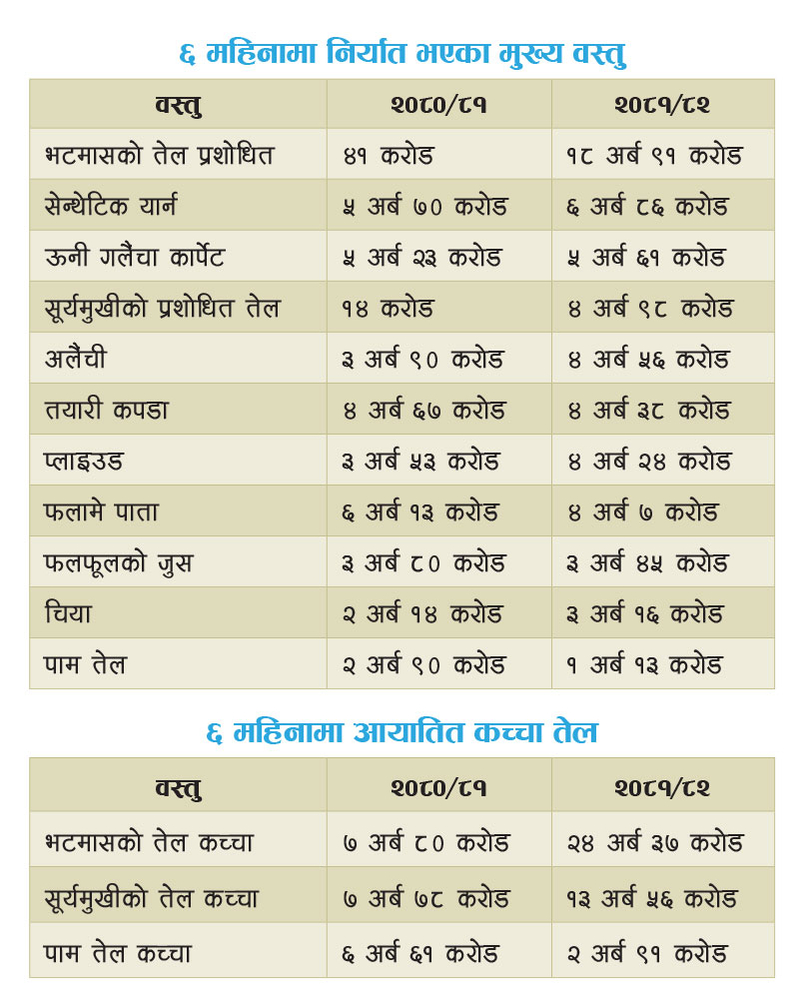
The overall export trade of the current financial year has increased by 32 percent due to the increase in the export of soybean, sunflower and palm oil imported from third countries. In 6 months, the share of oil is 25.32 percent in the exports worth 98 billion 78 crores.
According to the Customs Department, the exports in the first 6 months of 2080/81 were worth 74.96 billion. At that time, oil worth 3.45 billion was exported. This year, 25 billion worth of edible oil (soybean, sunflower and palm) has been exported in 6 months.
There is a duty exemption facility when exporting oil to India. According to the Nepal-India Trade Agreement, goods produced in Nepal with 30 percent value addition get duty-free entry into the Indian market. India has increased the customs rate of oil imported from other countries last August. That is why the oil industry has prioritized exports.
The outgoing president of Nepal Vegetable Ghee Oil Industry Association Sandeep Agarwal said that while exporting to India, industrialists also get advance payment. Customs rates are different between India and Nepal. The industrialists have got some concessions while exporting," he said. "Exporting to India is paid in advance. But selling in Nepal takes 90 to 120 days credit. For that reason, emphasis is placed on exports. According to the
department, crude oil worth 40.84 billion has been imported in a period of 6 months. Crude oil is imported from America, Argentina, Ukraine, Indonesia, Malaysia, Thailand. In the first 6 months of 2080/81, crude oil was imported worth 22.19 billion. According to Aggarwal, there is a cycle of about 100 days when importing and exporting raw materials.
Raw material should be brought and refined from a third country via Kolkata. Be it domestic market or export, it takes 100 days," he said. Therefore, exports were less compared to imports.'
The country consumes about 25,000 tons of oil including sunflower, mustard, and soybeans per month, which is not covered by domestic production. Insufficient raw materials are imported by industrialists and sent to the local market and also exported.
Raw materials produced in Nepal are consumed locally. It doesn't reach big industries," Agarwal said, "Big industries import all raw materials." According to him, there are about 15,000 direct/indirect jobs in the oil industry.
According to businessmen, the customs rate of oil due to the Covid epidemic was 42 percent in India, it was only 10 percent in Nepal. Exports from Nepal increased due to the high cost of customs duties in India. In 2022, India reduced customs rates. As oil became cheaper in India, exports from Nepal decreased. After India raised the customs rate again last August, exports from Nepal started to increase again.
India has increased the basic customs duty on crude and refined edible oil by 20 percentage points with effect from August 19. Indian media has reported that the tax on crude oil imported by India has reached 27 and a half percent after the increase in customs duties.
Rajan Paudel, Director General of Commercial Supply and Consumer Protection Department, said that after the increase in customs duties in India, businessmen are focusing on exports. Looking at the data of import and export, the import is more. Industrialists have also stockpiled. Some are also consumed domestically. But they have exported more," he said.
According to the customs department, soybean oil worth 18.91 billion has been exported in 6 months. Whereas in the last six months of the financial year, only 41 crores were exported. Sunflower oil worth Rs 4.98 billion has been exported in six months of the current financial year, compared to Rs 140 crore in the same period of 2080/81. In the 6 months of the current financial year, palm oil has been exported worth 1.13 billion, compared to 2.90 billion in the same period of the previous financial year.
In terms of extraction, it is good to increase the export of oil, but it is not a product produced in Nepal itself. These goods imported from third countries are re-exported after increasing the price," said former Commerce Secretary Purushottam Ojha. "It would be better if exports of Nepal's raw materials increased. It is not even the export of Eknas, when the customs in India decrease, the export decreases again.
He said that to sustain the export, emphasis should be placed on domestic production. "Government should emphasize on export of goods with comparative advantage, emphasis on goods with competitive ability, it will also create jobs," he said. In order to increase exports, the government has revised the Nepal Trade Integrated Strategy (NTIS) several times. But Ojha said that there was no satisfactory result in exports even from that.
According to the customs department, apart from oil, exports of synthetic fabrics, woolen carpets, cardamom, and ready-made fabrics have also increased. In 6 months, 6 billion 86 crore worth of synthetic yarn has been exported. During the same period last year, synthetic yarn worth 5.7 billion was exported.
In the first six months of the last financial year, woolen carpet carpets were exported for 5.23 billion, while this year the export was 5.61 billion for the same period. In 6 months of this year, 4.56 billion worth of cardamom was exported, last year in the same period, 3.9 billion worth of cardamom was exported.
Director General of Customs Department Harisharan Pudasaini said that the increase in exports sent a positive message to the market. He said that this would confirm that the economy is running as industrial products are moving towards export. "Edible oil and iron exports were on the decline, cement and plywood exports have also increased," he said. According to the
department, 4.38 billion worth of ready-made garments have been exported in 6 months. This amount is less than last year. In the first 6 months of 2080/81, readymade garments were exported worth 4.67 billion. This year, 4 billion 240 million worth of plywood has been exported in 6 months, while last year, 3 billion 53 billion was exported in the same period.
In the first 6 months of last year, 3.80 billion worth of fruit juice was exported, but this year, 3.45 billion was exported. According to the department, 3.16 billion worth of tea has been exported in 6 months of this year. During the same period last year, tea worth 2.14 billion was exported.
Nepal Chamber of Commerce President Kamlesh Agarwal said that sustainable exports are necessary. He said that since the economy is gradually gaining momentum, an environment should be created to increase the export of other goods. "The main reason for the increase in overall exports is oil. Oil exports from Nepal have increased after India increased customs duties," President Agarwal said percentage has increased. According to the customs department, goods worth 822 billion 370 million have been imported in the 6 months of the current financial year. In the same period of 2080/81, the import was 7 trillion 68 billion 16 billion.
Most petroleum products are imported. In 6 months, diesel worth 54.36 billion, petrol worth 32.14 billion, gas worth 29.79 billion have been imported. Similarly, pure iron worth 25.71 billion, ready-made garments worth 22.9 billion, HR seats worth 21.21 billion, mobile phones worth 17.84 billion have been imported. Trade deficit has increased by 4.38 percent in 6 months to 7 trillion 23 billion 58 million. In the six months of 2080/81, the trade deficit was 6 trillion 93 billion 19 billion .

